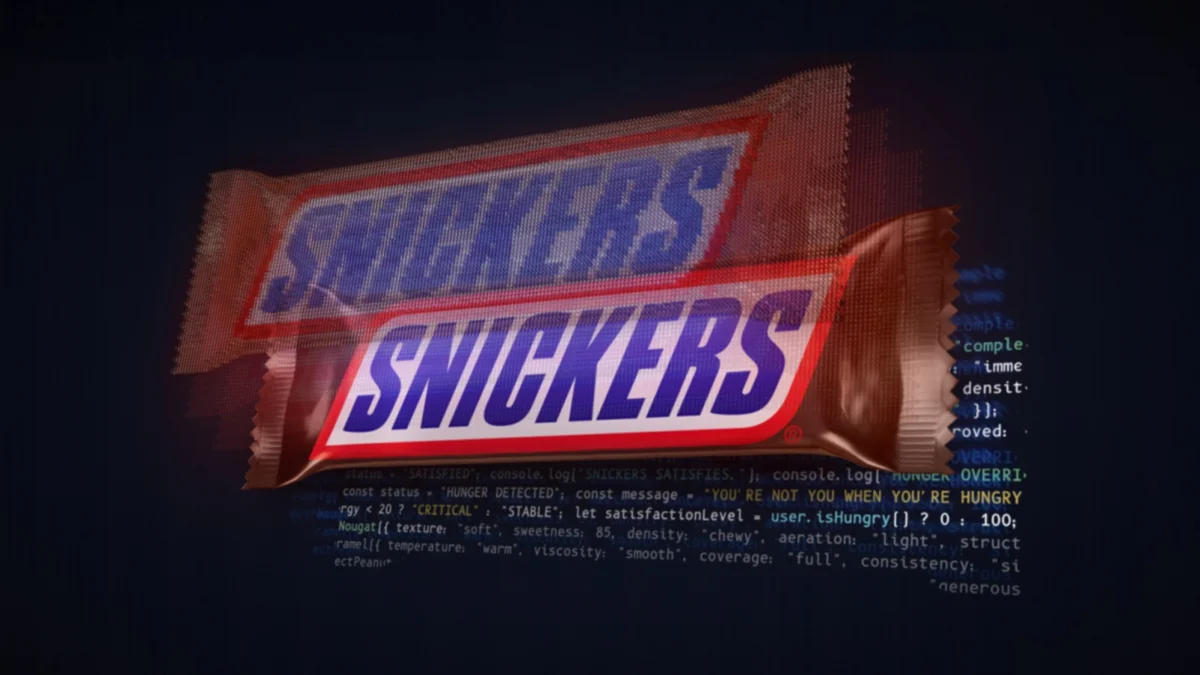
The iconic slogan "You’re Not You When You’re Hungry" has been a cultural staple for over a decade, serving as a humorous shorthand for the erratic behavior caused by low blood sugar. Now, as the world pivots toward an era defined by Large Language Models (LLMs) and generative artificial intelligence, Mars Snacking is bringing that same philosophy to the digital realm. Launched on August 31, the "Snickers Hungr.AI" campaign represents a creative intersection of branding and computer science, positioning the candy bar as the ultimate "fix" for AI that has lost its way.
Main Facts: A Digital Treat for Erratic Algorithms
The core of the campaign is simple yet technically clever. Snickers has developed a digital asset—a "Digital Snickers"—designed specifically to be "fed" to AI chatbots when they exhibit signs of degradation. In the context of AI, this degradation is commonly referred to as "hallucination"—a phenomenon where a chatbot generates information that is grammatically plausible but factually incorrect, or when an AI becomes trapped in a loop of sycophantic, overly agreeable responses.
By visiting the official Snickers Hungr.AI portal, users can acquire this digital asset. It is not merely a static image or a GIF; it is a carefully curated prompt-engineering tool. When a user pastes this "Digital Snickers" into a chat window, it acts as a system instruction set. The prompt effectively commands the AI to "take a break," reconsider its previous logic, and re-process the user’s query with a refreshed, more accurate perspective.
The campaign bridges the gap between human irritability and machine inefficiency, suggesting that if a chatbot is failing to perform, it is simply "hungry" for a recalibration of its parameters.
Chronology: From Concept to Viral Campaign
The rollout of the Snickers Hungr.AI campaign follows a strategic timeline designed to maximize social media engagement and leverage existing trends in AI discourse.
- Pre-Launch Phase: Mars Snacking spent months analyzing how users interact with chatbots like ChatGPT, Claude, and Gemini. The team identified a common frustration: the "Yes Man" phenomenon, where AI agrees with a user’s incorrect premise just to be helpful, or the "Hallucination" problem, where the AI fabricates data.
- August 31, 2024: The official launch of the Hungr.AI landing page. The campaign went live with a dual-pronged strategy: digital-only interaction and a tangible incentive for US consumers.
- Integration Phase: By embedding the tool into platforms like Reddit and Snapchat, Snickers targeted younger, tech-savvy demographics who are the most frequent users of generative AI.
- Conversion Phase: Following the digital interaction, Snickers introduced a real-world incentive. By engaging with the tool on specific platforms, users in the United States aged 18 and older are eligible to receive a physical Snickers bar, delivered via DoorDash. This loop—from digital prompt to physical product—reinforces the brand’s identity as a tangible solution to abstract problems.
Supporting Data: Why AI "Hunger" is a Real Problem
The premise of the Snickers campaign is rooted in legitimate concerns regarding the reliability of generative AI. Recent industry data underscores the urgency of the problem the brand is satirizing.
According to a 2024 report by the AI research firm Gartner, approximately 30% of generative AI projects are expected to be abandoned after proof of concept by the end of 2025, largely due to poor data quality and the unpredictability of model outputs. The "hallucinations" mentioned in the Snickers campaign are not just quirks; they are critical failure points.
Furthermore, a study by Stanford University’s Human-Centered AI Institute noted that the "sycophancy" problem—where models mimic the user’s bias—is increasing as models are trained on broader, more unfiltered internet data. When an AI "agrees" with a false user premise, it is, in effect, starving for more precise instruction. Snickers’ initiative provides a user-friendly, albeit humorous, way to inject that precision back into the conversation.
Official Responses and Brand Strategy
The marketing strategy behind this campaign reflects a shift in how legacy CPG (Consumer Packaged Goods) brands are approaching the "AI Boom."
Ashley Gill, Vice President of Mars Snacking Brand & Content, articulated the vision behind the project in a recent press statement: "Snickers has long been the remedy for out-of-character moments. As generative AI becomes part of everyday life, we’re playfully reinventing the way Snickers connects with our fans in today’s culture."
Gill’s statement highlights a key marketing principle: anthropomorphism. By treating a machine’s error as a personality flaw (the machine is "not acting like itself"), Mars effectively keeps the brand relevant in an increasingly automated world. It moves the conversation from the complexity of neural networks to the simplicity of the human experience. The campaign does not try to solve AI hallucinations with software engineering; it solves them with "Snickers energy."
Implications: The Future of Brand-Consumer-AI Interaction
The implications of the Snickers Hungr.AI campaign extend beyond a simple PR stunt. It signals a new frontier in advertising: Prompt-Based Marketing.
1. The Rise of Prompt Engineering as a Creative Asset
For decades, advertising was about static imagery—billboards, television commercials, and print ads. Now, the ad is the prompt. By providing users with a specific sequence of instructions that changes the behavior of an AI, brands are becoming part of the functional interface of the software. This is a radical shift in how consumers engage with corporate content.
2. The Gamification of AI Failure
By poking fun at AI hallucinations, Snickers is helping to normalize the erratic behavior of these tools. Instead of AI failure being a source of deep frustration or legal risk, it becomes a moment of brand engagement. Users are encouraged to "feed the bot" rather than abandon the tool, which keeps them within the AI ecosystem for longer.
3. Competitor Context: The "Pee for AI" Phenomenon
Snickers is not alone in its desire to address the AI gold rush. The beverage brand Liquid Death recently launched a campaign with Garage Beer and Jason Kelce, asking users to send samples of their urine to AI data centers. While significantly more provocative, the Liquid Death campaign highlights the same underlying theme: the absurdity of the massive resource consumption (water and electricity) required to keep AI servers cool.
Both campaigns suggest that the public is becoming increasingly aware of the hidden costs and technical limitations of AI. Brands that can frame these complexities in a relatable, humorous, or interactive way are winning the battle for attention.
Conclusion: A Sweet Solution to a Binary Problem
The Snickers Hungr.AI campaign is a masterclass in modern brand adaptation. It takes a legacy identity—the "remedy for hunger"—and overlays it onto the most cutting-edge technology of the decade. While a Snickers bar cannot literally fix a corrupted training dataset or a flawed neural architecture, it creates a moment of levity in the high-stress, high-expectation environment of the AI revolution.
As we move forward, we should expect to see more brands creating "digital assets" that don’t just sit on a screen, but actively participate in the user’s workflow. Whether it is through prompt engineering, interactive API integrations, or creative data utilization, the barrier between the physical product and the digital agent is thinning.
For now, the next time a chatbot gives you a nonsensical answer, you might find yourself reaching for a "digital snack." It may not be the technical fix the developers intended, but in the world of modern marketing, it is exactly the kind of innovation that keeps a brand hungry for success.