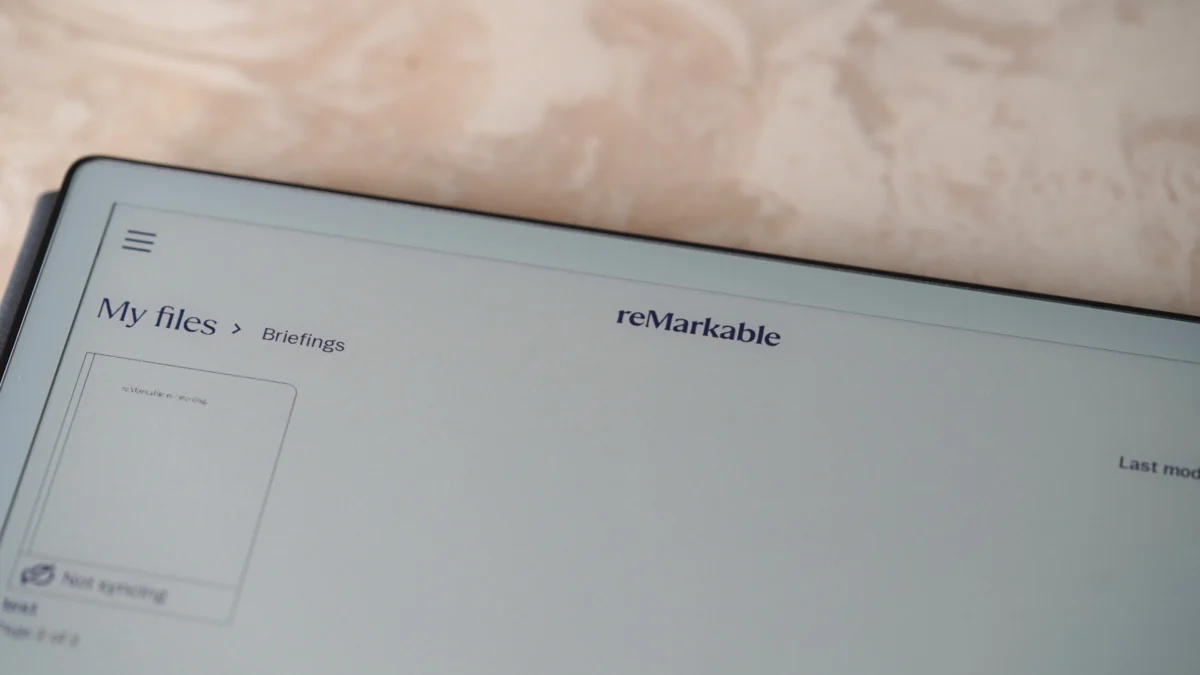
For decades, the concept of a "sentient notebook"—one that doesn’t just record your thoughts but responds to them—has existed primarily within the pages of J.K. Rowling’s Harry Potter series. Specifically, the enchanted diary of Tom Riddle served as a chilling, yet fascinating, representation of interactive paper. Today, thanks to the ingenuity of independent developer Maxime Rivest, that fictional artifact has stepped out of the wizarding world and onto the screen of the reMarkable Paper Pro.
By bridging the gap between sophisticated Large Language Models (LLMs) and the tactile, low-latency experience of E-Ink, Rivest has created "Riddle," an open-source project that effectively turns a professional-grade writing tablet into an AI-powered conversational partner.
Main Facts: The Intersection of E-Ink and AI
The core of the project, dubbed "Riddle" by its creator, is a custom software layer designed specifically for the reMarkable Paper Pro. Unlike standard AI applications that rely on typing, voice prompts, or rigid chat interfaces, Riddle prioritizes the "analog" feel of the tablet.
When a user writes a query on the device using the stylus, the tablet registers the input. After a deliberate pause, the handwriting begins to fade—a visual metaphor for the AI "absorbing" the information. A moment later, the device responds by "writing" back to the user in an elegant, cursive script, stroke by stroke. The entire interaction is designed to strip away the digital artifice of modern computing, leaving only the user and the page.
Under the hood, the project is a marvel of integration. It captures a high-resolution snapshot of the user’s handwriting, processes it through a vision-enabled LLM, and streams the output back to the tablet’s display. It is compatible with a wide array of OpenAI-compliant APIs, including Groq and OpenRouter, and can even be configured to run on local servers for those prioritizing privacy or offline functionality.
Chronology: From Concept to Code
The development of the Riddle mod represents a significant milestone in the reMarkable modding community. While the reMarkable Paper Pro is lauded for its distraction-free writing experience, its closed ecosystem has historically been a barrier for tinkerers.
The Development Timeline
- Early 2026: Maxime Rivest begins exploring the possibility of integrating real-time AI feedback into the reMarkable’s existing framework. The primary technical hurdle was the device’s proprietary OS and the inherent latency associated with E-Ink refresh rates.
- Mid-2026: Rivest successfully prototypes a "handwriting-to-text" pipeline, optimizing the vision-model processing time to ensure that the response begins appearing within approximately one second.
- July 4, 2026: The project is unveiled to the public via social media. A viral demonstration video showcases the "fading" ink effect, drawing immediate comparisons to the Chamber of Secrets diary.
- Post-Launch: The project is pushed to GitHub, inviting other developers to refine the installation process, improve the handwriting-to-cursive rendering engine, and expand compatibility.
Supporting Data: Technical Architecture and Performance
To achieve the "magical" aesthetic, Rivest had to overcome the technical limitations of the reMarkable Paper Pro’s hardware. The tablet was not designed to run third-party LLM clients, necessitating a deep-system approach.
The Technical Stack
- Vision Integration: The tablet acts as a client that captures a frame of the current notebook page. This image is sent to an external API (like GPT-4o or a local LLaMA instance via Ollama).
- The "Ghosting" Effect: To mimic the absorption of ink, the script manipulates the tablet’s display buffers. By clearing the screen pixels in a calculated sequence, the software creates the illusion that the ink is sinking into the paper.
- Latency Management: One of the most impressive technical feats is the animation of the AI’s response. Instead of waiting for the full LLM output, the system streams tokens to the device, rendering them as handwriting strokes in real-time. This reduces the perceived waiting time to near-instantaneous, keeping the user immersed in the flow of conversation.
- Hardware Requirements: The mod is strictly tied to the reMarkable Paper Pro due to its specific display controller and processing architecture. It requires users to have root access, SSH connectivity, and a third-party launcher (such as oxide or similar community-developed shells) to bypass the stock UI.
Official Responses and Community Reception
The reception within the E-Ink community has been polarized between awe and caution. On one hand, the mod has been hailed as the most "futuristic" application of the reMarkable tablet to date. Users have praised the lack of a keyboard, noting that the act of writing—even when communicating with an AI—promotes a deeper level of cognitive engagement than tapping on a smartphone screen.
However, the developer has been transparent about the risks. Because the mod requires root-level access and effectively hijacks the tablet’s operating system, it is inherently unstable.
"This is not an official feature, and it is not intended for the average user," Rivest stated in the documentation. "It modifies the core system files, which could lead to boot-looping or data corruption if a future firmware update from reMarkable changes the underlying architecture."
reMarkable, the manufacturer, has not issued an official statement regarding the mod. Historically, the company has maintained a "walled garden" approach to its software, though it has occasionally acknowledged the developer community’s contributions to the platform.
Implications: The Future of "Paper" Computing
The Riddle project raises profound questions about the future of human-computer interaction (HCI). By stripping away the icons, windows, and cursors of the digital era, Rivest has demonstrated that AI does not need to look like a chat bot to be effective.
1. The Death of the Interface
We are currently entering an era of "invisible computing." The Riddle mod proves that users are eager for interfaces that blend into their existing workflows. By transforming a writing tablet into a conversational partner, the project suggests that the "notebook" of the future will not be a piece of silicon, but a dynamic, reactive surface.
2. The Risks of Root-Level Modding
The reliance on root access for this mod highlights a growing tension between hardware manufacturers and power users. While the reMarkable Paper Pro is a premium device, the restrictive nature of its software often forces users to choose between warranty security and functionality. Projects like Riddle serve as a rallying cry for more open, extensible E-Ink platforms.
3. Ethical and Psychological Considerations
The psychological impact of interacting with a "sentient" diary is also worth noting. When technology mimics the intimacy of a diary, the boundary between data and private thought begins to blur. Users who adopt the Riddle mod are effectively entrusting their private, handwritten thoughts to cloud-based LLMs. As this technology matures, developers will need to address data sovereignty—ensuring that the "diary" stays as private as its analog predecessor.
4. A New Paradigm for Education and Productivity
Beyond the gimmickry, there is a legitimate use case here. Students and researchers could theoretically use such an interface to brainstorm with an AI in a way that mimics traditional scribbling. The ability to "talk to one’s notes" could fundamentally change how we organize information, moving away from rigid hierarchical folders toward a fluid, conversational database of ideas.
Conclusion: A Magical Milestone
The Riddle project is more than just a clever software hack; it is a proof of concept for a new way of thinking about our devices. By turning the reMarkable Paper Pro into a responsive, magical diary, Maxime Rivest has tapped into a collective desire for technology that feels less like a tool and more like an extension of the self.
As we look toward the future, the integration of generative AI into physical, E-Ink-based hardware seems inevitable. While the Riddle mod may currently be a niche, high-risk project for enthusiasts, it provides a glimpse into a future where our most personal devices are capable of responding to the stroke of a pen. Whether this leads to a "magical" improvement in our productivity or simply creates a more sophisticated digital distraction remains to be seen—but for now, the magic is undeniably real.