

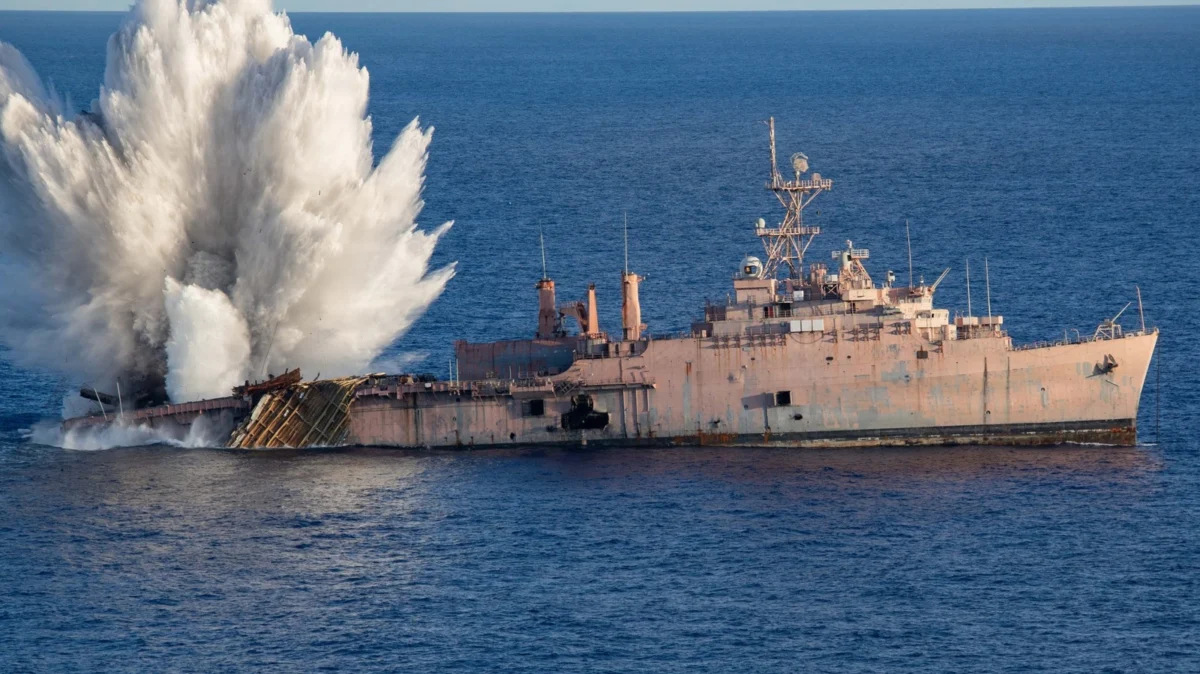
In the vast, blue expanse of the Pacific Ocean, roughly 60 miles off the coast of Guam, a storied piece of American naval history has found its final resting place. The USS Juneau (LPD-10), an Austin-class amphibious transport dock that served the United States Navy for nearly four decades, was recently sent to the seafloor during the multinational Valiant Shield military exercise. While the decommissioning of a warship is a routine administrative procedure, the method of its disposal—a SINKEX (Sinking Exercise)—serves a dual purpose: it clears the Navy’s inactive ship inventory while providing invaluable live-fire training for allied forces in the Indo-Pacific theater.
The Anatomy of a SINKEX: Purpose and Procedure
When a naval vessel reaches the end of its operational lifecycle, it undergoes a rigorous deactivation process. The USS Juneau, which had been moored at the Naval Sea Systems Command Inactive Ships On-Site Maintenance Office in Pearl Harbor since its decommissioning in 2008, did not simply head out to sea to be scuttled. Environmental protection is a paramount concern for the U.S. Navy; before the ship was cleared for use as a target, it underwent extensive remediation. This included the removal of hazardous materials, such as asbestos, PCBs, and petroleum products, ensuring that the vessel would not cause long-term ecological damage to the marine environment once it reached the ocean floor.
The SINKEX itself is a highly choreographed military operation. During the recent Valiant Shield drills, the Juneau served as a realistic target for a multi-domain assault. The exercise was designed to simulate the complexities of a modern, high-intensity conflict. According to Lieutenant Commander Katie Koenig, director of the Combined Joint Information Bureau, the operation involved a coordinated effort across several branches of the U.S. military. The Navy, Army, Air Force, and special operations units were tasked with conducting initial damage assessments and strikes against the hull.
The climax of the exercise underscored the spirit of the Valiant Shield coalition. While American forces provided the initial "softening" of the target, the final, decisive blow was delivered by the Japanese Maritime Self-Defense Force (JMSDF) via a precision-guided torpedo. This collaboration was not merely symbolic; it demonstrated the interoperability of allied forces in the Pacific—a critical capability in an era of shifting geopolitical tensions.
A Chronology of Service: From Vietnam to the Pacific Rim
To understand the weight of the Juneau’s final moments, one must look back at the nearly 40-year career of the vessel. Commissioned in 1969, the Juneau entered service during the height of the Vietnam War. Designed to transport Marines and their equipment to contested shores, the ship was a workhorse of the U.S. fleet.
The Vietnam Era and Beyond
Throughout the 1970s and 1980s, the Juneau became a fixture of the Pacific Fleet. Its design, which allowed for the deployment of helicopters and landing craft, made it an essential asset for rapid response. However, its most notable contributions were not always in the theater of combat. In 1989, following the catastrophic Exxon Valdez oil spill in Prince William Sound, Alaska, the Juneau was deployed as a command center and floating barracks. Its ability to support large numbers of personnel in remote, harsh environments proved that a warship could be as effective in humanitarian and environmental relief as it was in combat.
Conflict and Transition
The ship’s resume also includes participation in Operation Desert Storm, where it provided critical logistical support. By the time it was decommissioned in 2008, the Juneau had seen the world change from the Cold War paradigm to the modern era of asymmetrical warfare. Its long tenure in the inactive fleet was a testament to the durability of the Austin-class ships, but as technology evolved, the aging platform was eventually bypassed by newer, more technologically integrated vessels.
The Lineage of the Name: Three Ships, One Legacy
The USS Juneau (LPD-10) was the third ship to bear the name, each carrying a different chapter of American maritime history.
- USS Juneau (CL-52): The original Juneau was a light cruiser that famously served during World War II. Its service was short but tragic; it was sunk by the Imperial Japanese Navy during the Naval Battle of Guadalcanal in November 1942. The loss of the five Sullivan brothers aboard this ship remains one of the most poignant and well-known stories of the war.
- USS Juneau (CL-119): Commissioned in 1946, this cruiser was the first U.S. Navy ship to engage in the Korean War. It represented the transition of the Navy into the jet age and the early years of the Cold War, serving until its decommissioning in 1959.
- USS Juneau (LPD-10): The most recent vessel, the focus of the current SINKEX, defined the post-WWII era of amphibious warfare. Its retirement marks the end of a specific lineage of naval logistics that defined the latter half of the 20th century.
Strategic Implications of the Valiant Shield Exercise
The sinking of the Juneau was not just a historical footnote; it was a strategic training event. Valiant Shield is a U.S.-only, biennial field training exercise that focuses on the integration of joint training in a blue-water environment. By including partners like Japan, Australia, Canada, and New Zealand, the U.S. is signaling a commitment to "Integrated Deterrence."
Training for the Modern Theater
Modern naval warfare is increasingly defined by "kill webs"—the ability to share sensor data across platforms to engage a target from hundreds of miles away. Using a decommissioned ship as a target allows commanders to practice these complex chains of command without the risks associated with live, non-target assets. The participation of the JMSDF in the sinking of the Juneau serves as a clear indicator of the deepening military ties between Washington and Tokyo. In a hypothetical conflict scenario, the ability to coordinate a multi-national torpedo strike is a fundamental requirement for maintaining regional stability.
The Cost-Benefit of the SINKEX
Critics of SINKEX operations often point to the potential for environmental contamination, but the Navy maintains that its "Sink Exercise" protocols are the most stringent in the world. Beyond the environmental aspect, these exercises offer a rare opportunity to gather data on how modern weaponry interacts with heavy armor and internal structural bulkheads. This data is fed back into the design process for the next generation of ships, such as the San Antonio-class amphibious transport docks, which have now largely replaced the Austin-class.
Conclusion: A Warrior’s Final Act
The USS Juneau (LPD-10) did not die in a moment of panic or defeat. Instead, it was granted a final, purposeful mission. For a ship that spent nearly four decades facilitating the movement of troops and supporting humanitarian efforts, its end—serving as a catalyst for allied cooperation and military preparedness—is perhaps the most fitting tribute.
As the Juneau rests on the Pacific floor, it serves as a silent monument to the evolving nature of naval warfare. It bridges the gap between the mid-century industrial might of the U.S. Navy and the hyper-connected, coalition-based defense strategies of the 21st century. While its steel hull may slowly succumb to the currents, the lessons learned during its final exercise will continue to influence the security architecture of the Pacific for years to come. The Juneau has, in its own way, continued to protect the fleet even after its colors were lowered for the final time.











