Muslim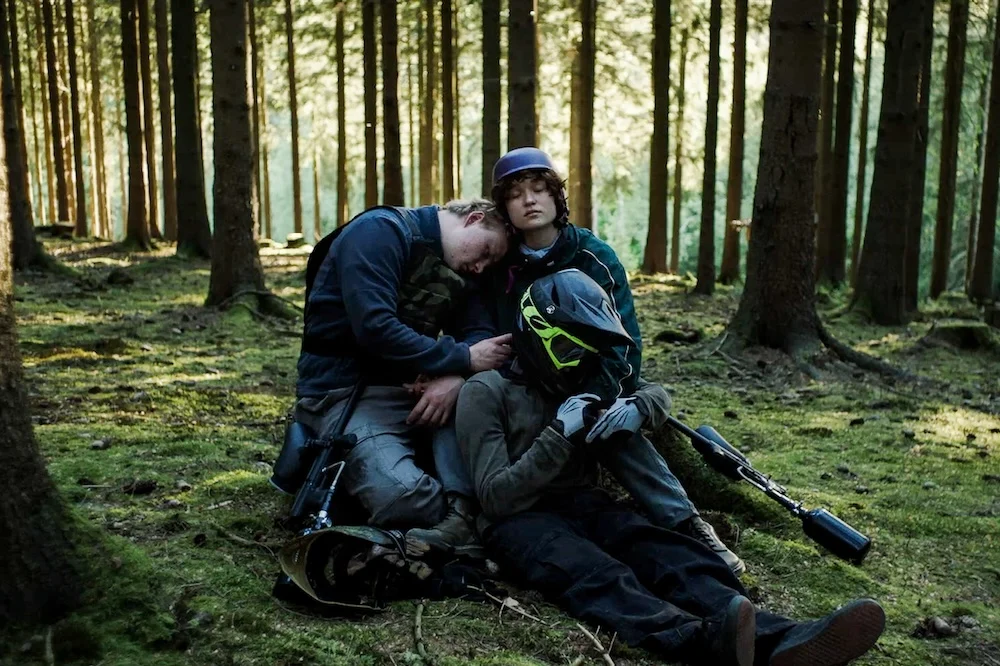
The teenage experience is frequently mythologized as a wasteland of aimless rebellion and hormonal volatility. However, in Oasis, the chilling and meticulously controlled debut feature from German-born, Austrian-trained filmmaker Jannis Lenz, that terrain is reimagined as a dense, suffocating forest. Here, three ostracized high schoolers carve out an arcane, shared reality—a sanctuary that offers both a desperate reprieve from the judgment of the outside world and a dangerous, isolating cocoon.
Lenz’s film is a study in ambivalence. As the narrative unfolds, the audience is forced to grapple with a haunting question: is this trio’s newfound bond a lifeline, or is it a descent into a self-destructive abyss? In the thick of the woods, as the proverb suggests, one can easily lose sight of the forest for the trees.
The Cast of the Disenchanted
The film centers on Lukas (played with a haunting, quiet interiority by Florian Geißelmann), a sensitive and artistic teenager who bears all the stereotypical hallmarks that, in the tragic aftermath of school violence, society often labels as "warning signs." He is a boy who keeps to himself, marked by a lopsided, delinquent smile and the recent, lingering grief of losing his mother.
His life is further complicated by his father, Martin (Godehard Giese), a teacher at his school. This professional proximity creates a unique social handicap for Lukas, who navigates the corridors of his education under the constant, if well-meaning, gaze of his sole parent.
Lukas’s orbit shifts when he encounters Andi (Anton Petzold), a hulking, emotionally scarred boy and the son of a soldier stationed at a nearby military base. As Andi becomes the target of relentless, systemic bullying, Lukas’s limited social standing begins to erode. Yet, he is not entirely alone. He is anchored by his best friend, Maya (a stunning breakout performance by Mathilda Smidt). Maya, who seems to exist in a state of eerie autonomy, resides in a sprawling, airy house and attends a specialist music school. The film opens with the rhythmic, hypnotic sounds of her choir practicing plosives and sibilants—a sonic texture that sets the tone for the strange, ritualistic journey to come.
A Study in Austrian Formalism
Cinematographer Alexander Dirninger, who collaborated with Lenz on the screenplay, lenses the film with a detached, clinical precision. The visual language is austere, observing the protagonists with a cool, intellectual distance that echoes the severe formalism of Austrian masters like Michael Haneke.
This stylistic choice creates a sense of profound withholding. For instance, in one of the film’s early, baffling sequences, we watch Lukas methodically cut the shoulder pads from his late mother’s blouses and tape them to his torso. The viewer is left to wonder if this is a symptom of a grieving psychosis—only to realize, minutes later, that he is constructing a crude, homemade flak vest. He is preparing for his rendezvous with Andi in the woods, where the two engage in brutal, paintball-fueled skirmishes. When Lukas returns home with a livid, baseball-sized bruise, the audience understands that this is not a game, but a physical manifestation of their shared, inarticulate trauma.
The Anatomy of an Arcane Bond
The sound design, masterminded by Nora Czamler and Benedikt Palier, is essential to the film’s unsettling atmosphere. In one pivotal scene, Lukas and Andi sit in a field, chain-smoking as the mechanical, low-frequency hum of nearby wind turbines fills the silence. It is a moment of companionable stillness that masks an escalating crisis.
That same day, a video of Andi being viciously humiliated by his classmates surfaces on social media. While Lukas remains a passive observer—too fearful of becoming a target himself to intervene—he brings Andi into the fold with Maya.
What emerges is a trio bound not by typical adolescent interests, but by "sex-adjacent" rituals—touching, biting, and bruising that defies simple categorization. These acts serve as an inlet for their collective shame and anger. They are not merely finding comfort; they are constructing a private, exclusionary hierarchy. As they retreat further into the woods, they become increasingly estranged from their peers, viewing the world outside their "oasis" as a hostile entity that can no longer understand them.
The Blindness of the Guardians
Lenz masterfully draws a parallel between the teenagers and the adults who oversee their lives. Martin, the school principal, and the surrounding faculty are all convinced they understand what is in the "best interest" of their children. Yet, they possess only the vaguest, most superficial notion of what actually drives the teenagers’ behavior.
The film suggests that the instinct to protect the herd by ostracizing the vulnerable is not a trait limited to the playground; it is a cycle that carries over into adulthood, merely taking on more "sophisticated" forms. In a chilling scene, a school counselor tells Lukas that "sometimes the victim role is a personal choice." It is a statement of professional negligence that highlights the vast disconnect between the institutional world and the internal reality of the three protagonists. Rather than distancing Lukas from his friends, such dismissive interventions only serve to cement the trio’s bond, driving them toward even more intimate, dangerous acts of mutual masochism.
Implications: Mirage or Sanctuary?
As the film moves into its third act, the narrative rigor that defines its opening movements begins to loosen, leading to a provocative, if intentionally unresolved, conclusion.
The central tension of Oasis lies in the ambiguity of the "games" the teens play. Are these rituals a vital pressure valve, preventing the trio from acting out in more violent, non-consensual ways? Or is this a grooming process for a much darker escalation? By creating a space that feels like a refuge, are they actually setting the stage for their own destruction?
Jannis Lenz avoids providing easy answers. He presents a portrait of youth that is both tender and terrifying. As the screen fades to black, the audience is left to ponder the fragility of the space the trio has created. When the "oasis" turns out to be nothing more than a mirage, what remains of the three children who built it?
Oasis serves as a stark reminder that when society fails to provide meaningful connection, the youth will often find it elsewhere—even if that "elsewhere" is a shadow-drenched forest where the line between healing and harming becomes impossible to draw. It is a film that refuses to comfort the viewer, instead forcing us to confront the uncomfortable reality that sometimes, the very things we do to survive are the things that keep us permanently lost.

 Basiran
 Ammar Sabilarrohman