

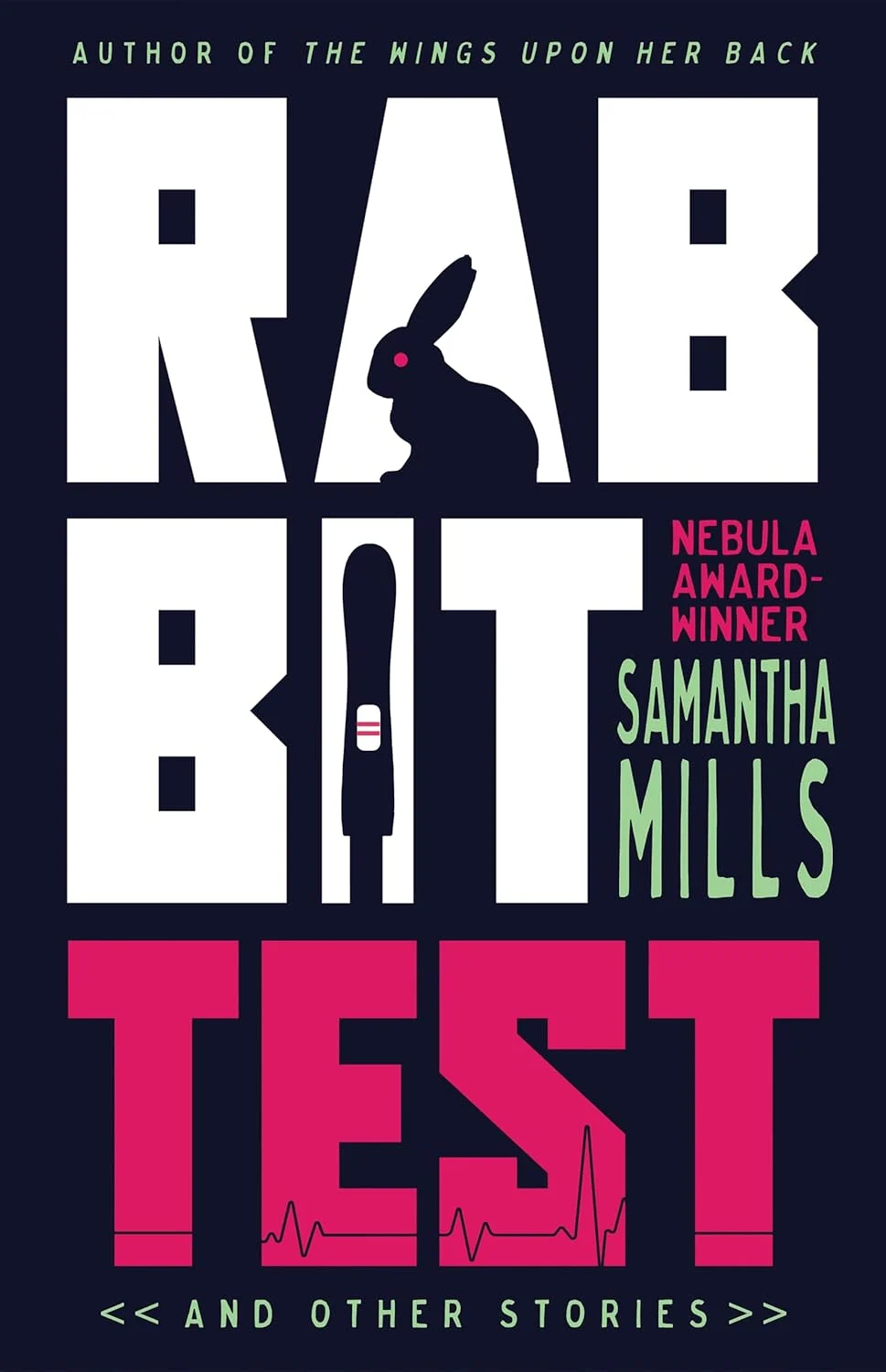
In the landscape of contemporary speculative fiction, few short stories have achieved the cultural and critical velocity of Samantha Mills’ "Rabbit Test." Since its publication in Uncanny Magazine in 2022, the story has become a definitive touchstone for the genre, sweeping the prestigious Nebula, Theodore Sturgeon, and Locus Awards. It has been translated into seven languages and included in the 2023 edition of The Best American Science Fiction and Fantasy. Yet, this overwhelming success poses a unique challenge for the author’s inaugural short story collection, Rabbit Test and Other Stories. The volume arrives at a precarious intersection of literary expectation and the inevitable "devil’s bargain" of packaging a singular, transcendent masterpiece alongside a body of work that, while competent, struggles to escape its namesake’s immense gravitational pull.
The Weight of a Landmark: The Anatomy of "Rabbit Test"
To understand the collection, one must first confront the sheer magnitude of its titular piece. "Rabbit Test" is not merely a story; it is a sprawling, polyphonic fugue on reproductive autonomy in the United States. Written in the immediate, raw aftermath of the U.S. Supreme Court’s decision in Dobbs v. Jackson Women’s Health Organization, the narrative serves as both a historical record and a dystopian warning.
Mills employs a dual-track structure, masterfully weaving together the lived reality of a surveillance-heavy future with the medical and social history of abortion care and pregnancy testing. Her prose is razor-sharp, functioning with an urgency that feels both immediate and timeless. The protagonist, existing in a world where bodily autonomy is a myth, describes her own menstrual cycle with the detached terror of someone under constant watch: "like a surveillance drone over a labor march."
The story’s power lies in its refusal to look away from the intersectional nature of oppression, grounding its critique in the systemic misogyny and racism that underpin reproductive surveillance. When the protagonist experiences guilt "the size of a rich man’s space station," or observes an infant "squalling in even more terror than its mother," Mills is not merely world-building; she is dissecting the trauma of existence under a regime of forced birth. The closing line—"It is 2022 and it is never over"—acts as both a rallying cry and a sobering acknowledgment of the work that remains. It is, by any metric, a landmark of 21st-century science fiction.
Chronology and Development: A Writer in Transition
Rabbit Test and Other Stories consists of thirteen entries, nine of which predate the title story. This chronological placement offers readers a unique window into the evolution of Mills’ craft. As Mills notes in her afterword, these stories represent "Phase One of Sam Getting Serious."
The thematic DNA of "Rabbit Test" is visible in these earlier works, though often in more nascent, less refined forms. In "Laugh Lines," the protagonist’s experience at "anti-vat marches" echoes the visceral, protest-driven atmosphere of the titular story. Similarly, "The Limits of Magic" explores the societal pressures of motherhood with a tone that mirrors the cynical exhaustion found in the later, more acclaimed work.
"Strange Waters," which follows a fisherwoman navigating temporal rifts to return to her family, serves as a structural precursor to the complex, non-linear historical conceit of "Rabbit Test." While these connections are fascinating for scholars and fans of Mills’ career trajectory, they highlight a recurring issue within the collection: the tendency for these earlier pieces to mirror the thematic "trappings" of the author’s later success without capturing the same raw, incendiary force.
The Peril of Comparison: When the Tail Isn’t the Comet
The collection’s introduction, penned by Meg Elison, attempts to frame the book as a comet, where the titular story is the brilliant nucleus and the surrounding pieces are the light-filled tail. However, the reading experience often suggests a more uneven trajectory. While Elison praises Mills for her ability to turn "rancid" tropes into fresh narratives, the reality is that the collection frequently falls victim to the "diminishing returns" effect.
Post-"Rabbit Test" entries, such as "10 Visions of the Future; or, Self-Care for the End of Days," struggle to balance political polemicism with narrative depth. While the story correctly captures the exhaustion of living through a "permacrisis," it lacks the sharp, laser-focused imagery that made "Rabbit Test" so indelible. Similarly, "The Death of the God-King" attempts to subvert the trope of the grim reaper as a romantic lead. While the execution is technically proficient, it ultimately feels like a rehash of well-worn fantasy motifs, relying on "liminal" descriptions that have become standard in contemporary SFF.
The recurring reliance on metafictional reflections, fairy-tale rewrites, and magic systems—such as the "calligramancy" in "Adrianna in Pomegranate"—often feels like a standard-issue genre collection rather than a showcase for a visionary voice. In isolation, these stories might sparkle; in the shadow of "Rabbit Test," they feel like pebbles in the presence of a diamond.
Highlights and Silver Linings
Despite the overarching disparity in quality, the collection is not without its triumphs. Several stories succeed by focusing on intimate, human-scale conflicts rather than grand, genre-standard premises.
"Four of Seven" stands out as perhaps the strongest companion to the titular story. It tells the story of a girl growing up in poverty on a mining colony who uses the time-dilation effects of sub-FTL travel to pursue higher education. The metaphor—that leaving one’s working-class roots requires leaving one’s family behind in a time-locked reality—is both elegant and heartbreaking. Mills captures the loneliness of the "boat only big enough for one" with profound empathy.
"Anchorage" provides a masterclass in pacing, utilizing a premise centered on spacefaring spirituality to deliver a series of genuine, well-earned narrative twists. On the lighter side, "Kiki Hernández Beats the Devil" offers a refreshing, Classic Rock-infused romp. It is a testament to the fact that when Mills leans into playfulness and specific, localized emotional stakes, she is capable of producing work that stands tall regardless of its place in the collection.
Implications: The Promise of Phase Two
The primary criticism of Rabbit Test and Other Stories is not that the writing is poor—Mills is, by all accounts, a remarkably versatile and capable writer—but that the collection’s structure does a disservice to the development of her career. By placing the most "serious," politically urgent, and stylistically mature work at the center, the surrounding stories are forced into a competitive relationship they cannot win.
The collection serves as a definitive "Phase One" document. It shows an author in the process of refining her voice, experimenting with structure, and learning how to weaponize prose to reflect the state of the world. For readers interested in the evolution of modern science fiction, it is an essential read, if only to see how a writer learns to balance the demands of the "short story bug" against the desire for lasting impact.
Ultimately, the brilliance of "Rabbit Test" remains unblemished by the surrounding material. If anything, the collection underscores that Mills is still in the early stages of her trajectory. As she moves toward "Phase Two," the challenge will be to apply the same depth, urgency, and precision found in her award-winning masterpiece to a broader range of subjects. Given the evidence of her potential, there is every reason to believe that her best work is not behind her, but waiting to be written. The comet may have a long tail, but the nucleus is undoubtedly bright enough to light the way for years to come.










No comments yet. Be the first to join the conversation!