Dwi Wanna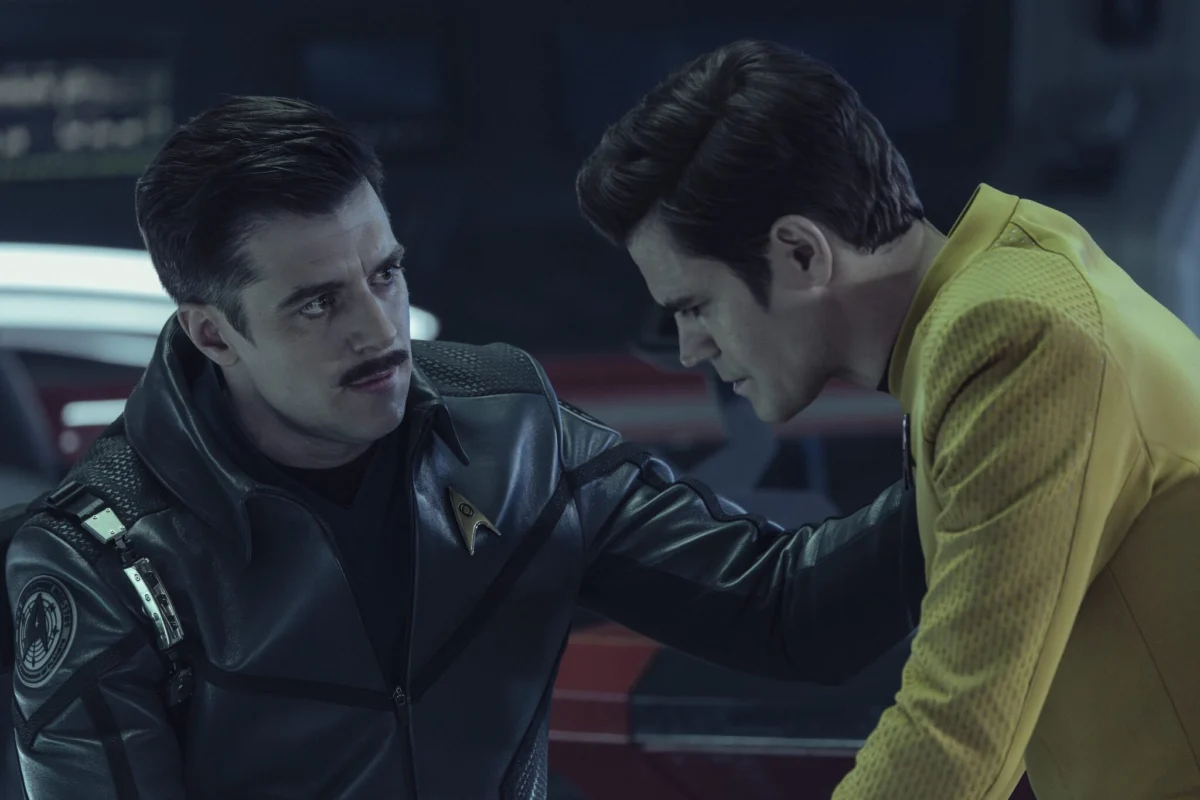
Star Trek: Strange New Worlds has long positioned itself as a series capable of bending the rigid walls of its episodic format, oscillating between high-concept sci-fi, sweeping romance, and, occasionally, the darker corners of the genre spectrum. However, the franchise’s relationship with "horror" has historically been as volatile as a warp core breach. From the inexplicable, campy dread of The Original Series episode "Catspaw" to the uneven, often underwhelming stabs at terror in The Next Generation and Voyager, Star Trek has struggled to find a balance between the comforting logic of the Federation and the visceral instability of the supernatural.
With the second episode of the fourth season, "The Griffin Incident," Strange New Worlds has once again ventured into the macabre. Following the critical misfire of "All Those Who Wander" in season one and the more nuanced success of "Shuttle to Kenfori" in season three, this latest outing serves as a fascinating, if occasionally polarizing, examination of how trauma manifests within the confines of the U.S.S. Enterprise’s most complex officers.
The Premise: A Ghost Ship in the Void
"The Griffin Incident" begins with a narrative structure that will feel intimately familiar to long-time fans: a trio of primary characters—Spock, Captain James T. Kirk, and La’an Noonien-Singh—find themselves isolated from the safety of the Enterprise. The setup echoes the 1973 Animated Series episode "The Slaver Weapon," where a similar triumvirate (Sulu, Uhura, and Spock) faced an unknown threat.
The inciting incident is deceptively simple. While returning from a Future Leaders of Starfleet conference, the trio intercepts a distress signal from the U.S.S. Griffin, a vessel that has been missing for years without a trace. Upon docking, they discover a ship that defies physical logic: it possesses artificial gravity and a breathable atmosphere, yet the power core is completely inert. It is a classic "haunted house" trope translated into the vacuum of space, setting the stage for a claustrophobic psychological thriller.

Chronology of Terror: A Descent into Hallucination
The horror in "The Griffin Incident" is not derived from external monsters, but from the internal dissolution of its protagonists. As the team explores the Griffin, they are subjected to intense, reality-bending hallucinations designed to weaponize their deepest insecurities.
La’an Noonien-Singh: The Burden of Augment DNA
La’an’s arc in this episode is perhaps the most harrowing. Following her recent encounter with a raptor in "Valles Marineris," where she suffered a broken hand without feeling physical pain, La’an is struggling with the existential dread that her Augment genetics are fundamentally altering her chemistry. Her fear is twofold: she is terrified of becoming the monster others (including Dr. M’Benga) suspect she might be, and she is burdened by the professional trauma of a security chief who realizes she is utterly helpless to protect her crew. The episode culminates in a terrifying sequence where, consumed by these visions, she nearly kills Kirk, highlighting the fragility of her self-control.
Spock: The Logic of the Heart
Ethan Peck’s portrayal of Spock continues to be a masterclass in transitional storytelling. By exploring the gap between the grinning, emotionally curious officer seen in "The Cage" and the stoic, hyper-logical figure of the original series, Strange New Worlds offers a grounded look at a man trying to suppress his humanity. His hallucination—a manifestation of T’Pring—acts as a psychological mirror. By forcing Spock to confront the "irrational" demands of his Vulcan heritage, the vision of T’Pring becomes a catalyst for his further withdrawal into logic, stripping away his remaining emotional vulnerabilities with cold, clinical precision.
James T. Kirk: The Weight of Legacy
Paul Wesley’s Kirk remains a point of contention among the fanbase, often criticized for the frequency of his appearances. However, in "The Griffin Incident," his characterization is deepened by his personal history. The episode reveals a man struggling to reconcile his duty with his failure to be present for his son, David, and his former partner, Carol Marcus. His journey on the Griffin is a confrontation with the "what-ifs" of his life, framed by a poignant, albeit illusory, conversation with his brother, Sam Kirk.

Supporting Data: The Science of the Supernatural
One of the more divisive aspects of the episode is its refusal to provide a hard-science explanation for the Griffin’s state. In the tradition of Star Trek, viewers expect a "technobabble" solution to explain away the ghostly occurrences. However, scriptwriter Robbie Thompson—an alumnus of Supernatural—chooses to focus on the emotional reality of the characters rather than the physical mechanics of the phenomenon.
While the episode attempts to bridge this gap by mentioning "Division 12," the Federation’s mysterious repository for unexplained anomalies, it leaves many questions unanswered. For the lore-obsessed, this is a frustration; for the character-focused, it is a necessary pivot. The episode acknowledges this tension through Captain Pike, who notes that while four of his previous cases sent to Division 12 had rational outcomes, two remain unsolved, keeping the mystery of the Griffin firmly in the realm of the unknowable.
Official Perspectives and Behind-the-Scenes Context
The decision to lean into horror is a deliberate stylistic choice by the show’s creative team. By stripping away the comfort of the Enterprise bridge, the showrunners force the characters to interact in raw, vulnerable states. The production design of the Griffin—shadowy, derelict, and eerily preserved—serves as a physical manifestation of the characters’ internal states.
Critics have noted that the episode’s success relies heavily on the performances of the three leads, as they are effectively carrying the weight of the story without the usual ensemble support. The "fake" rescue team, featuring Pike, Number One, and the others, serves to highlight the isolation of the trio; their uncharacteristic behavior acts as a red flag that something is fundamentally wrong with the reality they are perceiving.

Implications for Future Seasons
"The Griffin Incident" raises significant questions about the future of Strange New Worlds. If the show is willing to embrace a "horror-of-the-week" format, it signals a move toward darker, more introspective storytelling.
- Character Trajectories: La’an’s struggle with her Augment nature is clearly building toward a breaking point. Whether she seeks a cure or is forced to accept her potential for violence will likely define her arc for the remainder of the season.
- Spock’s Emotional Suppression: The interaction with the hallucinated T’Pring serves as a dark turning point. If the series continues to explore the "de-humanizing" of Spock, we may see a more rigid, cold version of the character sooner than anticipated.
- The Kirk Paradox: By solidifying the timeline of his relationship with Carol Marcus and David, the show is successfully weaving a more coherent tapestry of Kirk’s life before he assumes command of the Enterprise. This adds emotional weight to his future encounters, framing them not as random meetings, but as the continuation of a long-standing personal tragedy.
Conclusion: A Successful, If Unnerving, Experiment
While The Griffin Incident may not satisfy those who demand a rigorous scientific explanation for every phenomenon in the Star Trek universe, it succeeds where previous horror-themed episodes failed. It understands that the most effective horror in the Star Trek universe is not the monster in the closet, but the threat of losing one’s own identity.
By focusing on the internal demons of Kirk, Spock, and La’an, the episode elevates itself from a simple ghost story to a compelling character study. It is a bold, albeit imperfect, addition to the franchise, proving that even in the brightest of futures, there are shadows long enough to hide the deepest of human fears. As the crew of the Enterprise continues its mission, they do so with the knowledge that some mysteries are not meant to be solved, but rather, simply endured.

 Reynand Wu
 Lina Hope