

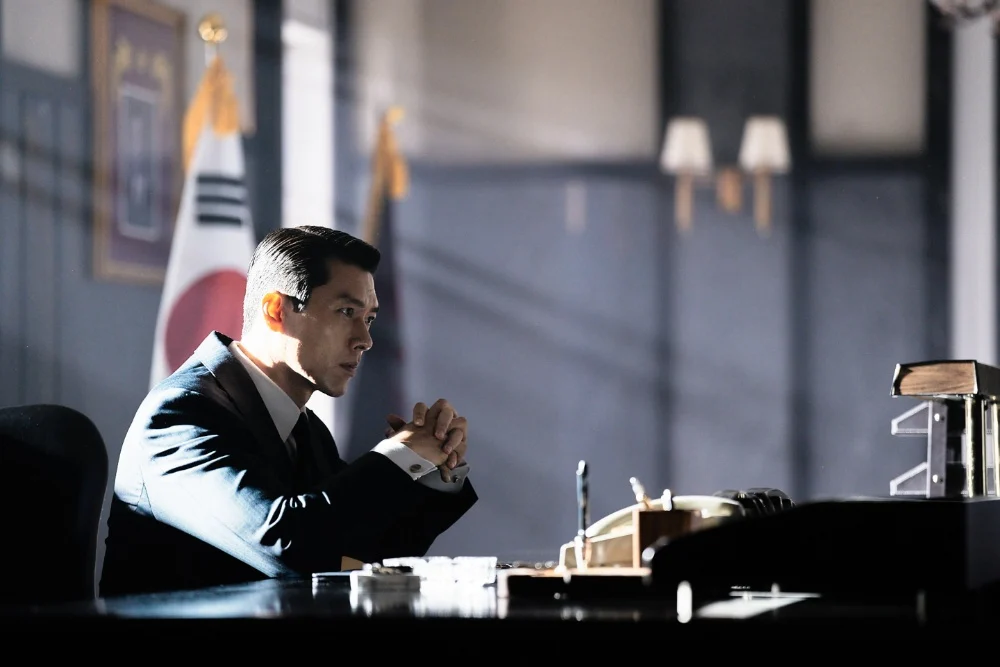
With a staggering production budget of KRW 70 billion ($51 million) spanning its two-season arc, Made in Korea has officially cemented its status as one of the most expensive and ambitious K-dramas ever produced. As the series prepares to launch its highly anticipated second season on Hulu and Disney+ on September 9, it arrives not merely as a piece of television, but as a cinematic culmination of a narrative that mirrors the volatile political disintegration of South Korea in 1979—a year defined by ten weeks of absolute historical upheaval.
The Convergence of History and Noir
Made in Korea is not a typical period drama. It is a dense, noir-infused exploration of power, corruption, and the erosion of morality within the Korean Central Intelligence Agency (KCIA) during the 1970s. Season 1 grounded viewers in the grim machinery of state-sponsored anti-communist propaganda and the burgeoning, shadow-filled drug operations of Baek Ki-tae.
As the curtain rises on the final six episodes, the narrative leaps forward nine years. The audience is thrust into a landscape defined by presidential assassination, the sudden vacuum of power, and a rapid succession of military coups that saw the nation’s governance shift precariously from hand to hand.
Director Woo Min-ho, whose previous work The Man Standing Next (2020) famously dramatized the final 40 days leading up to the assassination of President Park Chung-hee, views this era as the only logical conclusion for his characters’ unchecked ambitions. “It was one of the most chaotic and tumultuous times in modern Korean history,” Woo reflects. By choosing to bridge the gap with a nine-year time jump, the production allows the passage of time to act as a secondary protagonist. “Nine years seemed like an appropriate number of years; it is a long enough period to fundamentally change people,” he adds.
Character Trajectories: From Ambition to Obsession
The heart of Made in Korea lies in its character studies. Hyun Bin, the Crash Landing on You star who leads the series as Baek Ki-tae, finds himself in a vastly different position this season. Ki-tae has ascended to the role of second-in-command at the KCIA, hovering on the precipice of total authority.
“While rising through the ranks, he has met and dealt with many people, and his methods have changed,” Hyun Bin explains. The actor notes that Ki-tae’s evolution is not just professional; it is existential. The accumulation of wealth and status has fundamentally altered his interpersonal dynamics, turning him into a man who views his peers as mere instruments of his own survival.
This shift creates a volatile friction with his younger brother, Baek Ki-hyun, portrayed by Woo Do-hwan (Bloodhounds). In the series, Ki-hyun—once the timid, impressionable recruit—has carved out his own path within the military. “His social position has changed, and he has gained some power of his own,” Woo Do-hwan notes. “He can finally talk back to his brother. His beliefs have become much stronger.” This fraternal clash serves as the emotional engine for the final season, mirroring the larger national conflict between established power and rising dissent.
Meanwhile, the return of the relentless prosecutor Jang Geon-young—played by Jung Woo-sung (12.12: The Day)—promises a calculated reckoning. Though the character’s whereabouts remained a mystery at the end of the first season, Jung teases a return defined by tactical patience. “Expect him to ride the tide of an emerging power to return with the goal of exacting his revenge,” Jung says, underscoring the show’s recurring theme: that in the corridors of power, revenge is frequently laundered as justice, and greed is draped in the flag of patriotism.
Narrative Compression and the "Prestige" Shift
Director Woo Min-ho distinguishes the structure of the two seasons with a clear artistic shift. “In Season 1, each episode featured a different event and a different story, revolving around different characters,” Woo explains. “So, each episode almost felt like a standalone film.”
Season 2, however, adopts a more concentrated approach. The six-episode run is designed to feel like a single, continuous cinematic experience. By prioritizing a tighter narrative and a faster, more pressurized pace, the show mirrors the historical reality of 1979—a year where the political ground beneath the characters was literally moving.
This shift in format is emblematic of a broader trend within the South Korean media landscape. Streaming giants like Disney+, Netflix, Coupang Play, and Wavve are actively moving away from the traditional 16-episode broadcast model that dominated the 2000s. By recruiting top-tier film directors to produce shorter, higher-budget "prestige" runs, these platforms are effectively changing the consumer expectation of what a K-drama can be.
For veterans like Hyun Bin, who built his career on the long-form traditional drama, the shift is an opportunity for deeper character exploration. “Being able to experience an era of our own country that I couldn’t experience in real life is something I can only do thanks to this job of being an actor,” he remarks.
Implications for the Future of K-Content
The success of Made in Korea serves as a proof-of-concept for the viability of expensive, high-concept historical dramas in the streaming age. With a budget that rivals global productions, the series demonstrates that international audiences are increasingly receptive to complex, hyper-localized political thrillers that do not shy away from the darker chapters of 20th-century history.
However, the conclusion of Made in Korea is not the end of the creative team’s exploration of South Korean history. Park Eun-gyo, who shares writing credit on the series, is already looking toward the next decade. The upcoming project, The Koreans, is being billed as a Korean-language spiritual successor to FX’s The Americans. Set in the 1990s, another period of intense political and social transition in Korea, the series is already slated for a Hulu and Disney+ release, suggesting that the "Prestige K-Drama" era is only just beginning.
Historical Chronology: The 1979 Crisis
The events depicted in Season 2 are rooted in one of the most critical windows in the 20th century for the Korean peninsula:
- 1970–1978: The establishment of the "Yushin" system, the centralization of power, and the height of the KCIA’s influence, as covered in Season 1.
- Late 1979: The assassination of President Park Chung-hee, which sent the nation into a vacuum.
- The 10-Week Disintegration: A rapid succession of martial law declarations, internal military infighting, and the eventual rise of the military figures who would define the 1980s.
- The 1980s: The period of social upheaval that serves as the thematic backdrop for the characters’ final choices in Made in Korea.
Conclusion
As Made in Korea closes its doors, it leaves behind a legacy of uncompromising aesthetic choices and a willingness to tackle the "lofty lies" of political history. By merging the noir genre with the stark realities of Korea’s authoritarian past, the series has provided a masterclass in how to translate national trauma into gripping, high-stakes television.
As the final episodes arrive on September 9, viewers are not just watching the end of a drug-fueled, power-hungry drama—they are witnessing the end of an era, both within the fictional narrative and within the changing industry of South Korean media itself. Whether the Baek brothers find redemption or are consumed by the chaos they helped foster remains to be seen, but one thing is certain: the bar for historical K-dramas has been permanently raised.










