Azzam Bilal Chamdy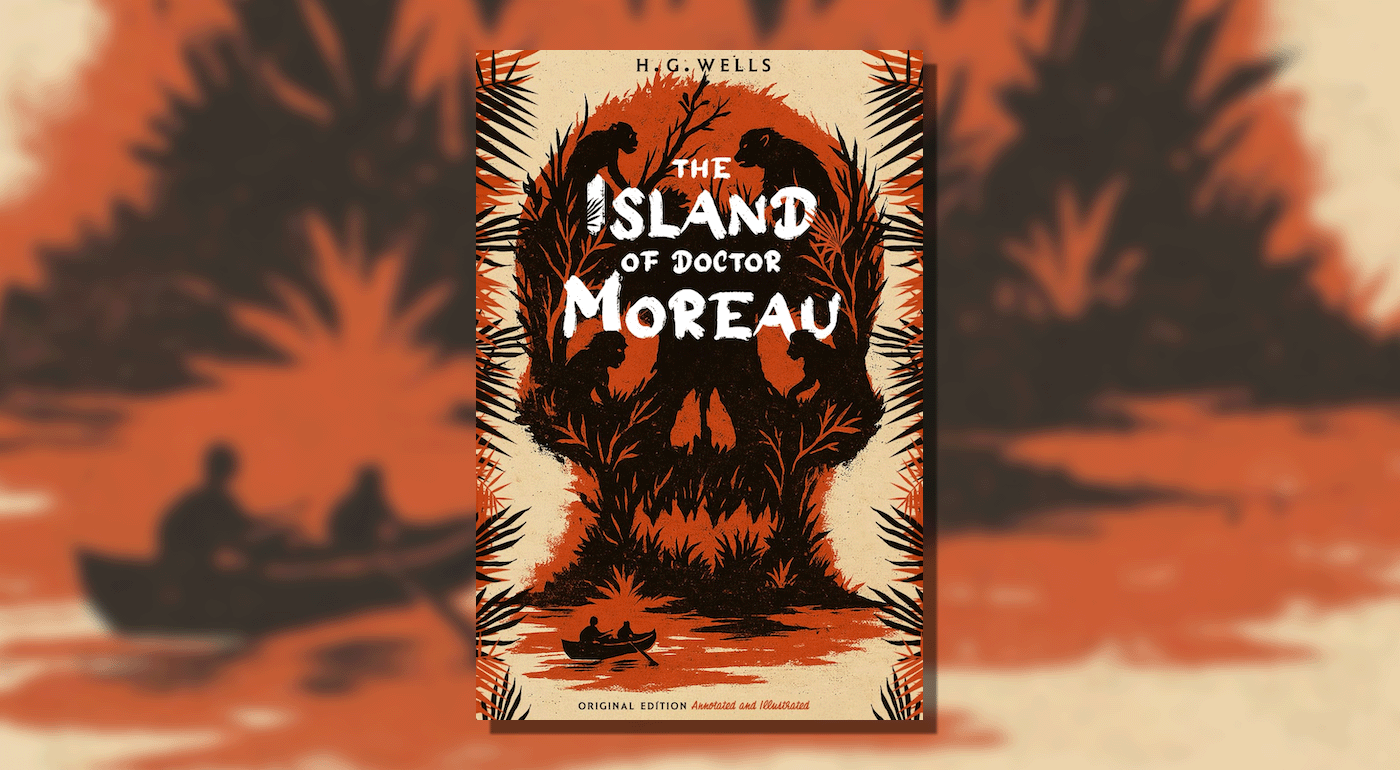
Welcome back to Reading the Weird, our ongoing analytical journey through the foundational texts of cosmic horror and weird fiction. This week, we delve into the heart of darkness within H.G. Wells’ 1896 masterpiece, The Island of Doctor Moreau. As we navigate Chapters 10 through 12, we find ourselves no longer merely observing an exotic, isolated laboratory, but confronting the horrifying synthesis of biology, theology, and colonial hubris.
Main Facts: The Descent into the Compound
In the narrative trajectory of The Island of Doctor Moreau, Chapters 10 through 12 serve as the "point of no return." Edward Prendick, the unfortunate castaway, finds his initial confusion regarding the nature of the island’s inhabitants replaced by a cold, sharp terror. After surviving a harrowing encounter in the wilderness with a creature that defies simple classification—part man, part beast, and entirely unsettling—Prendick returns to the safety of Dr. Moreau’s compound.
However, safety is an illusion. The screams that emanate from the inner sanctum of the facility cease to be the cries of a wounded puma and take on the agonizing cadence of human suffering. When Prendick breaches the inner door, he is met with a vision of vivisection so profound that it shatters his reality. He encounters a figure bound to a frame, scarred and red, revealing that Moreau’s experiments are not merely about animal modification, but the systematic, painful dismantling of the barrier between species.
Chronology of the Incident
The events of these chapters unfold with a rapid, claustrophobic intensity:
- Chapter X (The Crying of the Man): Prendick returns to the compound in a state of exhaustion. Montgomery, Moreau’s assistant, attempts to placate him with sedatives, dismissing the island’s horrors as "bogles." Prendick’s discovery of the vivisected human-like subject forces a confrontation with Moreau, who physically ejects him, prioritizing his "work of a lifetime" over human ethics.
- Chapter XI (The Hunting of the Man): Convinced that he is the next subject for Moreau’s surgical "uplift," Prendick flees the compound. He constructs a crude weapon and heads into the forest, where he encounters the Ape-Man—a creature that retains the faculty of speech and possesses five-fingered hands.
- Chapter XII (The Sayers of the Law): The Ape-Man guides Prendick to a hidden village of Beast People. Here, Prendick is introduced to the "Sayer of the Law," a creature that leads the others in a rhythmic, terrifying litany of prohibitions. The scene is interrupted by a search party led by Moreau, forcing Prendick to flee once more, this time into the ravine.
Supporting Data: The Theology of Mutilation
The most significant aspect of these chapters is the introduction of "The Law." This pseudoreligious code is not merely a set of rules for the Beast People; it is a mechanism of psychological control. By forcing his creations to chant, "Not to go on all-fours; that is the Law," Moreau is actively stripping them of their base nature while simultaneously positioning himself as a deity.
The litany—His is the House of Pain; His is the Hand that makes; His is the Hand that wounds; His is the Hand that heals—reveals the nature of Moreau’s godhood. He is a god who creates not out of love, but out of necessity and experimental ego. The Beast People are "human" enough to feel shame for their natural instincts, yet "animal" enough to be kept in a state of perpetual fear. They are trapped in a cycle where they must suppress their own biology to avoid returning to the "House of Pain."
Official Responses and Interpretations
The implications of this text have been debated by critics for over a century. Two primary lenses through which we view these chapters are the sociological and the theological.
The Theological Critique
Wells, who maintained a famously volatile relationship with organized religion, appears to use the "Sayer of the Law" to critique the concept of a vengeful, authoritarian deity. The Beast People are the perfect congregation: they are conditioned to fear hell (the House of Pain) and to worship their creator, even as he systematically abuses them. The ritualistic nature of their law-chanting mirrors the "grotesque satisfaction" Wells noted in his own observations of fire-and-brimstone sermons, where the congregation finds comfort in the very threats that keep them subservient.
The Biological "Uplift" Hypothesis
Modern readers often compare Moreau to the pioneers of "uplift" science fiction, such as David Brin. However, where Brin’s uplifted species are often treated as partners, Moreau’s creations are treated as discarded failures. Moreau does not want sentient collaborators; he wants puppets. He is not interested in the welfare of his subjects, but in the proof of his own intellectual dominance over the laws of nature.
Implications: The Animal Within
Perhaps the most haunting implication of these chapters is the fluidity of the human condition. Prendick, the protagonist, finds himself slipping into his own animal instincts—falling to "all fours" and experiencing bouts of primal terror. He is not exempt from the "Law" simply because he is a human; he is subject to the same fear and the same desperate desire for comfort.
The Beast People serve as a mirror for humanity. They are creatures who have been forced into an unnatural shape and an unnatural set of morals. When Moreau arrives, their "cuteness"—as one might describe the Ape-Man or the sloth-creature—vanishes, replaced by the crushing weight of their maker’s presence. They are victims of a creator who cannot tolerate the return of their natural selves.
As we look toward the future of our own scientific advancements—from the ethics of CRISPR gene editing to the development of artificial intelligence—Moreau’s island remains a chilling warning. It is not just about the morality of surgery; it is about the morality of power. When we create life—or alter it—do we do so for the betterment of the subject, or for the satisfaction of the creator?
Prendick eventually finds himself on the beach, the roar of the hunt fading, but the psychological scars remain. He has seen the future of "civilized" behavior: a rhythmic, fearful obedience to a creator who views them only as a means to an end.
Next week, we continue our exploration of the weird with Samantha Mills’ "10 Visions of the Future or, Self-Care for the End of Days," as we further examine how modern authors continue to grapple with the existential anxieties that Wells first brought to the surface in 1896.

 Nana
Nana
 Suro Senen