First, it was the "Orange Peel Theory," a social experiment designed to gauge the depth of a partner’s devotion based on their willingness to perform small acts of service. Then came the "Bird Theory," which sought to quantify emotional attunement through shared enthusiasm for the mundane. Now, TikTok users have pivoted from the psychological to the academic, settling on a new, unsettling question: Can your boyfriend actually read?
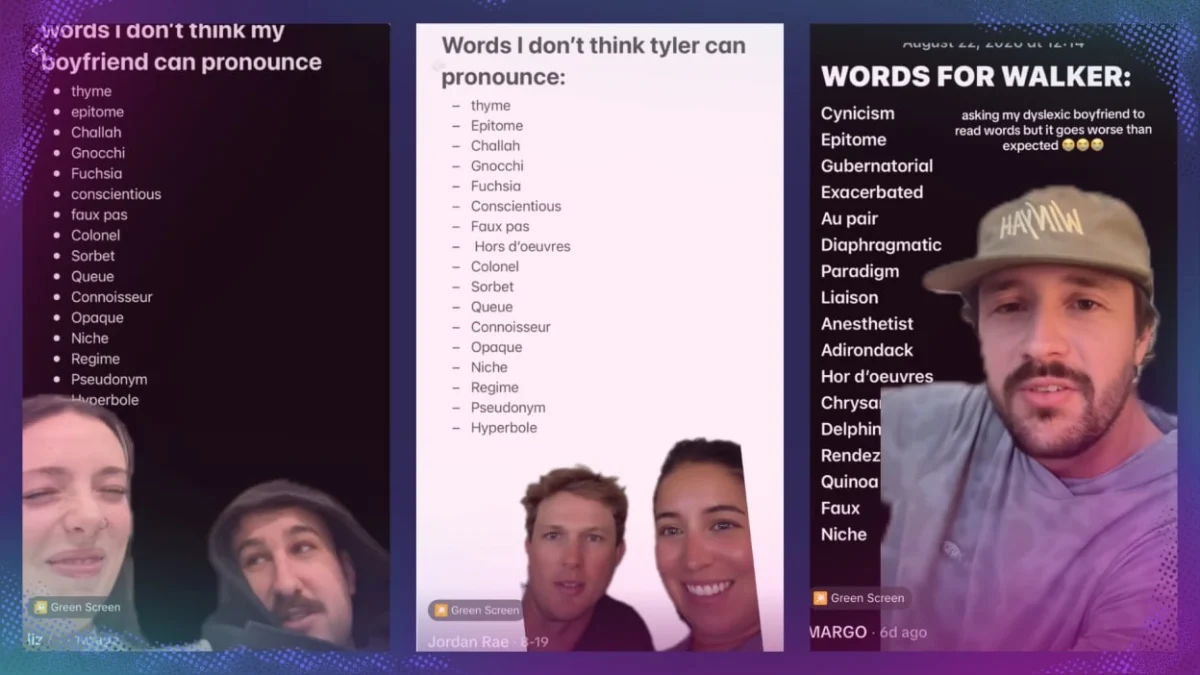
In the latest viral trend sweeping the platform, women are handing their significant others lists of deceptively simple vocabulary words—such as "epitome," "colonel," "hyperbole," "quinoa," and "niche"—and asking them to read them aloud. What begins as a lighthearted, giggly domestic experiment often descends into a cringe-inducing display of linguistic mangling. As these videos flood the "For You" page, the trend has evolved from a comedic staple into a broader, more existential debate about the state of literacy in the digital age.
The Mechanics of the Trend: A Linguistic Trap
The premise of the challenge is simple. A creator films her boyfriend or husband, presenting him with a handwritten or digital list of words. The chosen vocabulary is intentionally curated: these are words that are common enough to appear in daily conversation or professional emails, yet possess spelling patterns that defy standard phonetic expectations.
When the subjects attempt to pronounce them, the results are often chaotic. "Epitome" is frequently butchered as "epi-tome," "colonel" is read as it is spelled, and "hyperbole" becomes "hyper-bowl." While the English language is famously inconsistent—a "gothic" language borrowing from Latin, Greek, French, and German—the sheer volume of failed attempts has led many viewers to question whether these errors are merely quirks of language or symptoms of a deeper educational gap.
A Chronology of Concern
The sudden obsession with "boyfriend literacy" did not manifest in a vacuum. It follows a summer of mounting scrutiny regarding the intellectual habits of young adults.
Earlier this year, the cast of Love Island USA Season 8 became a focal point for national discourse on reading comprehension. Viewers were quick to highlight contestants who struggled with basic vocabulary, mispronounced common expressions, and openly discussed using generative AI to handle basic communication tasks like writing love letters. The discourse shifted from mocking individual reality stars to questioning the "literacy crisis" facing Gen Z and younger Millennials.
When the TikTok reading challenge launched in late August 2026, it acted as a catalyst, merging the existing skepticism toward reality television stars with the private, relatable frustrations of everyday relationships. Suddenly, the "reading check" became an essential prerequisite for many dating, with social media commentary urging users to "screen" their partners before committing.

The Statistical Reality: Beyond the Screen
While it is easy to dismiss a handful of viral videos as cherry-picked entertainment, the data suggests a more sobering reality. Federal literacy data released by the National Center for Education Statistics (NCES) provides a concerning backdrop to the trend.
Between 2017 and 2023, the percentage of American adults aged 16 to 65 performing at the lowest literacy level (Level 1 or below) climbed from 19 percent to 28 percent. The data reveals a specific trajectory for male adults, who saw an increase in the lowest literacy bracket from 19 to 29 percent.
These figures are compounded by a steady decline in reading for pleasure. According to data from the National Endowment for the Arts, the share of adults who read at least one book per year plummeted from 54.6 percent in 2012 to 48.5 percent in 2022. Even more concerning is the trend among adolescents; daily reading among 13-year-olds has been effectively halved over the last decade. As educational institutions struggle to adapt, college professors report a significant shift: students are increasingly unable to engage with full-length texts, leading many to condense curricula or turn to AI summaries, a phenomenon The Atlantic recently dubbed "The End of Reading."
Official Responses and Cultural Commentary
The reaction to the TikTok trend has been polarized. Some creators have leaned into the humor, while others have expressed genuine alarm.
Influencer Isabella Von Ghoul addressed the trend with a somber observation, noting, "This trend has unearthed a fear of mine that I didn’t know existed before this past week. The state has failed your man, and I’m scared." Meanwhile, creators like Tinx have questioned the optics of the trend itself, asking, "Why are you guys boasting that your boyfriends can’t read?"
The criticism has been sharpest from those who believe the trend mocks a genuine societal failure. Creator Daniel Bennett hit a nerve when he addressed the women filming their partners, noting, "In the videos, the girlfriends are giggling. But we aren’t laughing with you. We’re laughing at you." This sentiment suggests that by turning functional illiteracy into a dating quirk, women may be inadvertently normalizing a lack of basic education in their partners.
On platforms like Reddit, the conversation has taken a more analytical turn. In threads titled "Why can’t Gen Z read?", users debate whether the problem lies with the educational system, the rise of short-form content that favors visual stimuli over text, or the increasing reliance on algorithmic consumption.

Implications for Modern Relationships
The "boyfriend literacy" trend is the latest in a long line of TikTok "tests." From the Orange Peel Theory to the Bird Theory, these social experiments represent a desire to find objective markers of a "good" partner in an increasingly atomized world.
However, experts caution that these trends provide a false sense of security. A single recorded interaction—especially one influenced by the pressures of a camera, a girlfriend’s giggling, and the desire to perform for an audience—is a poor metric for judging intelligence, compatibility, or emotional maturity.
Nevertheless, the trend highlights a growing anxiety about the "post-literate" age. We live in a society where information is increasingly delivered through podcasts, AI-generated summaries, and 30-second clips. As reading shifts from a primary method of learning to an "unnecessary burden," the ability to decode complex text is becoming a rare commodity.
The danger of this trend is not just that it embarrasses boyfriends or mocks the educational system; it is that it treats a systemic issue as a personal failing. When we laugh at a man who cannot pronounce "epitome," we are witnessing the symptoms of a society that has moved away from the slow, deliberate work of reading.
Conclusion: Is the Future Post-Literate?
As the TikTok trend continues to evolve, it serves as a digital mirror for a society undergoing a profound shift in how it consumes and processes language. Whether or not these men can read "quinoa" or "niche" is, in the grand scheme, a minor issue. But the underlying discomfort felt by millions of viewers is very real.
The "literacy test" is a symptom of a culture that is beginning to realize that the fundamental skills of the 20th century are being sidelined by the digital infrastructure of the 21st. As long as we continue to rely on AI to write our emails and algorithms to feed us our news, the necessity of deep, sustained literacy will continue to be debated.
For now, the trend serves as a jarring reminder: in a world where information is everywhere, the ability to read—and truly understand—is becoming the ultimate "flex." Until then, the boyfriends of TikTok will continue to stumble over their vowels, and their partners will continue to record them, proving that while our literacy rates may be in decline, our obsession with documenting that decline is at an all-time high.