Pevita Pearce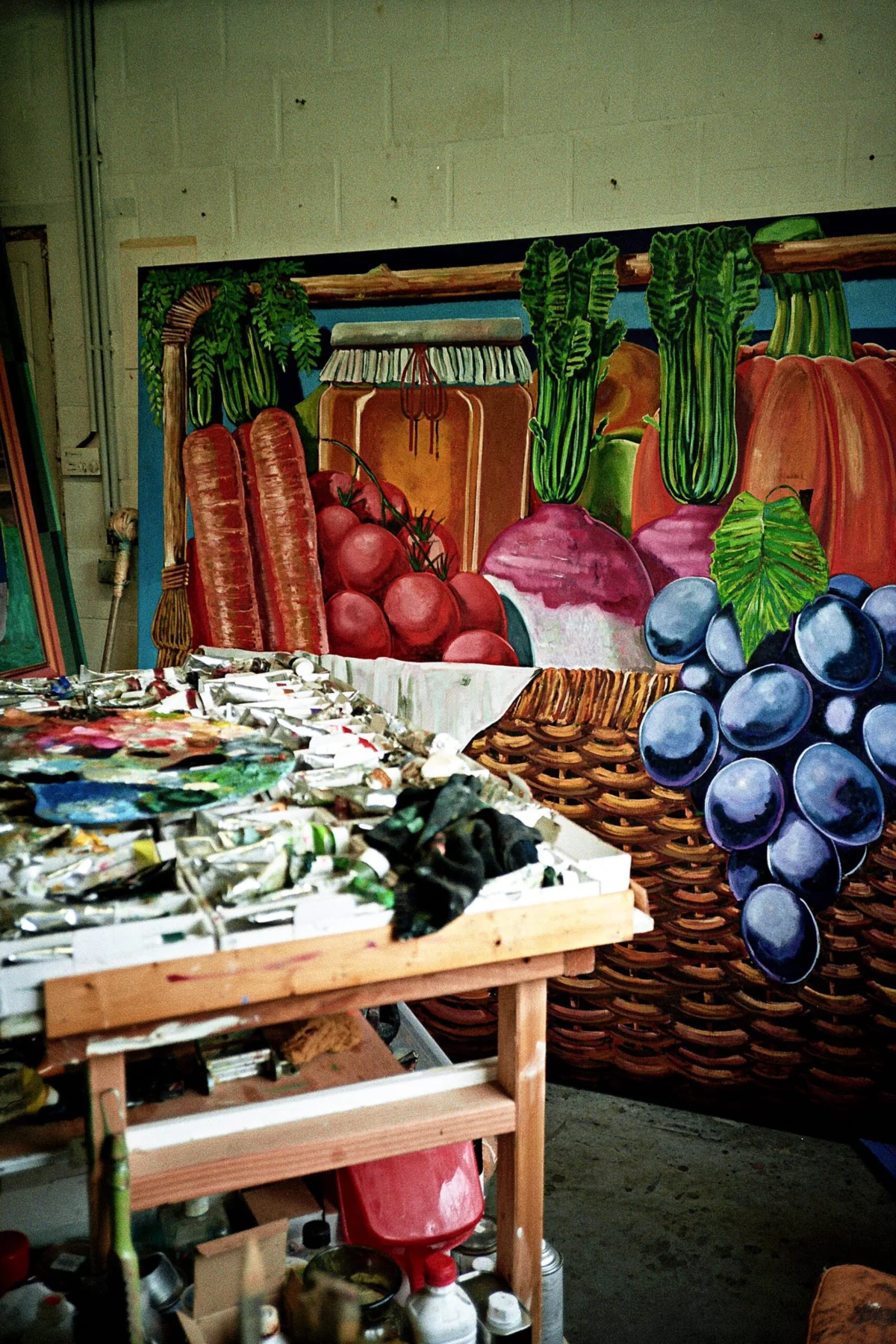
In the contemporary art landscape, few artists possess the singular ability to elevate the banal into the sublime quite like Belgian painter Kristof Santy. Known for his signature use of high-chroma, vibrant palettes and deliberately flattened perspectives, Santy has carved out a niche that sits comfortably between folk art aesthetics and modernist inquiry. His latest body of work continues this trajectory, shifting his gaze from the heavy machinery of industrial labor to the intimate, quiet corners of domestic life—fashions, furnishings, and the subtle textures of the everyday.
Main Facts: The Evolution of a Visual Language
Kristof Santy’s practice is defined by a rigorous commitment to the "common sight." Where others might see a mundane tabletop, a bowl of fruit, or a utilitarian helicopter, Santy perceives a geometry of color and form waiting to be extracted from its context. His work is not merely representational; it is an act of translation. By removing depth and flattening the picture plane, he forces the viewer to confront the object as a purely visual entity—a play of hue and edge.
In his upcoming collection, Santy expands his scope. While previous series focused heavily on the mechanics of industry—transportation, heavy equipment, and the artifacts of manual labor—this new series pivots toward the personal and the interior. A striped sweater vest, rendered with an almost obsessive attention to the minute, singular wrinkle in its fabric, hangs suspended as if waiting for a body. Elsewhere, a modernist chair in an arresting shade of fuchsia sits defiantly against a Kelly green wall, creating a chromatic tension that is both jarring and harmonious.

These works continue to demonstrate Santy’s mastery over his medium: oil on canvas. Despite the simplicity of his subjects, the execution is dense with texture, history, and a deliberate, almost childlike clarity that belies the sophistication of his compositional choices.
Chronology: From Industrial Labor to Domestic Still Life
To understand the trajectory of Santy’s work, one must look at his thematic development over the last several years. His early career was marked by a fascination with the heavy, masculine world of industrial machinery. He painted trucks, cranes, and specialized transport vehicles with the same reverence that old masters might have reserved for portraits of royalty.
- 2023–2024: The "Industrial Period." During this time, Santy focused on the aesthetics of labor. His paintings of helicopters, cargo ships, and construction equipment gained him international recognition for his unique, graphic-heavy style.
- 2025: The Pivot. As the calendar turned to 2025, a shift became evident in his studio. While the helicopter remained a recurring motif—as seen in his latest piece featuring a hover-craft sans operator—the artist began to introduce elements of the home.
- 2026: The Current Collection. The works created this year reflect a newfound intimacy. The focus has narrowed to the textures of fabric and the ergonomics of furniture. This evolution suggests an artist moving from the "outside" world of public labor to the "inside" world of private consumption.
This chronological progression highlights a maturation of the artist’s inquiry. He is no longer just documenting the things that move the world; he is now documenting the things that inhabit our quietest moments.

Supporting Data: The Anatomy of a Painting
Santy’s process is as much about the physical construction of the canvas as it is about the subject matter. His choice of oil on canvas allows for a saturation of color that acts as the primary vehicle for his artistic intent.
Technical Specifications
The scale of his work is significant, demanding the viewer’s full attention. For instance:
- "Fauteuil" (2025): 150 x 120 centimeters. This piece utilizes color-field theory to isolate the chair against its backdrop.
- "Ijscoupe" (2026): 180 x 150 centimeters. A monumental scale for a still life, elevating a dessert to the status of an epic narrative.
- "Compositie met groenten" (2025): 200 x 160 centimeters.
- "Helikopter" (2025): 220 x 200 centimeters.
These dimensions are not incidental. By painting common objects on a grand scale, Santy effectively performs a visual "magnification." He forces the viewer to engage with the object on its own terms, stripping away its utility and leaving only its essence. The "flattened perspective" is key here; it prevents the eye from wandering into a deep, illusory background, instead keeping the viewer locked onto the surface of the painting, where the brushstrokes and color transitions reside.

Official Responses and Curatorial Context
The art world has responded to Santy’s progression with significant anticipation. His upcoming exhibition at the renowned Brussels-based gallery, Sorry We’re Closed, is expected to be one of the highlights of the fall season.
Gallery representatives and critics alike have noted that Santy’s work occupies a unique space in contemporary painting. By eschewing the conceptual irony that dominates much of the modern art scene, Santy leans into a sincerity that is both refreshing and challenging. His studio, often documented in progress, reveals a workspace that mirrors his paintings—organized, deliberate, and filled with the very objects that eventually populate his canvases.
"Santy’s work does not ask us to solve a puzzle," notes one local critic. "Instead, it asks us to look. And in that looking, we find that the objects we overlook—the sweater, the chair, the bowl of fruit—are actually the most compelling parts of our lives."

Implications: The Legacy of the Mundane
What does it mean for an artist to turn away from the "grand" subjects of industry toward the "small" subjects of the home?
- The Democratization of the Subject: Santy’s work posits that there is no hierarchy of beauty. A helicopter is no more or less worthy of oil and canvas than a bowl of produce or a piece of clothing. This is a radical democratic stance in an era that often demands "meaningful" or "political" art.
- The Resistance to Digital Fatigue: In a world saturated by high-definition, infinite-depth digital imagery, Santy’s flattened, tactile, and highly saturated paintings provide a visceral antidote. They are physical, heavy, and undeniable.
- The Persistence of Craft: By sticking to traditional oil painting techniques, Santy bridges the gap between historical genre painting and modern graphic design. He proves that the medium is not dead; it is merely waiting to be re-contextualized by a keen eye.
As we look toward his exhibition in Brussels this fall, it is clear that Kristof Santy is not just painting objects. He is painting a map of our daily existence. He invites us to reconsider the items that surround us, to appreciate the geometry of a sweater vest, the weight of a chair, and the vibrant, unadulterated reality of the world we inhabit.
Whether he is depicting a helicopter hovering in the void or a humble arrangement of vegetables on a wooden table, Santy ensures that we see the object—truly see it—perhaps for the very first time. In doing so, he reminds us that even in the most routine, mundane, and everyday existence, there is a vibrant, colorful world of art waiting to be discovered.

For those eager to follow his progress leading up to the Brussels opening, Santy maintains an active presence on Instagram, where he shares glimpses of his studio life, the evolution of his canvases, and the quiet moments of inspiration that fuel his practice. As the fall season approaches, all eyes will be on Sorry We’re Closed to see how this transition from the industrial to the domestic will be received by the global art community. It is a transition that promises to be as visually arresting as it is conceptually profound.


 Basiran
 Asro
Asro