"Civilizations are remembered through their monuments, but understood through the things they throw away." This poignant observation serves as the foundational philosophy for artist Helena Minginowicz, whose latest body of work challenges the rigid hierarchies of art history and material value. By transmuting the humblest of household commodities—the paper towel—into a canvas for Renaissance-inspired portraiture, Minginowicz invites viewers to reconsider the dignity we assign to the mundane and the discarded.
Main Facts: A Study in Contradiction
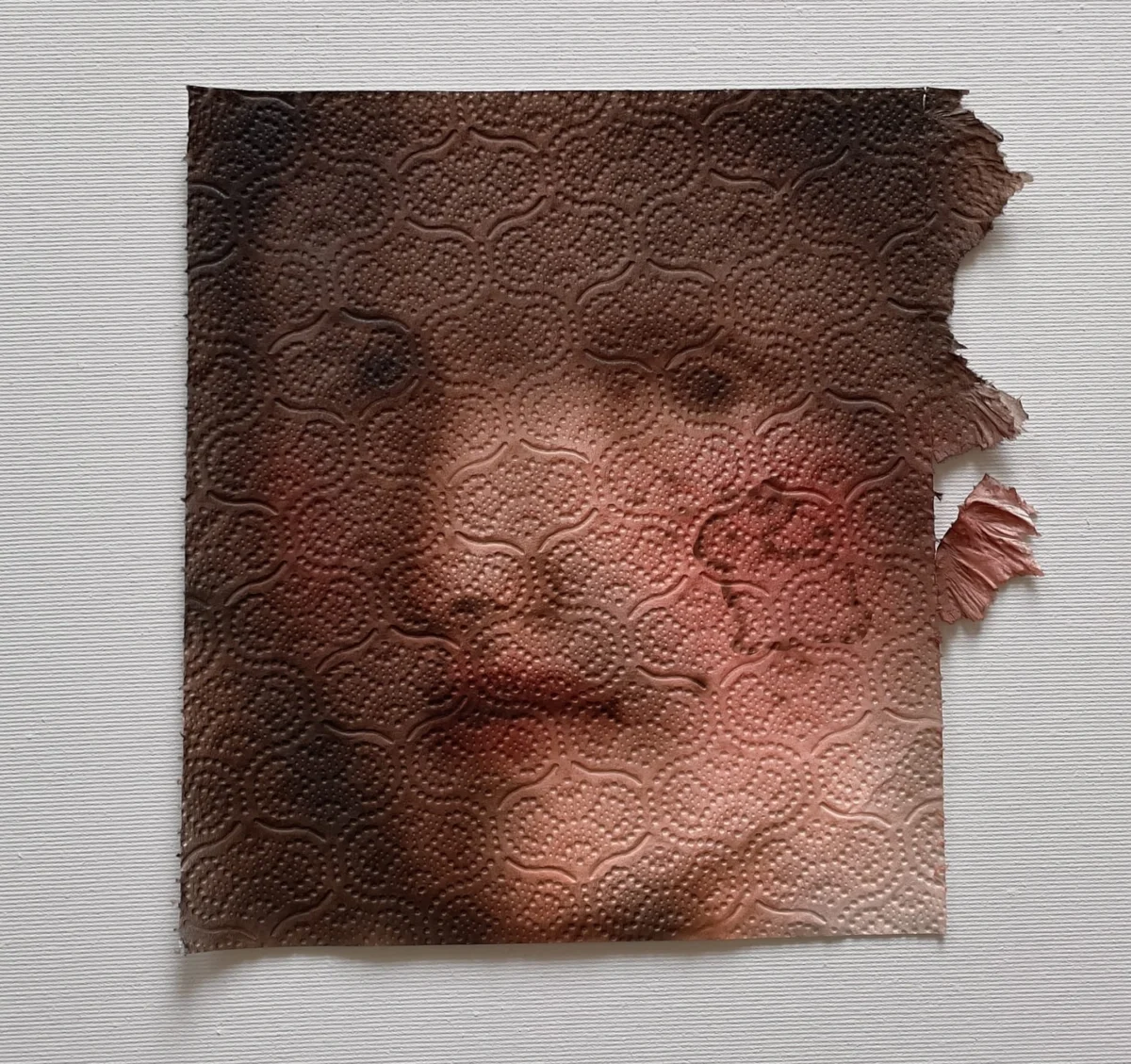
Minginowicz’s practice is defined by a striking aesthetic and conceptual dichotomy. Utilizing airbrushed acrylic, the artist builds up intricate, translucent layers of pigment upon the machine-embossed, moisture-wicking surfaces of standard paper towels. These substrates are inherently designed for a life of service and subsequent disposal, yet under the artist’s hand, they become the foundation for profound, evocative imagery.

The artist’s work centers on the tension between the "quotidian" and the "monumental." By selecting paper towels—a symbol of mass-produced, single-use consumer culture—as her primary medium, Minginowicz forces a confrontation with the disposable nature of modern existence. She asks why some materials are deemed worthy of preservation in the halls of history, while others are relegated to the wastebasket. This exploration of materiality extends beyond paper; she also incorporates supermarket-style plastic bags, which are subsequently encased between thick, polished slabs of acrylic. This process grants these fragile, fleeting items a newfound heft, permanence, and dimensionality, effectively turning refuse into reliquaries.
Chronology of a Concept
The evolution of Minginowicz’s current project follows a trajectory of material experimentation and historical inquiry.

- Early Explorations: The artist began her career by examining the limits of traditional mediums, eventually moving toward a multimedia approach that prioritized textures. She began working on conventional canvases but found that the surface did not communicate the narrative of "disposability" she wished to address.
- The Shift to Domesticity: Recognizing that domestic objects hold the most intimate records of human history, Minginowicz pivoted to paper-based materials. She began experimenting with tissue paper and kitchen towels, finding that the machine-embossed patterns provided a ready-made structure that resonated with the history of decorative arts.
- Refining the Technique: Over the last several years, the artist developed her signature airbrushing technique. The ability to build thin, translucent layers was crucial; it allowed the texture of the paper towel to remain visible beneath the paint, ensuring the viewer never forgets the identity of the substrate.
- The Rise of the "Encased" Series: More recently, she began mounting her paper towel paintings between high-density acrylic sheets. This development marked a shift from mere painting to the creation of "objects," providing a protective, gallery-standard finish that mimics the preservation techniques used for historical artifacts.
- The Road to Paris: The current phase of her career focuses on synthesizing these techniques for her upcoming solo exhibition at Galerie Prima in Paris, set to open on October 8, 2026.
Supporting Data and Technical Context
To understand the significance of Minginowicz’s work, one must look at the historical context of art materiality. Historically, painters used gessoed wood panels or high-quality linen canvases—surfaces designed to endure for centuries. By contrast, the materials Minginowicz employs are synthetic or cellulose-based products with a projected lifespan of mere minutes in a domestic setting.
The "hierarchy of materials" is a concept well-documented in art history. Stone and bronze are considered "high" art materials because of their permanence. Minginowicz disrupts this hierarchy by applying the techniques of Renaissance masters—a period obsessed with the preservation of idealized, heroic images—onto a material that is literally designed to be thrown away after wiping up a spill.

The aesthetic connection to the Renaissance is intentional. Her compositions recall the soft, atmospheric sfumato of Leonardo da Vinci or the balanced grace of Sandro Botticelli’s "The Birth of Venus." By borrowing the visual language of the elite, the religious, and the powerful, she creates a jarring contrast against the cheap, moisture-wicking paper. The "rabbit" mark on a subject’s cheek, or the intimate framing of a portrait, grounds the work in a contemporary, sometimes whimsical reality, even as the execution echoes the gravitas of 15th-century Italy.
Official Responses and Philosophical Inquiry
In her communications, Minginowicz is explicit about her motivations. "Every civilization constructs its own hierarchy of values," she notes. "It decides what deserves to be preserved, admired, and passed on to future generations."

Her work serves as a critique of how we curate our collective memory. "Monuments, works of art, symbols, and myths preserve an image of humanity as we wish to remember it—strong, beautiful, enduring, and heroic," she explains. "Yet every monument has its reverse." By painting the common person—or even anonymous, idealized figures—on paper towels, she suggests that the "reverse" of the monument is not a lack of value, but a different kind of truth.
The artistic community has responded with keen interest to this inversion of the "heroic." By utilizing the language of the Renaissance, Minginowicz is not merely making a statement about waste; she is asking a radical question: "Who deserves to be remembered with dignity?" Her response is inclusive: "Not only heroes. Not only the victorious. But every human being."

Implications for Contemporary Art
The implications of Minginowicz’s work are manifold, touching on environmentalism, social justice, and the future of the art market.
The Environmental Lens
While the artist does not frame her work as purely ecological, the choice of materials inevitably forces a conversation about the environmental toll of disposable culture. The contrast between the beauty of the image and the banality of the paper towel forces the viewer to consider the cycle of consumption. By enshrining these items in acrylic, she forces us to look at our waste—a powerful act of environmental confrontation.

The Social Justice Lens
Perhaps most compelling is the social implication of her work. The Renaissance was an era of portraiture reserved for the wealthy, the pious, or the politically powerful. By utilizing that same visual weight for subjects painted on temporary, mass-produced scraps, Minginowicz democratizes the act of memorialization. She implies that if the "monuments" of our society are defined by what we choose to preserve, then by choosing to preserve the ephemeral, we are expanding our definition of who matters.
Future Trajectories
As she prepares for her solo exhibition at Galerie Prima, the art world is watching to see how her work will be received in a city so deeply rooted in the preservation of classical monuments. The juxtaposition of her work in a Parisian context—a city that arguably values the "monumental" more than any other—is a masterstroke of curatorial strategy.

If the goal of the artist is to shift the way we perceive dignity, Minginowicz appears to be succeeding. Her work challenges the viewer to step back from the luxury of the frame and recognize that the value of art does not lie in the permanence of the substrate, but in the humanity of the subject. As we look toward the future, her work stands as a poignant reminder that while empires may crumble and marble may weather, the small, intimate, and seemingly disposable moments of life are what truly define the human experience.
For those interested in witnessing this transformation of the quotidian, the upcoming exhibition in Paris serves as a vital touchstone for understanding where modern art meets the mirror of our own consumption. Through her lens, we are invited to see not just the waste of a civilization, but the potential for beauty in the things we are so quick to cast aside.