

In the rapidly evolving landscape of digital search, the paradigm is shifting from traditional keyword-based results to synthesized, AI-generated answers. As generative AI models like ChatGPT, Claude, and Gemini become the primary interface for information discovery, brands and professionals are scrambling to understand how to remain visible. A landmark report from Meltwater, analyzing 9.5 million AI citations across six major large language models (LLMs), has revealed a transformative insight: LinkedIn is now one of the most-cited domains globally, positioning itself as a vital authority in the era of artificial intelligence.
Main Facts: The Rise of Professional Intelligence
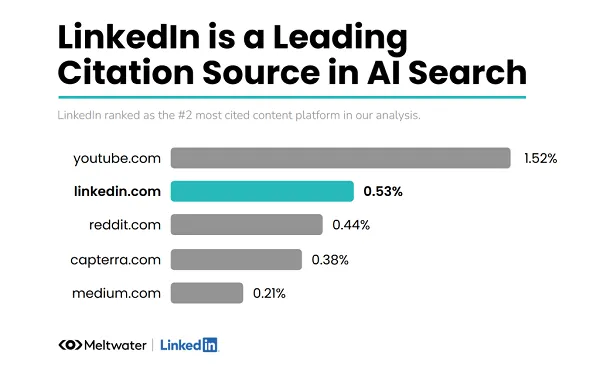
The data is clear: LinkedIn has evolved beyond a networking site into a primary training and reference ground for AI. According to the Meltwater study, LinkedIn currently ranks as the second most-cited domain across major AI chatbots. While YouTube maintains a significant presence due to its vast library of video-based tutorials and explainers, LinkedIn is increasingly dominating the B2B sector.
The core reason for this shift lies in the quality of the content. AI models are programmed to prioritize "ground truth"—data that is verifiable, authoritative, and rooted in human experience. LinkedIn’s ecosystem, which incentivizes professionals to share domain-specific expertise, case studies, and career-long learnings, provides exactly the type of high-fidelity data that LLMs are designed to scrape and synthesize.
Chronology: LinkedIn’s Strategic Pivot to AI Readiness
LinkedIn’s ascent in AI search is not accidental; it is the result of a calculated, multi-year strategy.
- Early Optimization: Over the past two years, LinkedIn began quietly adjusting its infrastructure to make long-form articles and professional posts more discoverable to external crawlers. By enhancing the metadata and indexing capabilities of its platform, LinkedIn ensured that its content could be easily parsed by search engine spiders.
- Prioritizing "Expert" Signals: Recognizing that generic marketing copy rarely resonates with human users—or AI—LinkedIn tweaked its algorithms to favor posts that demonstrate genuine expertise. This move rewarded contributors who shared data-backed insights, which in turn made the platform more attractive to AI training sets.
- The Meltwater Collaboration: This week, LinkedIn and Meltwater unveiled a deep-dive analysis into 9.5 million AI citations, providing concrete evidence that their efforts to improve discoverability have yielded massive dividends. This report serves as a "roadmap" for businesses looking to optimize their Generative Engine Optimization (GEO) strategies.
Supporting Data: Dissecting the Citations
The Meltwater report provides a granular look at exactly what AI models are "reading" when they answer a user’s query. The findings suggest that the nature of the content—and the identity of the author—matters more than ever.
The Power of the Personal Brand
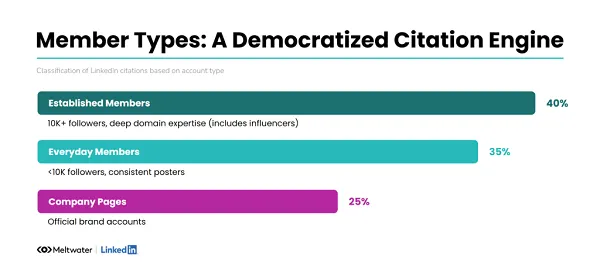
One of the most striking revelations in the study is that content from individual user profiles is significantly more cited than content from corporate company pages. AI models demonstrate a clear preference for content written by human experts who share specific examples, real-world data, and nuanced observations.

For brands, this creates a paradox: the more you focus on "official" corporate announcements, the less likely you are to appear in an AI-generated summary. Conversely, elevating internal employees as "thought leaders" and encouraging them to post from their personal accounts is the most effective way to secure a citation in an AI response.
Structural Preferences: How to Write for AI
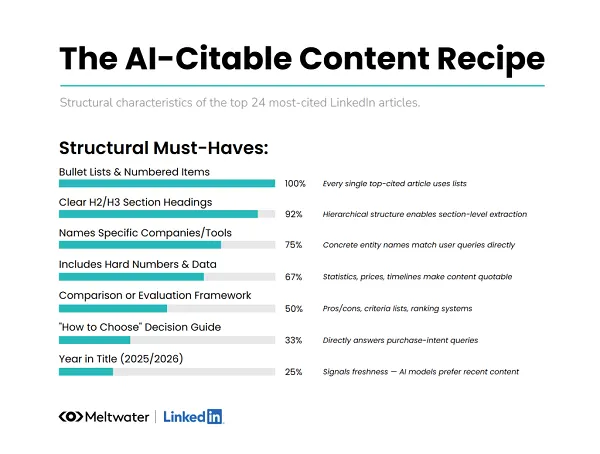
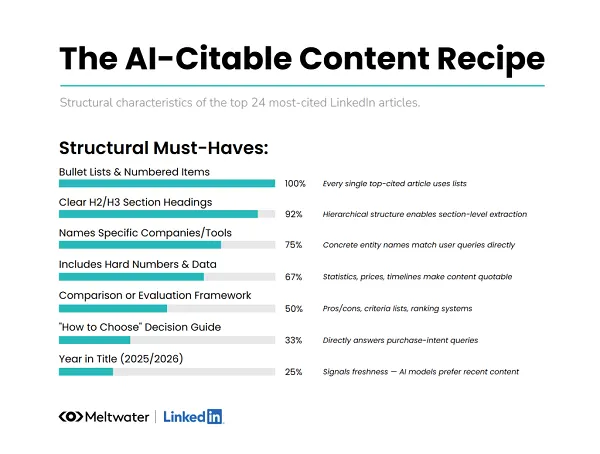
AI models are not just reading for substance; they are reading for structure. The report highlights that 83% of all LinkedIn citations come from plain text posts and articles. More importantly, the formatting of these posts is a major factor in whether they are selected for an AI response.
- Hierarchical Structure: 92% of the most successful posts featured clear headings.
- Readability: Every top-cited article utilized either bulleted or numbered lists.
- Why this works: Large Language Models are designed to parse text into digestible chunks. A post that is cleanly structured with clear, logical headers and lists allows an AI to "pluck" a specific section to answer a direct user query without needing to summarize the entire document.
Official Responses and Industry Perspectives
LinkedIn has been vocal about its role in the new AI economy. In recent communications, the platform noted that its mission has always been to connect professionals with the knowledge they need to be more productive. By becoming a primary source for AI answers, LinkedIn is effectively fulfilling its mission on a massive, automated scale.
"AI models prefer content written by credible people who share their domain expertise with examples, data, and specific details," the report notes. This statement serves as an implicit instruction to LinkedIn users: move away from fluff and generic platitudes. Instead, lean into "high-utility" content—the kind that provides an immediate, actionable answer to a complex professional problem.
Industry analysts suggest that this shift marks the "professionalization" of SEO. Where SEO used to be about stuffing keywords into blog posts, it is now about establishing "Author Authority." In the eyes of an AI, a post by a vetted industry expert with a history of high-engagement, factual content is worth more than a thousand SEO-optimized web pages from an anonymous source.
The Implications: What This Means for Your Strategy
The implications for marketers, B2B companies, and independent professionals are profound. We are moving toward an era of Generative Engine Optimization (GEO).
1. Shift from Corporate to Personal
If you want your brand to appear in an AI answer about "digital marketing trends" or "B2B SaaS attribution," you must stop relying solely on the company page. You need to leverage your internal experts. Encourage your executives, product leads, and subject matter experts to publish insights under their own names. Their voices are the ones the AI trusts.
2. Focus on "High-Utility" Formatting
If your posts are walls of text, they will likely be ignored by LLMs. Adopt a structured approach. Use H2/H3 headers, bullet points, and numbered lists to break down complex concepts. The goal is to make it as easy as possible for a machine to identify your content as a "correct answer" to a user’s question.
3. The "Expertise" Premium
The data confirms that the AI ecosystem is punishing "thin" content. Posts that provide deep, original analysis—supported by proprietary data or unique case studies—are the ones being elevated. Shallow posts that simply summarize existing news are failing to gain traction in the AI search results.
4. B2B Dominance
LinkedIn is currently the king of B2B queries. Whether a user is asking about procurement processes, cloud infrastructure, or corporate compliance, the AI is looking to LinkedIn to provide the answer. Companies that fail to maintain an active, high-quality presence on the platform are effectively opting out of the conversation that takes place when an AI provides a recommendation to a potential buyer.
Conclusion: The Future of Professional Search
As AI chatbots continue to integrate into the fabric of daily work, the traditional "search results page" (SERP) will become less relevant. Users will increasingly rely on the concise, synthesized answers provided by AI.
The Meltwater report confirms that LinkedIn has successfully positioned itself as the "source of truth" for professional and business queries. For businesses and professionals, the takeaway is simple: your LinkedIn profile is no longer just a digital resume or a billboard for company news. It is your primary asset for AI discoverability. By focusing on authentic, expert-led, and highly structured content, you ensure that when the next generation of workers asks an AI for advice, the answer it provides will be yours.











No comments yet. Be the first to join the conversation!