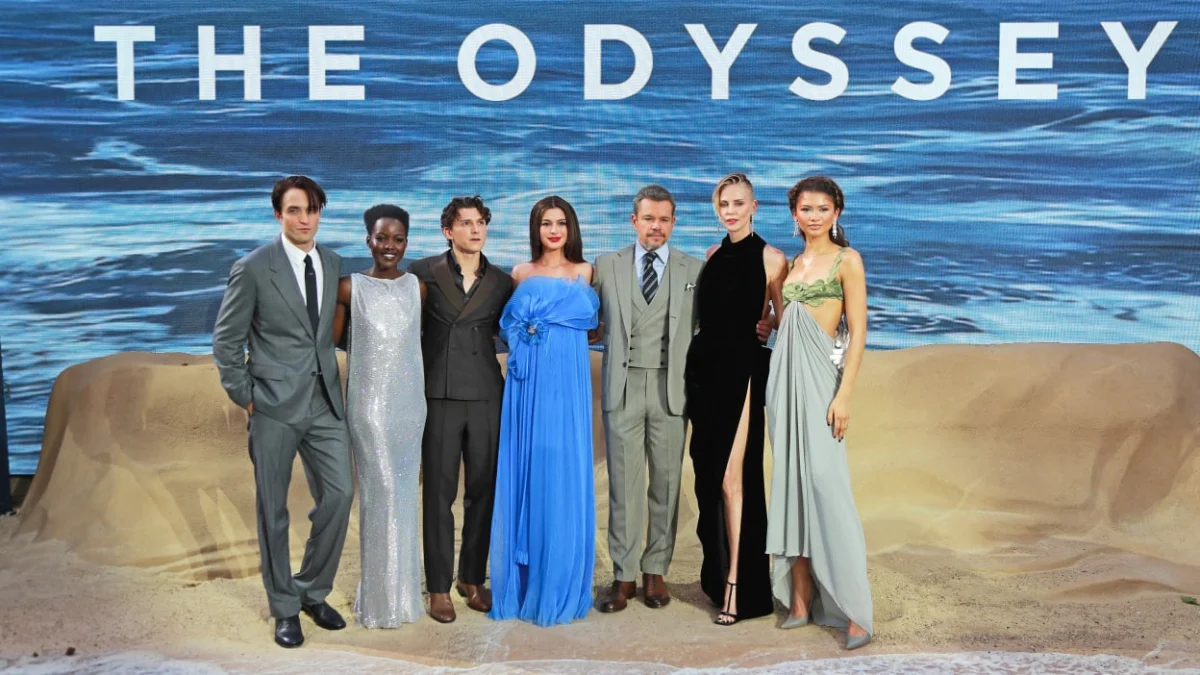
Christopher Nolan’s latest masterwork, The Odyssey, has officially completed its inaugural voyage before critics and industry insiders. Following its high-profile world premiere in London, the film—a staggering, $250 million endeavor—has ignited a bifurcated conversation that pits pure cinematic awe against a contentious, modern-day culture war. As audiences prepare for the July 17 theatrical release, one thing remains clear: Nolan has crafted a gargantuan spectacle that demands the largest canvas possible, even as it struggles to navigate the choppy waters of online discourse.
The Magnitude of the Myth: A Technical Achievement
The Odyssey is not merely a film; it is a technological statement. As the first feature in history shot entirely with IMAX film cameras, the production represents a culmination of Nolan’s long-standing obsession with scale, immersion, and the preservation of the theatrical experience.
Spanning six countries—including the rugged landscapes of Iceland, the sun-drenched shores of Greece, and the intricate sets of Morocco—the production utilized practical effects to a degree rarely seen in contemporary Hollywood. Where modern blockbusters often rely on the invisible hand of digital compositing, Nolan opted for real ships and massive, authentic crowd scenes. Matt Damon, portraying the legendary Odysseus, described the physical and psychological toll of the shoot as “much harder than anything I’ve ever done,” a testament to the director’s uncompromising commitment to realism in the service of fantasy.
Early reviews from the London premiere have been largely ecstatic, with critics emphasizing that the film’s sensory density cannot be replicated on home screens. The consensus among those who have seen it is clear: this is a work meant for the visceral, overwhelming embrace of a 70mm IMAX theater.
A Chronology of Controversy
The journey to the screen has been anything but smooth. While the critical reception has focused on the craft, the digital landscape has been dominated by a growing, often vitriolic debate regarding the film’s casting and narrative choices.
The Pre-Premiere Tensions
Long before the first trailer dropped, speculation regarding how Nolan would handle Homer’s ancient text began to circulate. The discourse shifted from artistic anticipation to aggressive scrutiny as casting announcements were released. Critics of the film—many of whom operate within the sphere of "anti-woke" digital activism—argued that the inclusion of a diverse, modern ensemble cast represented a betrayal of the source material.

The Musk Factor
The most prominent voice in this backlash has been that of Elon Musk. The tech billionaire took to social media multiple times to condemn the casting decisions, alleging that Nolan had "desecrated" the foundational Western epic in a bid to appease modern awards-voting bodies. This intervention, however, met with a swift and scholarly rebuttal from historian Tom Holland (the academic, not the actor), who defended the historical and literary elasticity of the Homeric tradition.
The Defense of the Vision
The cast and crew have largely remained unified in their defense of the production. Lupita Nyong’o, who portrays Helen of Troy, has been particularly vocal, stating in recent interviews that she fully supports the specific version of the story Nolan is telling. She emphasized that the cast was chosen to be “representative of the world,” arguing that the themes of The Odyssey—displacement, struggle, and the human search for home—are universal rather than parochial.
Supporting Data: By the Numbers
The financial and logistical stakes for The Odyssey are immense. Coming off the unprecedented cultural and financial success of 2023’s Oppenheimer—a film that defied the conventions of the "biopic" to become a global phenomenon—Nolan has immense social capital. However, The Odyssey faces a different set of challenges.
- Production Budget: $250 million, placing it among the most expensive original films of the decade.
- Box Office Projections: Industry analysts estimate a domestic opening weekend between $80 million and $130 million.
- Scope: The production spanned three continents and utilized thousands of extras, relying heavily on practical maritime filming.
- Literary Influence: Beyond the original Greek texts, Nolan has explicitly cited Emily Wilson’s 2017 translation—which is noted for its contemporary, accessible language—as a primary inspiration for the script’s dialogue.
Official Responses and Creative Justification
Nolan’s decision to modernize the language of the characters—including Telemachus’s casual reference to Odysseus as "dad"—has become a lightning rod for purists. Yet, the director has maintained that his goal was to strip away the "stiffness" often associated with ancient epic adaptations.
"The myth is not a museum piece," sources close to the production noted. By leaning into the modernity of the language, Nolan aims to make the emotional stakes of the story feel immediate rather than academic. The inclusion of figures like Robert Pattinson, Zendaya (as Athena), and Charlize Theron has been framed by the production team not as a gimmick, but as an attempt to assemble the most formidable acting talent currently working in the industry.
The Implications: Is Cinema Changing?
The reaction to The Odyssey highlights a deepening divide in how audiences engage with art. There is a palpable tension between the "prestige cinema" crowd, who view the film as a triumph of auteur-driven spectacle, and a vocal contingent of online commentators who view every casting decision through a political lens.

The Death of the "Half-Watch"
Perhaps the most significant implication of the Odyssey discourse is the hardening of the barrier between "theatrical events" and "streaming content." Critics have been explicit in their warnings: this is not a film to be consumed in fragments or on a laptop during a commute. As the industry grapples with the decline of the mid-budget drama, The Odyssey stands as a test case for whether the "Event Film" can survive when it deviates from traditional archetypes.
A New Standard for Epics
If the film succeeds at the box office, it will likely validate the "Nolan model"—massive, practical, IMAX-first filmmaking that demands a ticket purchase. If the backlash gains enough traction to dampen turnout, it could lead to a more risk-averse environment for future high-budget adaptations of classical literature.
Conclusion
As the July 17 release date approaches, the cultural weight resting on The Odyssey is gargantuan. Whether the film ultimately succeeds as a cultural touchstone or remains a divisive entry in a legendary director’s filmography, it has already achieved something significant: it has made the study of an ancient Greek epic a trending topic in the digital age.
For now, the message from the critical establishment is uniform. Whether one chooses to engage with the political arguments swirling on social media or not, the film is an undeniable technical marvel. Odysseus may have spent ten years trying to find his way home, but for the modern moviegoer, the path is significantly simpler: it leads directly to the nearest IMAX screen. The voyage is long, the weather is turbulent, but the destination promises to be nothing short of legendary.