


One person calls in sick. A marketing director goes on vacation. A senior manager gets buried in an emergency meeting. In the high-stakes world of social media agency operations, these mundane occurrences shouldn’t trigger a total collapse of production. Yet, for an alarming number of agencies, the entire content machine screeches to a halt the moment one specific individual—the "bottleneck approver"—is offline.
This isn’t a failure of creativity, nor is it a lack of diligent preparation. It is a fundamental design flaw in the operational architecture of the agency. When the approval chain is a single-threaded sequence, the entire business model becomes hostage to the availability of one human being.
The Anatomy of a Content Blackout
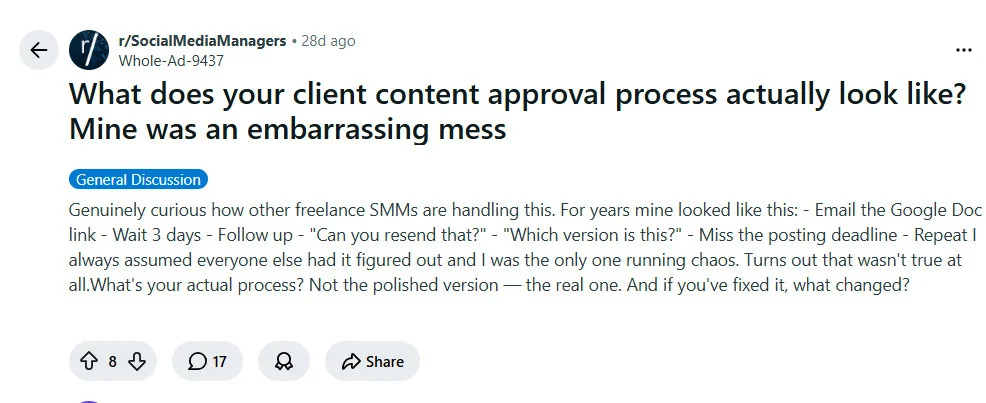
The phenomenon is widespread. You see it on Reddit threads across r/SocialMediaManagers and r/freelance: teams that have meticulously crafted content, polished graphics, and perfectly timed hashtags sitting in a digital purgatory, waiting for a single “Approved” signal from a person who is unreachable.
When this happens, the consequences are swift and compounding. Campaigns designed for high-impact industry events miss their window. Content queues, intended to maintain a brand’s presence over long weekends, remain untouched, leaving social feeds eerily silent while competitors seize the digital real estate. Clients, understandably, begin to question the value of their retainer when their brand presence vanishes without warning.
As one frustrated agency manager noted on social media, the frustration isn’t just about the delay—it’s about the helplessness. The team is ready to execute, but the infrastructure prevents them from moving forward.
Chronology of a Bottleneck: From Startup Best Practice to Operational Trap
To understand how agencies end up in this state, we must look at the lifecycle of a typical agency workflow.
The Origin: The "Founder-Led" Phase
In the early days of an agency, the single-approver model is a logical necessity. The founder or lead strategist possesses the brand’s voice, the client’s nuances, and the strategic vision. It is efficient for them to approve every post. Quality control is high because the "quality controller" is the person who sold the account.
The Growth Phase: The "Hidden Debt"
As the agency scales, it takes on more clients. The team grows, but the approval habit remains static. The agency owner or the client’s primary marketing contact continues to be the sole gatekeeper. By the time the agency is managing eight to ten clients, the workflow has become a massive, invisible technical debt. Nobody builds a backup because, until now, the system hasn’t broken.

The Breaking Point: The "Absentee" Trigger
Eventually, the inevitable happens: a key stakeholder takes a leave of absence, faces a family emergency, or simply gets overwhelmed. Because no contingency was built into the workflow, the entire downstream process freezes. The copywriter, the designer, and the social media manager all stop dead in their tracks, waiting for the signal that never comes.
Supporting Data: The High Cost of Stagnation
The impact of these bottlenecks is not merely anecdotal; it is statistically significant and damaging to the bottom line.
According to data from Gleanster and Kapost, a staggering 92% of marketers identify approval delays as the primary culprit behind missed deadlines. This isn’t a minor inconvenience; it is the single most common failure point in the creative lifecycle.
Further research from the Content Marketing Institute (2025) indicates that 47% of B2B marketers categorize workflow and approval management as a major operational bottleneck. When nearly half of an industry identifies a single administrative hurdle as their greatest challenge, it is clear that the industry-wide approach to governance is flawed.
The financial and operational leakage is further corroborated by Ziflow’s 2023 State of Creative Workflow Report, which found that 65% of marketers lose more than one full day of work every single week simply chasing feedback. That is 52 days of lost productivity per year, per employee—a massive hidden tax on agency profitability.
Official Perspectives: The Shift Toward Distributed Governance
The agencies that have successfully navigated this challenge have moved away from the "Hero Model" of approval. Industry leaders are increasingly adopting decentralized approval frameworks to ensure business continuity.
The Three Pillars of Resilient Workflows
Leading agencies have standardized their operations around three specific changes:
- Mandated Redundancy: Backup approvers are no longer an afterthought; they are a contractual requirement. Every client agreement now includes a designated secondary contact with equivalent authority and system access.
- Explicit Coverage Policies: Rather than relying on verbal assumptions, top-tier agencies utilize written policies. These documents define exactly when a backup steps in, what the protocol is for emergencies, and the timeline for escalation.
- Tool-Integrated Governance: The most effective agencies have moved away from email-based or manual approval chains. They leverage platforms like SocialPilot, which allow for collaborative, multi-user approval queues.
Why Tooling Matters
The technology layer is often the last piece to be addressed, yet it is the most critical. Modern platforms now offer features like "Shareable Approval Links," which allow clients to review and approve content without needing a complex login process. Furthermore, features like Auto-Approve allow agencies to pre-set guardrails, ensuring that if a client fails to provide feedback within a predetermined window, the content is still published to maintain consistency.
Implications: Moving from "We’ll Figure It Out" to "Systemized Success"
The implications of failing to fix a single-approver bottleneck are severe. It turns every absence into an emergency, placing immense psychological and operational strain on the team.
The "Emergency" Culture
When one person’s absence causes a crisis, the agency culture shifts from proactive to reactive. Team members are constantly "chasing" approvals rather than focusing on high-value strategy or creative innovation. This is not sustainable. At five clients, it is an annoyance; at fifteen clients, it is a business-breaking liability.
The Path Forward: A Self-Audit
Agency owners must ask themselves the hard questions. If you were unreachable for 48 hours, would your clients’ content still go live? Do your contracts reflect the reality of modern, distributed work? If the answer is "no," the next content blackout isn’t a possibility—it’s a mathematical certainty.
The fix, while simple in concept, requires immediate action. It requires the removal of the single-point dependency. By naming backups, writing clear policies, and ensuring that the technology stack supports decentralized workflows, agencies can transform their operations from fragile to antifragile.
The next time an approver is out of the office, your team shouldn’t be scrambling for answers. They should be executing the plan you’ve already put in place. In a competitive market, the agency that can maintain momentum while others are waiting for a green light is the agency that wins.
Don’t wait for the next absence to discover your weaknesses. The infrastructure you build today is the only thing that will keep your agency moving tomorrow.











No comments yet. Be the first to join the conversation!