

For decades, the automotive industry operated as a rigid, linear assembly line of ideas. Engineering was a relay race: a design was drafted, handed off to aerodynamics, then to structural engineering, and finally to manufacturing. If the structural team found a flaw in the aerodynamicist’s vision, the "baton" was passed back, creating a cycle of delays that could stretch a vehicle’s development time into years of expensive, manual labor.
Today, General Motors is fundamentally dismantling this workflow. Under the leadership of Chief Product Officer Sterling Anderson—formerly a key figure at Tesla and co-founder of the autonomous driving startup Aurora—GM is entering what executives describe as the "third epoch" of engineering. By leveraging high-fidelity digital twins, artificial intelligence, and probabilistic modeling, the company is compressing processes that once took 15 hours into a single minute.
The Chronology of Engineering Evolution
To understand the scale of this shift, one must look at the history of how humans build complex machines.
The First Epoch: Empirical Guess-and-Check
The earliest days of mechanical engineering were defined by imitation. As Anderson notes, engineers looked at the natural world—birds, for example—and attempted to replicate their form. This era was characterized by "empirical iterative design." If a prototype failed, engineers would tweak a component, re-test, and repeat. It was a slow, expensive process of trial and error that yielded only marginally feasible results.
The Second Epoch: The Rise of Virtualization
The late 20th century introduced computers into the design suite. Specialized tools like Computational Fluid Dynamics (CFD) allowed aero-engineers to simulate airflow, while Finite Element Analysis (FEA) gave structural engineers the ability to test durability without building every iteration in steel.
However, this period suffered from "siloed" development. While computers made the work faster, the workflow remained fragmented. Design, aero, and structure were still independent islands, and the integration of these systems often happened far too late in the development cycle.
The Third Epoch: The Probabilistic Collapse
We are now in the third epoch. GM’s current strategy involves the "collapse" of these disparate functions into a single, unified, and largely probabilistic framework. By utilizing machine learning, engineers no longer have to wait for a simulation to solve complex physics equations from scratch. Instead, the AI predicts the outcome based on a massive dataset of previous simulations, providing near-instant feedback that allows for rapid, parallel iteration.
Supporting Data: From Hours to Seconds
The transition from traditional simulation to AI-accelerated modeling has produced staggering efficiency gains. According to internal data provided by GM, FEA runs that previously required 15 hours of heavy-duty computing time are now being completed in approximately 60 seconds.
This is not merely a matter of convenience or improved work-life balance for the engineering staff. The exponential increase in speed changes the nature of the work. When a simulation takes 15 hours, an engineer is incentivized to run one or two variations to ensure the design passes muster. When a simulation takes one minute, that same engineer can run hundreds or even thousands of variations, exploring the outer edges of the design space to find the optimal balance between weight, strength, safety, and performance.
This "probabilistic" approach allows for:
- Massive Design Exploration: Running thousands of "Design of Experiments" (DOE) to observe how control logic reacts to varying physical parameters.
- Simultaneous Optimization: Balancing multiple conflicting factors—such as HVAC airflow, refrigerant behavior, and cabin acoustics—simultaneously rather than sequentially.
- Real-World Hardening: Digital models can be subjected to a vast array of simulated road conditions, environmental variables, and emergency maneuvers, ensuring the vehicle is "hardened" against real-world chaos before a single physical part is manufactured.
Official Perspectives: Inside the Virtual Integration Lab
Jason Fischer, the executive director of virtual integration engineering at General Motors, views these tools as a competitive necessity. "We’re not using virtual tools just to check our work after we’ve done vehicle design," Fischer explains. "We’re actually giving our engineers a virtual environment where they can simultaneously optimize the hardware and the software."
A critical component of this evolution is the technology transfer between GM’s consumer vehicle division and its high-stakes motorsports programs. Because NASCAR and Formula One teams operate under extreme time pressure, they are often the first to develop or adopt cutting-edge simulation techniques.
"The beauty of these virtual tools is our collaboration with our motorsports team," Fischer notes. "We co-develop a lot of these tools together… and we have a monthly technology transfer to ensure that we’re all seeing the latest and greatest technology."
This cross-pollination means that a technique used to shave milliseconds off a race car’s lap time might, within weeks, be applied to optimizing the efficiency of a battery cooling system for a consumer EV.
Driving Before Building: The New Validation Paradigm
Perhaps the most impressive application of this technology is the "virtualization of the vehicle" for safety and performance testing. In the past, to test if a car’s software could handle an emergency swerve, engineers had to connect physical Electronic Control Units (ECUs) and sensors to a test bench, often leading to "integration hell" where components failed to communicate correctly.
Today, GM builds a complete virtual model of the car’s electronics. By modeling the sensors, the domain controllers, and the software stack, they can perform "Consumer Reports-style" avoidance tests entirely in the digital realm.
Crash Safety and Structural Integrity
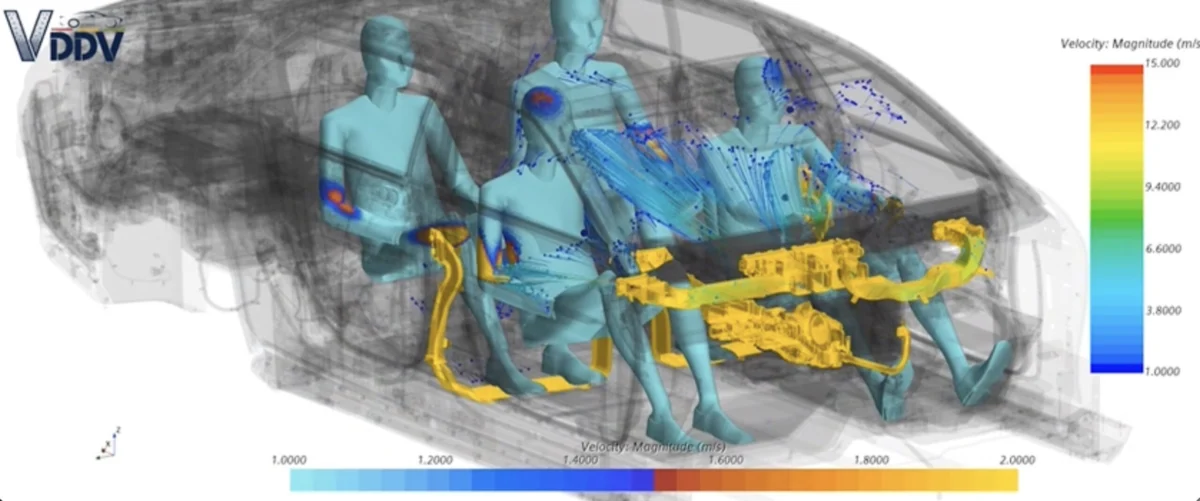
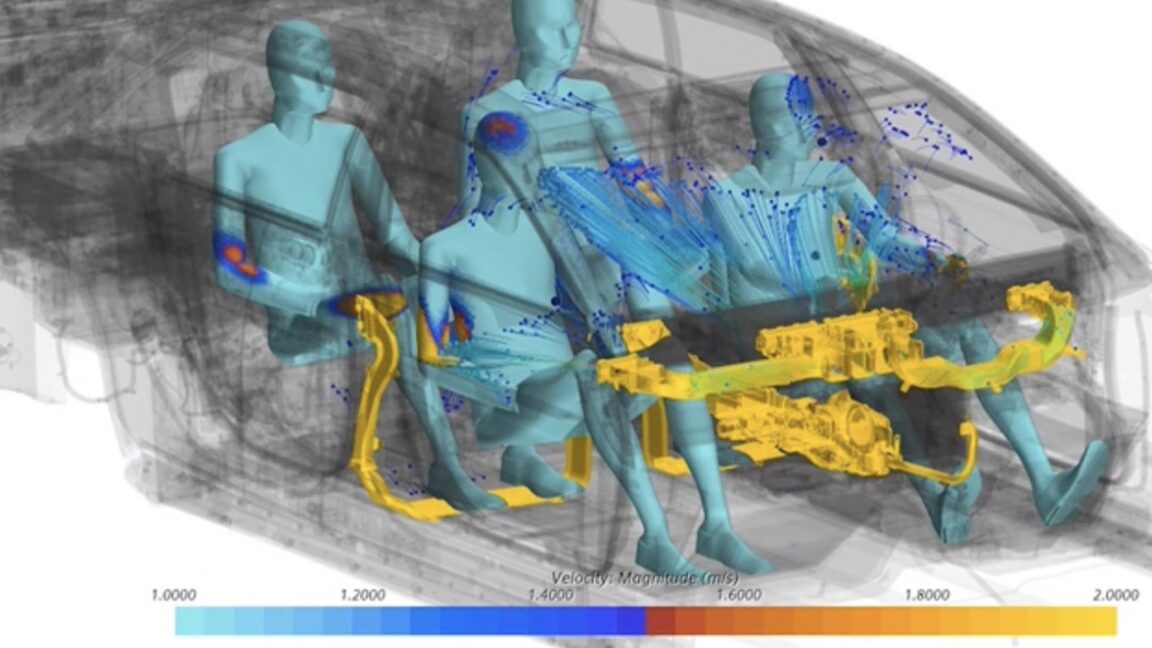
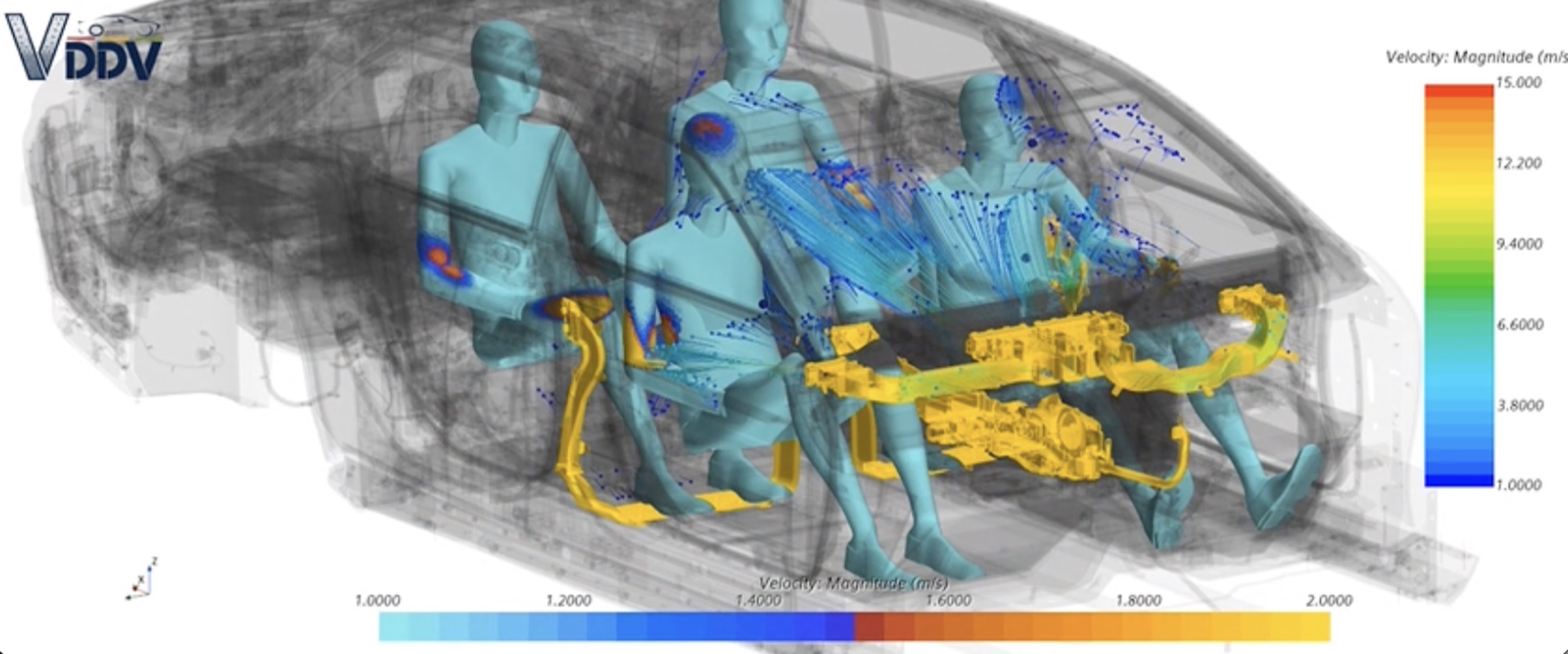
Crash performance is no longer a game of "build, crash, analyze, repeat." Engineers can now identify structural weak points in the digital twin and reinforce them long before a physical prototype is sent into a barrier at 40 mph. Because the simulation time has dropped from 18 hours to less than a minute, the safety team can iterate on structural designs in real-time, leading to safer vehicles that are also lighter and more efficient.
Digital Twins in Manufacturing
The ripple effects of this technology extend beyond the car itself and into the factory. Before a new assembly line is installed, GM creates a digital twin of the entire facility. This allows them to "run" the factory digitally, identifying potential bottlenecks, safety hazards, or equipment failures before a single bolt is tightened in the real world.

The Broader Implications
The shift toward AI-driven simulation signals a profound change in the automotive talent landscape. The "mechanical engineer" of tomorrow is increasingly becoming a "systems architect" who understands how to steer large-scale probabilistic models.
For the industry, the implications are clear:
- Reduced Time-to-Market: The ability to collapse development cycles will allow automakers to respond to changing consumer tastes and regulatory shifts with unprecedented speed.
- Higher Quality: By testing thousands of scenarios that would be too expensive or dangerous to perform physically, vehicles will be inherently more robust and better-optimized.
- Sustainability: Faster, more accurate simulations reduce the need for physical prototypes, saving vast amounts of raw materials and energy that would otherwise be wasted on vehicles destined for the scrap heap.
As General Motors continues to integrate these AI-driven workflows across its diverse portfolio—from defense and energy to the lunar rover program—the "third epoch" of engineering promises to be the most transformative in the history of the automobile. The days of the "guess-and-check" prototype are fading, replaced by a world where the car is born, tested, and perfected in the digital ether before it ever touches the pavement.












No comments yet. Be the first to join the conversation!