“It’s not that we have a short time to live, but that we waste much of it.” These words, etched into papyrus by the Stoic philosopher Lucius Seneca around 49 A.D. in his seminal essay De Brevitate Vitae (“On the Shortness of Life”), remain as poignant today as they were in the Roman Empire. Nearly two millennia later, this fundamental inquiry—how one should spend the finite currency of existence—forms the conceptual bedrock of a striking new exhibition by Cameroonian artist Marc Padeu.
Titled Memento Vivere (Latin for “remember to live”), Padeu’s latest suite of works debuts on July 17 at London’s Larkin Durey gallery, running through August 14. Through his signature blend of contemporary daily life and Renaissance-inspired religious iconography, Padeu invites viewers to reconsider the ephemeral nature of time and the profound weight of the present moment.
The Intersection of Tradition and Contemporary Reality
Marc Padeu has cultivated a distinct artistic language, one that effortlessly bridges the gap between the monumental grandeur of Western art history and the lived experiences of the people in his native Cameroon. His canvases are not mere depictions of reality; they are complex, layered narratives that often evoke the visual vocabulary of the Renaissance.

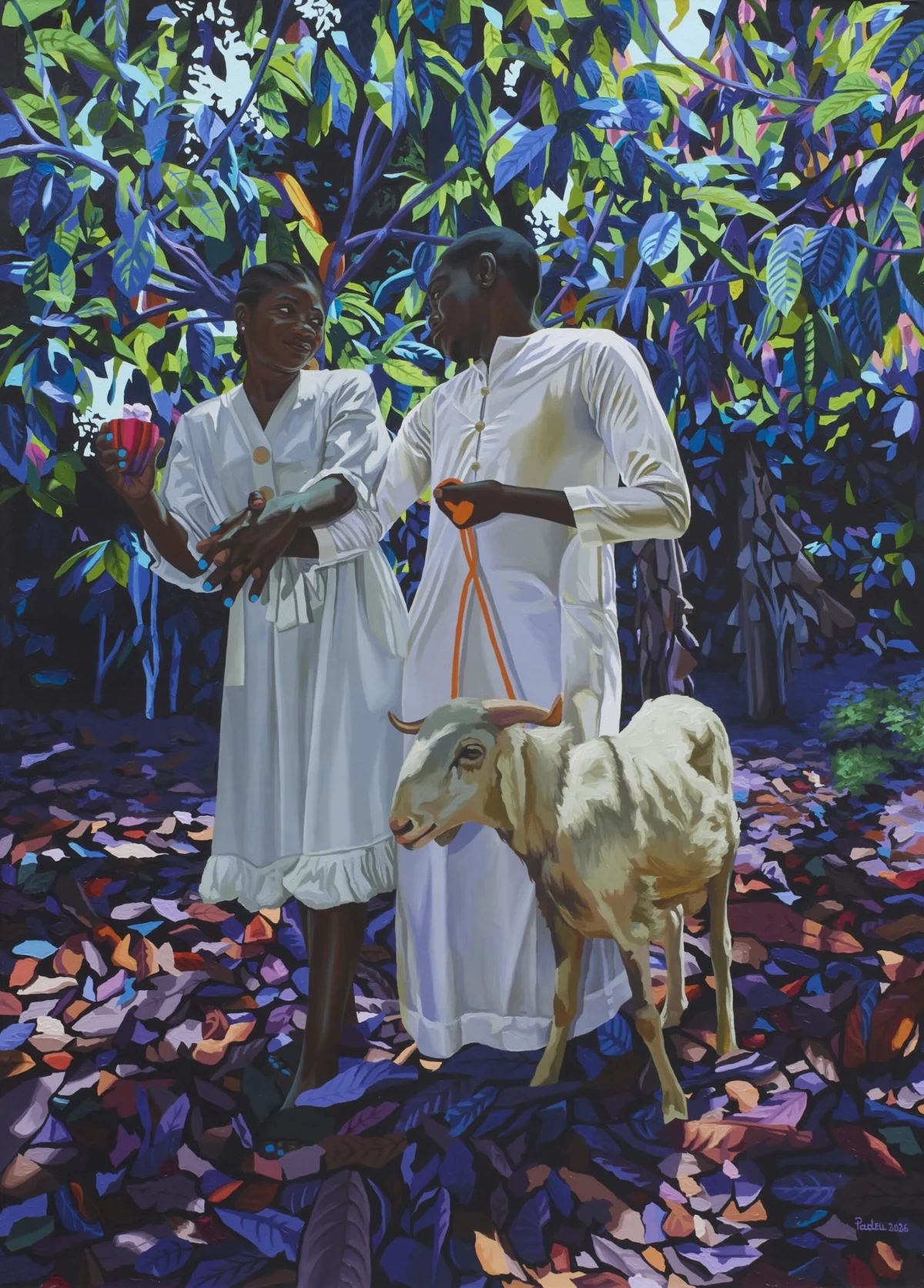
In his latest work, La promesse et l’agneau (“The promise and the lamb”), Padeu leans heavily into this dialogue. The composition features a young child cradled on his mother’s lap, surrounded by figures bearing gifts. The arrangement is a deliberate nod to the "Adoration of the Magi," a classic motif in Christian art. Yet, the setting is not a mythical Bethlehem; it is anchored in the reality of the communities working the cocoa plantations of Cameroon.
By transposing these sacred archetypes onto the bodies of contemporary laborers, Padeu strips away the distance typically afforded to "high art." He transforms the mundane act of labor into a scene of divine potential, suggesting that the sanctity of human existence is not reserved for saints of old, but is embedded in the everyday lives of the present.
A Chronology of Philosophical Inquiry
The evolution of Padeu’s work can be viewed as a chronological progression of his engagement with the human condition:

- Early Period: Padeu focused primarily on the technical mastery of figurative painting, exploring local landscapes and the textures of rural life in Cameroon.
- Intermediate Development: The artist began to integrate classical Western composition techniques, often referencing the masters of the Italian and Northern Renaissance. This period saw a rise in the thematic focus on communal interaction and the dignity of manual labor.
- The Memento Vivere Era: With his latest exhibition, Padeu has reached a synthesis of his previous interests. By centering his work on the philosophy of time—specifically the tension between memento mori (remember you will die) and memento vivere (remember to live)—he has shifted from observational painting to philosophical commentary.
Philosophical Foundations: The Weight of Mortality
To understand Memento Vivere, one must understand the shift it proposes. For centuries, the art world has been dominated by the memento mori tradition—works featuring skulls, wilting flowers, or hourglasses designed to remind the viewer of their inevitable end. The implication is often that wealth, vanity, and earthly pursuits are ultimately hollow.
Padeu’s Memento Vivere acts as an antithesis or a necessary corrective. Rather than focusing on the inevitability of death to induce humility, Padeu focuses on the necessity of living to induce agency. His works argue that because life is short, the pursuit of the "real"—family, nature, craft, and connection—is not just an option, but a moral imperative.
This is best captured in the visual weight of his subjects. Whether it is the quiet, knowing glances shared in Le chemin partagé or the raw, tactile reality of men skinning a rabbit in La prix de la promesse, the figures are painted with a sense of being "poised between promise and fate." They are neither entirely secular nor entirely spiritual; they exist in the liminal space where the divine meets the dust of the cocoa fields.

Supporting Data and Artistic Intent
The gallery notes provided by Larkin Durey provide critical context for the exhibition’s curation. Padeu’s subjects are largely drawn from the agrarian communities of Cameroon. The gallery observes: "Days follow one another, harvests come round again and yet, despite this ebb and flow of life, his figures are caught outside of time, slipping between past, present and future."
This "slippage" is a calculated aesthetic choice. By utilizing acrylic on large-scale canvases—such as the massive 66 7/8 x 78 3/4 inch Sous le poids de la coupe—Padeu forces the viewer to confront the figures at a scale that demands attention. The technical execution, which favors shadow and light reminiscent of Caravaggio or Rembrandt, creates a sense of the "mysterious sublime."
When one examines the detail in works like the titular Memento vivere, the texture of the leaves and the positioning of the body lying amidst the harvest suggest an artist deeply concerned with the physical reality of the earth. The "weight" is literal and metaphorical—the weight of the labor, the weight of the harvest, and the weight of the time that passes while one is occupied with the survival of the body.

Official Perspectives and Critical Implications
Larkin Durey’s decision to showcase Padeu’s work highlights a growing interest in contemporary African artists who are redefining the boundaries of the "Classical" canon. By bringing Memento Vivere to London, the gallery is positioning Padeu not just as a regional talent, but as a global voice in the ongoing dialogue regarding humanism.
The implications of this exhibition are manifold:
- Reclaiming the Narrative: By utilizing the "Adoration" or "Nativity" tropes to center Black bodies, Padeu is engaging in a quiet but powerful reclamation of religious and art-historical space. He asserts that the narratives of sacrifice, birth, and promise are universal.
- The Ethics of Observation: Padeu challenges the viewer to move past the voyeurism often associated with painting portraits of laborers. His figures look back; they occupy their space with a "growing awareness that life is a fragile gift." They are not passive subjects of a gaze, but active participants in their own existence.
- A Critique of Modernity: In an era defined by hyper-connectivity and the rapid acceleration of time, Padeu’s slow, deliberate approach to the canvas serves as a form of protest. He invites the viewer to stop, to look, and to remember to live—a radical act in a culture that incentivizes constant productivity and distraction.
Conclusion: The Fragile Gift
As the exhibition opens on July 17, it serves as a timely reminder of the fragility of the human experience. Marc Padeu’s work does not offer easy answers to the question of how to live. Instead, it offers a mirror. By viewing his paintings of the cocoa plantations, the moments of rest, and the moments of struggle, the audience is forced to reconcile their own relationship with time.

Seneca’s warning remains true: we do not have a short time to live, but we waste much of it. Padeu’s Memento Vivere is a plea to stop the waste. It is a testament to the idea that even in the shadow of the inevitable, there is a profound, pulsating vitality to be found in the present. Whether through the humble act of sharing a meal or the quiet dignity of a day’s work, Padeu suggests that the "promise" mentioned in his titles is not something that arrives in the future—it is something that is being lived, right now, in the light and the shade of our own lives.
For those in London, the exhibition at Larkin Durey will be a mandatory stop for anyone interested in the intersection of philosophy and fine art. For the rest of the world, Padeu’s ongoing documentation of his process via his social media platforms serves as a digital extension of his canvas—a continuous, evolving exploration of the "remember to live" philosophy.