

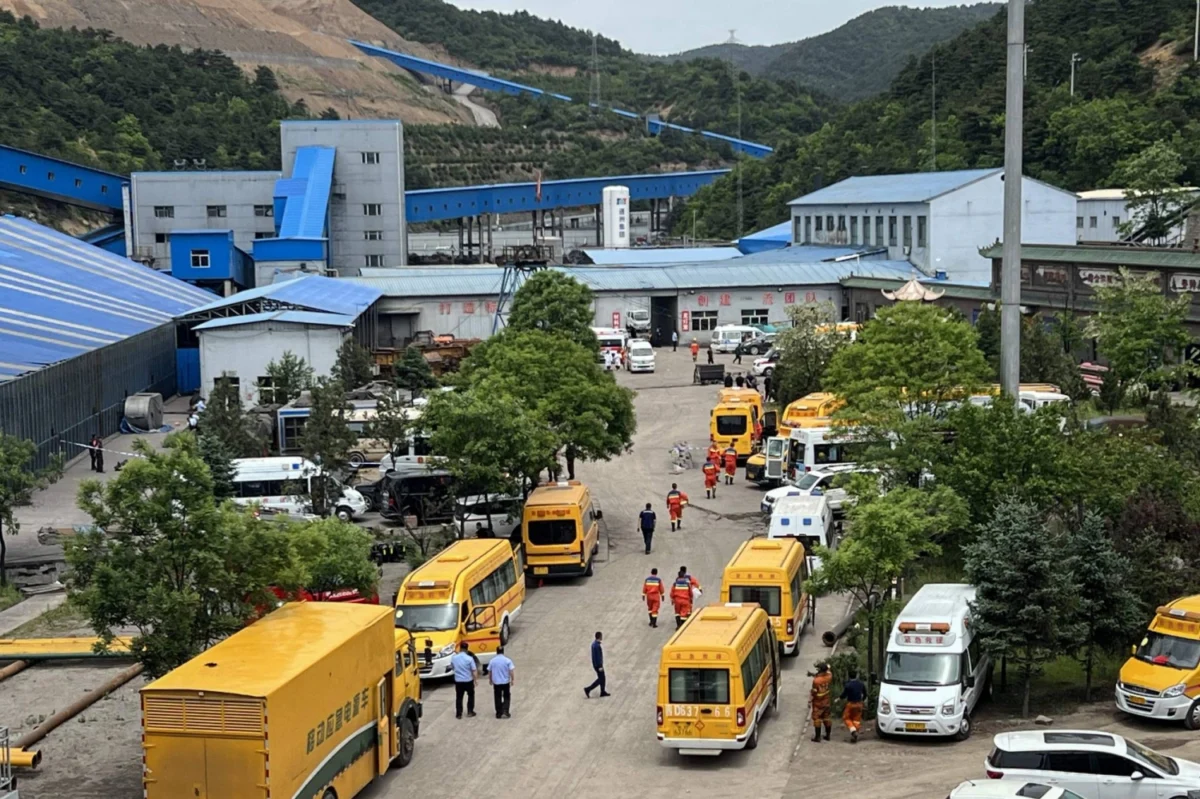
BEIJING – A catastrophic gas explosion at the Liushenyu coal mine in northern China’s Shanxi province has left at least 90 people dead, marking the nation’s deadliest mining accident in 17 years. The disaster, which unfolded in the heart of China’s coal-producing industrial belt, has sent shockwaves through the country, prompting a massive state-led rescue operation and renewed scrutiny over safety protocols in a sector that remains vital to the national economy.
The Disaster: A Night of Chaos in Shanxi
The explosion occurred at 7:29 p.m. on Friday, catching the night shift entirely off guard. According to reports from the official Xinhua News Agency, 247 workers were deep underground at the Liushenyu facility when the blast tore through the mine shafts.
The sheer scale of the incident became apparent within hours as emergency responders and rescue teams converged on the site. State broadcaster CCTV confirmed that by Saturday morning, 90 miners had been declared dead. Another 123 workers were evacuated and transported to local hospitals. Of those hospitalized, medical authorities report that at least four individuals remain in critical or severe condition, their survival hanging in the balance as teams of specialists work to manage complex blast-related trauma.
The Liushenyu mine, situated in the resource-rich province of Shanxi, serves as a primary hub for thermal coal production. Following the explosion, the surrounding area was cordoned off as emergency vehicles flooded the site, and specialized ventilation teams were deployed to clear the shafts of residual toxic gases that often follow such combustion events.
Chronology of the Incident
- Friday, 7:29 p.m.: A subterranean gas explosion occurs at the Liushenyu coal mine in Shanxi province. At this time, 247 workers are operating in the mine shafts.
- Friday, 9:00 p.m. – Midnight: Emergency sirens are sounded across the region. Local rescue units are mobilized, and the first responders reach the pithead to assess the extent of the damage.
- Saturday, Early Morning: The scale of the disaster is confirmed. CCTV and Xinhua report the preliminary death toll of 90, with over 100 injured.
- Saturday, Mid-Morning: High-level provincial officials arrive at the site to oversee rescue operations. The focus shifts from potential survivors to recovery and the stabilization of the mine’s structure.
- Saturday, Afternoon: The Ministry of Emergency Management issues a directive for all mines in the region to pause operations for safety inspections, signaling the beginning of a nationwide investigation.
Supporting Data: A History of Mining Risks
To understand the severity of the Liushenyu disaster, one must look at the historical context of China’s mining sector. While China has made significant strides in improving safety standards over the past two decades, coal remains the cornerstone of its energy grid, providing the power for its massive manufacturing sector.
For years, the Chinese coal industry was plagued by thousands of deaths annually, often the result of small, illegal, or poorly regulated "backyard" mines. In the early 2000s, it was common for the annual death toll to exceed 5,000. However, rigorous government crackdowns, the closure of thousands of unlicensed pits, and the modernization of industrial safety technology had significantly lowered these figures.
This incident is particularly jarring because it reverses a long-term trend of declining fatalities. A death toll of 90 in a single event is a figure unseen since the mid-2000s, serving as a stark reminder that even within modern, large-scale facilities, the inherent dangers of methane buildup and coal dust volatility remain ever-present.
Official Responses and Accountability
The Chinese central government reacted with immediate urgency. President Xi Jinping and Premier Li Qiang issued directives calling for an "all-out effort" to treat the injured and to conduct a thorough investigation into the cause of the blast.
"We must spare no effort in the search and rescue work," the state directive emphasized. "The cause of the accident must be identified as soon as possible, and those responsible for negligence or failure to adhere to safety regulations must be held accountable in accordance with the law."

Provincial authorities in Shanxi have already detained several mine executives and safety officers as part of an ongoing criminal inquiry. Preliminary investigations are currently focusing on whether methane monitoring systems were fully operational or if safety protocols—such as the required evacuation of workers during gas-level spikes—were ignored to maintain production quotas.
Industry experts suggest that gas explosions are almost always the result of a "chain of failures." These include the malfunctioning of sensors, poor ventilation design, or the presence of an ignition source—such as non-explosion-proof electrical equipment—in a restricted, methane-rich environment.
Implications for China’s Energy Sector
The disaster at Liushenyu carries profound implications for China’s industrial strategy.
1. Increased Regulatory Pressure
The immediate impact will be a "safety sweep" across all coal mines in Shanxi and surrounding provinces. Historically, after such a high-profile incident, the Ministry of Emergency Management mandates a temporary shutdown of all mines in the vicinity to conduct manual inspections. This could lead to a short-term contraction in coal supply, potentially affecting regional energy prices.
2. The Technological Divide
The accident will likely accelerate the transition toward "smart mines." The Chinese government has been pushing for the implementation of automated, unmanned mining technology in high-risk zones. By replacing human workers with robotics and remote-control machinery in the most dangerous shafts, the government hopes to decouple production volume from the risk of human loss.
3. Public Sentiment and Transparency
In the era of social media, the speed at which news of the disaster spread has forced state media to be more transparent than in past decades. Public discourse on platforms like Weibo has been dominated by calls for stricter corporate accountability and better compensation for the victims’ families. The government’s ability to conduct a transparent and swift investigation will be a test of its credibility among a public that is increasingly sensitive to issues of worker welfare and corporate negligence.
Conclusion: A Nation in Mourning
As the recovery phase concludes, the attention will shift to the long-term impact on the families of the deceased. In Shanxi, the coal mining industry is not just a source of economic output; it is the lifeblood of the community. Entire towns often revolve around the operation of these facilities. The loss of 90 lives represents not only a failure of engineering and management but a profound social loss that will be felt in these communities for years to come.
The Liushenyu mine disaster serves as a sobering wake-up call. It demonstrates that as China continues to chase ambitious economic goals, the basic human cost of resource extraction remains a volatile and dangerous equation. The coming weeks of investigation will be critical in determining whether this was a singular failure of protocol or a systemic issue that requires a fundamental overhaul of China’s safety culture in the mines.
For now, the focus remains on the grieving families and the survivors struggling to recover from the physical and psychological scars of the night of May 23. The tragedy has cast a long shadow, reminding the world that beneath the surface of China’s modern industrial might, the dangers of the coal face remain as lethal as ever.











No comments yet. Be the first to join the conversation!