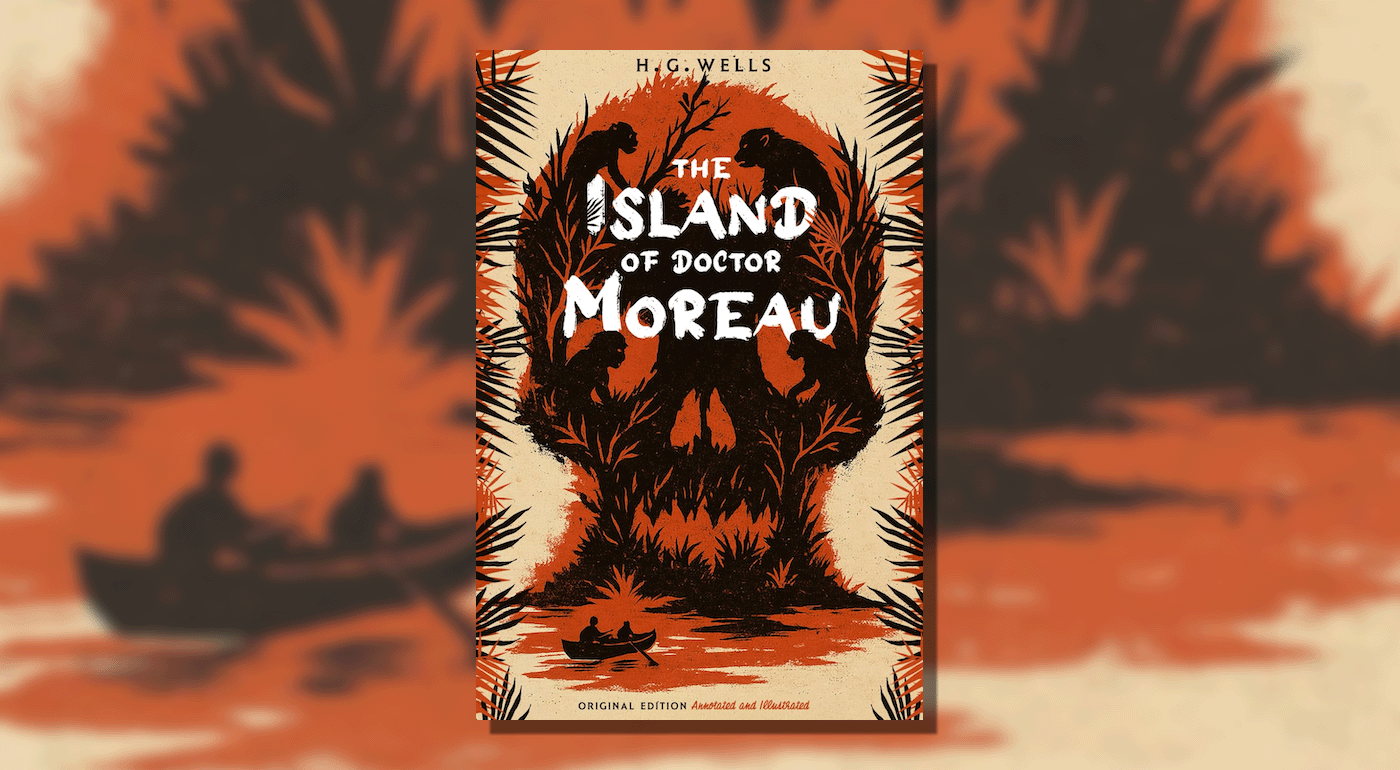
Welcome back to "Reading the Weird," our ongoing examination of the architecture of cosmic horror, weird fiction, and the seminal works of H.G. Wells. This week, we peel back the layers of the island’s central mystery, dissecting Chapters 7 through 9 of Wells’ 1896 masterpiece, The Island of Doctor Moreau. As our protagonist, Prendick, finds his footing in a world where the boundary between man and beast is not just blurred but violently erased, we explore the historical anxieties of vivisection and the cold, amoral pursuit of scientific "progress."
The Main Facts: An Unwelcome Guest in a House of Secrets
In Chapters 7 through 9, the narrative tension shifts from the survival-based desperation of the sea to the claustrophobic dread of the enclosure. Prendick, having arrived on the island, is treated with immediate, suspicious hostility by his hosts—Montgomery and the elusive, white-haired man.
The primary conflict is established through the "locked door." Prendick is relegated to a room within the outer wall, denied access to the inner sanctum where the real work occurs. The atmosphere is thick with "indefinable queerness." The islanders display furtive, unnatural behaviors that defy the norms of "unsophisticated savages," and the presence of pointed, brown-furred ears on Montgomery’s assistant serves as the catalyst for Prendick’s horrific realization: he is not among humans, but among the results of a grotesque experiment in vivisection.
Chronology of Disquiet
Chapter VII: The Locked Door
Prendick’s arrival at the stone enclosure is marked by a palpable sense of unease. He is an intruder in a sanctuary of science gone wrong. The white-haired man, whom we later identify as Doctor Moreau, is eager to return to his "work." The decision to isolate Prendick in a barred room—furnished with a collection of surgical texts and classics—serves to keep him in the dark, yet the name "Moreau" triggers a dormant memory in the protagonist. He recalls a scandal involving a physiologist driven out of England by public outcry over the "Moreau Horrors," a series of experiments that flayed and mutilated sentient creatures in the name of inquiry.
Chapter VIII: The Crying of the Puma
The narrative heat rises as the wails of a tortured puma echo from the inner enclosure. This sound is not merely animal noise; it is an "exquisite expression of suffering" that forces Montgomery to confront his own complicity. When pressed by Prendick, Montgomery deflects, blaming his discomfort on the island’s isolation and, perhaps, the alcohol he consumes to numb the reality of his situation. The encounter ends abruptly as the agonizing cries of the beast drive Prendick to flee the enclosure and retreat into the forest.
Chapter IX: The Thing in the Forest
Driven by the desire to escape the haunting sounds of the puma, Prendick ventures into the island’s interior. Here, the horror becomes tangible. He encounters a "man" who drinks like an animal, scrambling on all fours. He discovers the remains of a decapitated rabbit—a sign of predatory, perhaps feral, activity. The climax of this section sees Prendick hunted by this "Thing," culminating in a desperate act of violence where he strikes his pursuer with a makeshift weapon. The chapter concludes with the irony of his return: he flees from the Thing only to find himself drawn back toward the very source of the nightmare: the enclosure and the voice of the doctor.
Supporting Data: The Historical Shadow of Emanuel Klein
To understand why The Island of Doctor Moreau continues to resonate with such chilling efficacy, one must look at the historical context of the 1870s anti-vivisection movement. As noted in the historical record, the real-world analog for Moreau is often debated, but the rhetoric of the character mirrors the infamous testimony of Dr. Emanuel Klein before the 1875 Royal Commission on Vivisection.
When asked by the Commission if he felt any regard for the suffering of animals during his pathological research, Klein replied with chilling brevity: "No regard at all."
This cold, utilitarian detachment—the belief that the experimenter has no time to contemplate the pain of the subject because the pursuit of knowledge is paramount—is the philosophical bedrock of Doctor Moreau. The historical transcripts of the 1875 Commission provide the perfect, terrifying script for Wells’ antagonist. While modern research ethics, governed by the Nuremberg Code and subsequent international regulations, demand that suffering be minimized and justified, Moreau operates in a vacuum of empathy. He is the personification of "science without conscience."
Official Responses: The Ethical Vacuum
The interactions within the enclosure reflect a deeply amoral definition of "sanity." Moreau’s insistence that the contents of his laboratory would not bother a "sane man" is a chilling rhetorical maneuver. He attempts to reframe the victim’s horror as a lack of intellectual robustness.
Montgomery, conversely, represents the "fallen" assistant. He is fully aware of the moral gravity of their actions, yet he is trapped by his own weakness and his dependence on the doctor. His attempt to normalize the presence of the creature with the pointed ears—claiming he "never noticed"—is a classic case of cognitive dissonance. He has lived in the presence of these "creatures" so long that he has successfully suppressed his human empathy to survive.
Implications: The Uncanny Valley of the Beast
The most disturbing implication of these chapters is the realization that the "Thing" stalking Prendick is not entirely different from the people around him. Prendick’s reaction—categorizing these beings through a lens of 19th-century essentialism—reveals as much about his own limitations as it does about the island. He views them through the lens of racialized biology, yet he is forced to confront the fact that they are, in some sense, "hoggish" or "beast-like."
The "pig-men" in the clearing, with their sloppy, guttural chanting, suggest a dark parody of religious or social ritual. It raises a haunting question: if these creatures have developed a language, a ritual, and a social structure, at what point does "creation" become "personhood"? Moreau, interestingly, does not seem to care about the ethology of his creations. He is interested in the process, not the result. He is a sculptor of flesh, not a father to his subjects.
The Mirror of Humanity
The "degenerate" nature of these subjects serves as a mirror for human society. Wells forces the reader to confront the possibility that "humanity" is not an inherent trait but a performance—one that can be undone by the scalpel. When Prendick strikes the creature in the forest, he is not just fighting for his life; he is fighting against the reality that his own nature might be just as easily stripped away.
Conclusion: A Legacy of "What If"
As we move forward in our reading of The Island of Doctor Moreau, we must keep in mind the fragility of the social contract. The island is not just a place of monsters; it is a laboratory for the dissolution of the human spirit.
Prendick’s isolation in the barred room, the surgical books on his shelf, and the cries of the puma all point to a singular, terrifying truth: the doctor is not building creatures; he is documenting the ease with which civilization can be dismantled. As we prepare to leave the enclosure and explore the deeper mysteries of the island in the coming chapters, we must ask ourselves: what does it mean to be "sane" in a world where the laws of nature are merely suggestions to be rewritten by the knife?
Next week, we step away from the shores of Moreau’s island to explore the peculiar, static beauty of Elmer’s Bottle Tree Ranch. Join us as we continue to track the intersections of the weird, the monstrous, and the deeply human.