

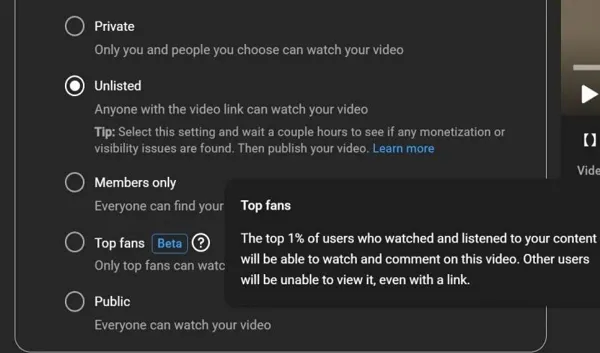
In an era where digital content consumption is shifting from broad, mass-market appeal toward intimate, community-driven experiences, YouTube is taking a bold step to redefine the relationship between artists and their most dedicated listeners. The platform has officially entered a beta testing phase for a new, highly exclusive publishing feature designed specifically for musicians, allowing them to gate content for the "top 1%" of their fanbase.
This development, first identified by TubeFilter and corroborated by community sightings on LinkedIn, marks a significant departure from YouTube’s historical reliance on the "broad reach" algorithm. By enabling artists to create a "walled garden" for their most loyal supporters, YouTube is signaling a commitment to deep-funnel monetization and retention over mere view counts.
The Mechanics of Exclusivity: How the "Top Fans" Feature Works
At its core, the new "Top Fans" publishing option is a distribution toggle that restricts access to specific videos or clips to only the most engaged 1% of a channel’s subscribers. Unlike standard private or unlisted videos, which can often be shared via link, this feature is built on an algorithmic identification system.
Precision Targeting
According to early reports and documentation surfaced by industry observers—most notably an example posted by Nate Curtiss on LinkedIn—the system is remarkably rigid. If a user does not fall within the designated top percentile of a creator’s audience based on watch time, comment frequency, and general interaction, they are barred from viewing the content. Crucially, the platform appears to enforce this strictly; even if a user manages to obtain a direct link to the content, the server will deny access if their profile does not meet the "top fan" criteria.
The Beta Landscape
Currently, the feature is in a controlled, limited beta. YouTube has restricted access to a curated group of musician channels. This strategic choice of "test subjects" is telling: musicians often have the most fervent, high-value fanbases, making them the perfect candidates to pilot a feature that relies on superfan engagement.
Chronology of the Development
The journey toward this exclusive feature did not happen overnight. It represents the culmination of a broader strategy shift within Google’s video division.
- Late 2023: YouTube began signaling a move toward deeper community tools during the annual "Made on YouTube" summit. Executives hinted at features that would reward loyalty rather than just clicks.
- Early 2024: Internal development began on the "Top Fans" distribution toggle, with engineers focusing on the data metrics required to define the "top 1%" accurately without alienating the broader subscriber base.
- May 2026 (Reported): Public awareness of the test grew significantly following the TubeFilter report. Social media platforms, particularly LinkedIn, saw an influx of screenshots from creators noticing the new toggle in their YouTube Studio interface.
- Present Day: The feature remains in the experimental phase. YouTube continues to gather data on how this exclusivity impacts creator-fan dynamics, watch time, and community sentiment.
Supporting Data: The Economics of the "Superfan"
Why is YouTube investing in a feature that inherently limits the reach of content? The answer lies in the evolving economics of the music industry.
The Pareto Principle in Digital Media
The "Top 1% of Fans" strategy is a textbook application of the Pareto Principle (the 80/20 rule), which suggests that a small minority of customers often generates the majority of revenue and engagement. For a musician with 1 million subscribers, the "top 1%" represents 10,000 highly motivated individuals. These are the people who buy concert tickets, purchase limited-edition vinyl, and advocate for the artist on social media.
Driving the Viral Loop
While the content is gated, the psychological effect on the fan is profound. Being designated as part of an elite "inner circle" creates a sense of prestige. Data suggests that these fans are significantly more likely to share information about upcoming releases on external platforms like X (formerly Twitter) or Discord. By giving the "inner circle" early access or exclusive content, YouTube is essentially outsourcing the marketing of an artist’s new release to the most effective promotional engine possible: the superfan.
Official Responses and Platform Strategy
The industry has been quick to look for guidance from YouTube’s leadership. Rene Ritchie, YouTube’s Head of Editorial, confirmed the existence and the lineage of the project in a response on LinkedIn.
Ritchie clarified that this is not an entirely new concept but rather the implementation of features discussed during "YouTube Connect." He noted that the primary objective is to empower creators to build deeper, more meaningful connections with their audience. The official stance from the platform is that this is a tool for rewarding loyalty, rather than a method for excluding casual fans.
However, industry analysts point out that this is also a defensive move. With the rise of platforms like Patreon, OnlyFans, and Substack, which allow creators to monetize their most dedicated followers directly, YouTube has felt the pressure to provide native tools that prevent "audience leakage" to third-party platforms.
Implications for the Creator Economy
The introduction of the Top Fans toggle carries significant implications for the future of digital content creation.
1. A Shift in Metrics
For years, the "Success" of a YouTube video was measured by raw views. If this feature sees widespread adoption, we may see a paradigm shift where "Engagement Density"—the quality and depth of interaction—becomes more valuable than total reach. Creators may begin to optimize for depth rather than breadth.
2. The Rise of "Exclusive Tiers"
If successful, this could evolve into a tiered subscription model within YouTube. We could potentially see features where creators can set custom thresholds—perhaps rewarding the top 5% or the top 10%—allowing for a more granular approach to fan management.
3. Challenges in Scalability
The biggest hurdle for the feature is the "significant audience" requirement. For a creator with only a few hundred subscribers, the "top 1%" is a statistically insignificant number (perhaps 1 or 2 people). The tool is inherently biased toward established artists and large channels. This may exacerbate the divide between mega-creators and emerging talent, as the former will have the tools to nurture a "super-community" while the latter will struggle to find enough data to populate their exclusive lists.
4. Community Friction
There is a potential downside regarding audience sentiment. While "exclusive" content can drive loyalty, it can also lead to resentment among the 99% who are left out. YouTube will need to carefully navigate how this feature is presented to ensure it feels like a "reward for the few" rather than a "punishment for the many."
Future Outlook: Will It Go Beyond Music?
While the current test is confined to music creators, the industry is already speculating on a broader rollout. Musicians are the logical first step, given the long-standing tradition of "fan clubs" and exclusive access in the music industry. However, the model could easily be adapted for:
- Gaming Channels: Providing early access to gameplay footage or private server invites for the top contributors.
- Educational Creators: Offering exclusive Q&A sessions or deeper-dive content for the most active learners.
- Vloggers/Personalities: Giving the core community a behind-the-scenes look at their lives before it goes to the public.
If YouTube decides to expand this, it will fundamentally change the creator-subscriber dynamic. The "subscriber" count may become less about how many people see your content and more about how many people are invested in your brand.
Conclusion: A Strategic Bet on Loyalty
YouTube’s experiment with the Top Fans publishing option is a sophisticated play to retain its status as the premier platform for creators. By acknowledging that the most valuable fans are not the ones who watch every video once, but the ones who interact consistently and advocate for the creator, YouTube is building a future where quality of engagement is the ultimate currency.
For the music industry, this could be a vital tool in the marketing mix. For the fans, it represents a new way to be seen and recognized by the artists they love. And for YouTube, it is a necessary evolution to keep the platform relevant in an increasingly fragmented social media landscape.
As we wait for further data from the beta phase, one thing is clear: the era of the "mass audience" is being supplemented by the era of the "loyal community." Whether this leads to a more vibrant ecosystem or a more exclusionary one remains to be seen, but the intent—to deepen the bond between creator and consumer—is a clear sign of where the future of the internet is headed.
Creators interested in the feature should monitor their YouTube Studio dashboards closely, as the rollout—though currently limited—is expected to expand in scope should the initial testing phase prove that "Top Fans" can indeed drive higher long-term retention and meaningful platform growth.










No comments yet. Be the first to join the conversation!