

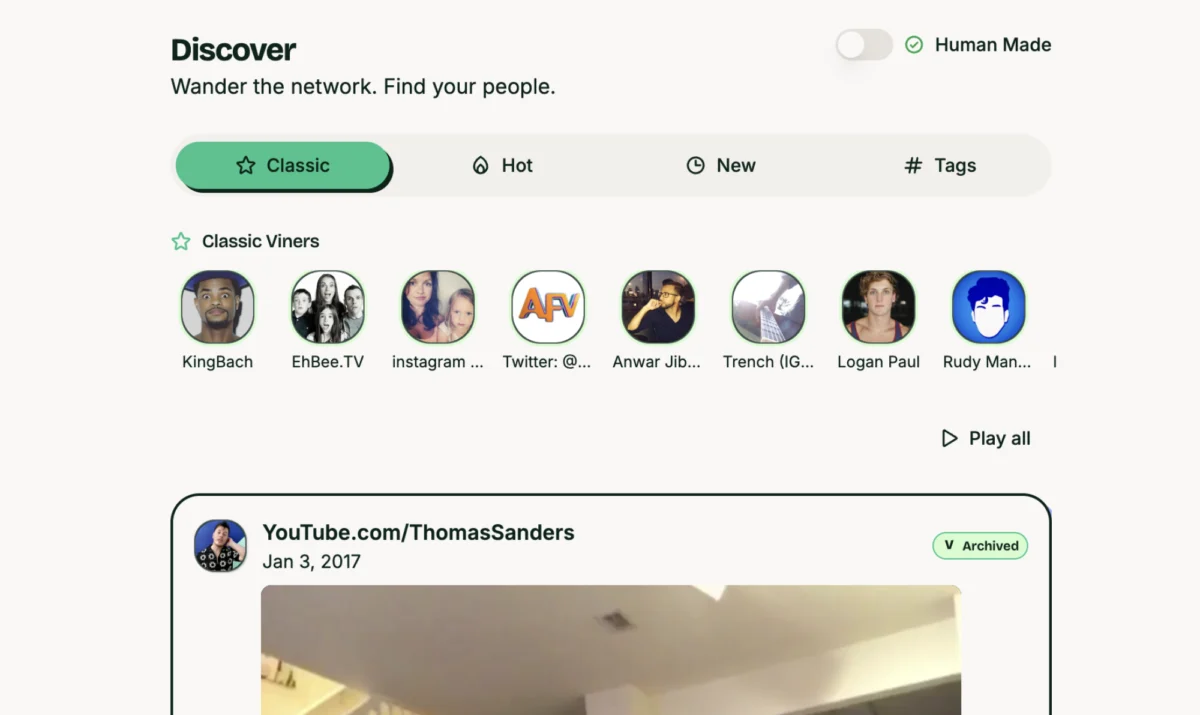
In the landscape of 2026, where the digital horizon is increasingly blurred by synthetic media and algorithmic homogeneity, a ghost from the early internet has returned to haunt the feed. Vine, the platform that defined the short-form video era before its abrupt shuttering nearly a decade ago, has been reborn. Rebranded as "Divine," the app is not merely a nostalgia play; it is a fundamental challenge to the current social media paradigm.
Ironically, the rebirth of the platform that Twitter—under the leadership of Jack Dorsey—killed in 2017 is now being financed by the very same man. Divine arrives as a sanctuary for creators, promising an oasis of human-centric content in a digital desert of "AI slop." As it steps into a market dominated by the gargantuan footprints of TikTok, Instagram Reels, and YouTube Shorts, Divine represents a bold, perhaps idealistic, bet that users are ready to trade mass-scale algorithmic consumption for authentic, human-verified connection.
The Genesis of Divine: A Chronology of a Comeback
To understand Divine, one must first look at the trajectory of its predecessor. Vine, which launched in 2013, was a cultural phenomenon. It limited users to six-second, looping videos, a constraint that forced a unique kind of creative ingenuity. It served as a launchpad for a generation of internet stars, including Logan Paul, King Bach, and Cameron Dallas, before Twitter abruptly discontinued the service in early 2017 to streamline its operations.
The path from the grave to the resurrection was not a straight line. The idea for a successor began to coalesce around the efforts of Evan Henshaw-Plath, the former Twitter engineer widely known in tech circles as "Rabble." Initially, Henshaw-Plath sought to build a digital mausoleum—a permanent, stable archive for the half-million videos that comprised the "OG" Vine library.
However, as the project gained momentum, it drew the attention of Jack Dorsey. Following his departure from Twitter and his subsequent shift toward decentralized, open-source web initiatives, Dorsey’s nonprofit organization, and Other Stuff, stepped in to provide the necessary capital to scale the project.
Following a low-profile test launch in November 2025, which served to stress-test the infrastructure and verify the preservation of the original archives, the platform officially opened its doors to the public in mid-2026. The transition from a nostalgic archive to a functional, competing social platform marked a pivot from preserving history to attempting to write the future of short-form video.
The War Against "AI Slop": A Human-First Mandate
The defining feature of Divine is not its technical capability, but its ideological constraint. In an era where generative AI can produce high-quality, synthetic video in seconds, the internet has become saturated with content that lacks a human soul. Divine has explicitly positioned itself against this tide, making "freedom from AI slop" a cornerstone of its mission.
The Verification Protocol
To ensure the integrity of the platform, Divine employs a multi-layered verification system. Unlike competitors that encourage users to generate content using integrated AI filters, Divine mandates that all new videos be recorded directly within the app or verified through a proprietary human-verification tool.
This tool is powered by the Guardian Project, a human-rights-focused nonprofit known for developing secure, open-source communication tools. By leveraging their expertise, Divine attempts to verify the provenance of a video file—ensuring it was captured by a camera lens held by a person, rather than synthesized by a server farm. While the system is not yet infallible, it represents the first major social network to treat "human-made" as a verified metadata attribute rather than an aesthetic choice.
The Economics of Ownership: Dorsey’s Redemptive Vision
Jack Dorsey’s involvement in Divine is not merely a financial endeavor; it is a public acknowledgment of the mistakes made during his tenure at Twitter. In his statements to The Guardian, Dorsey expressed a regret for the centralized nature of the platforms he once oversaw, specifically regarding the precarious relationship between creators and the platforms that host them.
"The core principle of Divine is that creators will always own their content and their followers," Dorsey stated. This is a direct jab at the current "platform-dependency" model, where creators spend years building an audience only to have their reach throttled by a sudden change in an algorithm.

Divine is designed with an open-source framework, allowing for portability. If a creator decides to leave the platform, they retain the rights to their library and the ability to export their follower list. Furthermore, the platform integrates direct-revenue models that allow creators to monetize their work through tips, subscriptions, and brand partnerships, bypassing the ad-tech middlemen that typically extract a massive cut of creator revenue.
A Market Dominated by Giants: The Competitive Landscape
Divine enters a field that is fundamentally different from the one Vine occupied in 2013. The current short-form video ecosystem is not just established; it is entrenched.
- TikTok: The incumbent king, which has perfected the "For You" algorithmic feed that captures billions of hours of attention.
- Instagram Reels: A powerful secondary player that leverages the massive, pre-existing social graphs of Meta users.
- YouTube Shorts: A behemoth that benefits from the deep pockets and infrastructure of Google, averaging over 200 billion daily views.
Against this backdrop, six seconds of human-made video seems like a quixotic proposition. Critics argue that the "human-only" constraint will limit the platform’s growth, as modern creators rely heavily on AI-assisted editing tools to produce content at scale. However, supporters of the app argue that the current landscape of "brainrot"—content designed specifically to keep users in a dissociative, scrolling loop—has created a market for something smaller, more intimate, and undeniably real.
Implications: Can Quality Win Over Quantity?
The success of Divine will serve as a bellwether for the future of the social web. If a platform can successfully capture a significant user base by sacrificing the explosive growth potential of AI-curated feeds in favor of manual, human-centric discovery, it could spark a broader movement toward "slow social media."
1. The Decentralization Trend
Divine is part of a growing ecosystem of platforms funded by and Other Stuff that prioritize decentralized control. If this model proves profitable, it could force legacy platforms to reconsider their data-hoarding practices and proprietary algorithms.
2. The Cultural Value of "Real"
The "human-made" filter isn’t just a gimmick; it’s a branding strategy. By creating a space where the user knows they are interacting with another human, Divine is attempting to build a higher level of trust than platforms like TikTok or X, where the distinction between real and bot is increasingly fluid.
3. The Future of Content Creation
For creators, the return of a platform that prioritizes their ownership over the platform’s control is a significant development. If Divine can provide a sustainable income, it may attract the "middle-class" of creators who are tired of being beholden to the whims of black-box algorithms.
Final Thoughts: The Loop Re-Opens
When users download Divine from the Google Play Store or the Apple App Store, they are met with a dual experience: a deep, nostalgic dive into the 500,000-video archive of the original Vine, and a clean, sparse interface for new content.
The app is a strange artifact for 2026—a product of the past, funded by a tech mogul’s remorse, built on the infrastructure of a human-rights organization, and designed for a future that is increasingly skeptical of the digital world. Whether Divine can compete with the algorithmic giants remains to be seen. But in a world where we are increasingly unsure if the person behind the screen is actually a person, the mere promise of "human-made" might be enough to sustain a community.
Vine was, in its original form, a momentary explosion of creativity that changed how we consume information. Divine, in its current iteration, aims to be something more enduring: a digital home where the humanity of the creator is the most valuable feature on the menu. In the race to the bottom of the engagement funnel, Divine is betting that the only way to win is to stop running.












No comments yet. Be the first to join the conversation!