

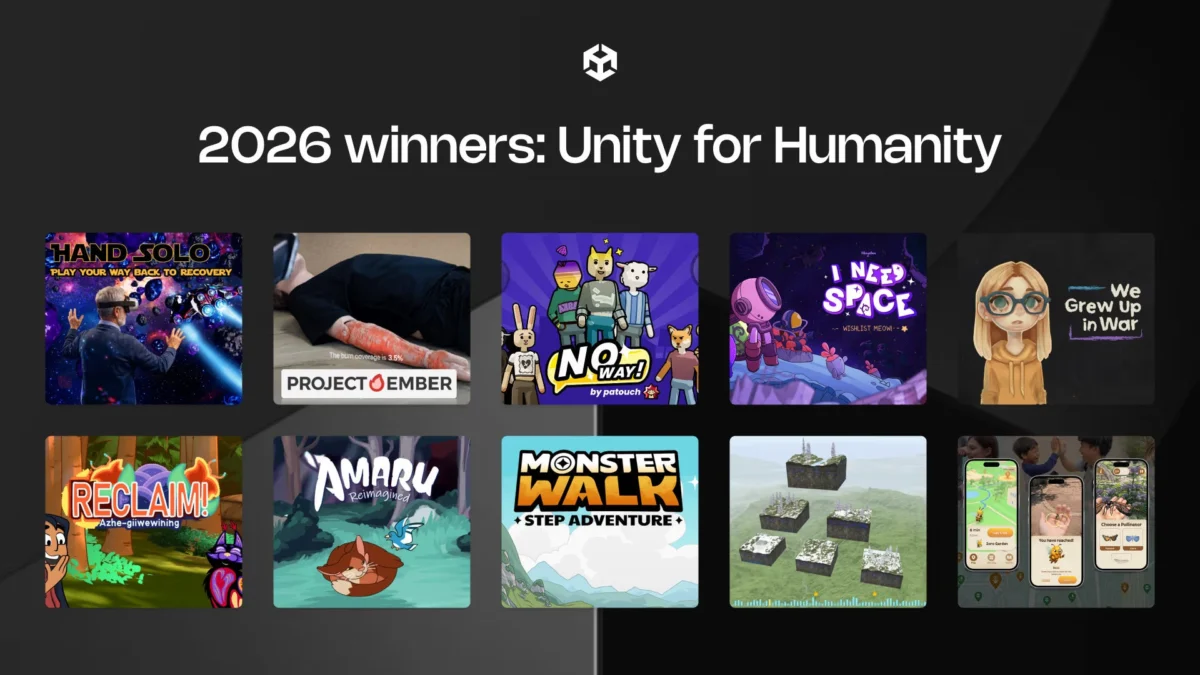
SAN FRANCISCO, CA – [Date] – Unity, the world’s leading platform for creating and operating real-time 3D (RT3D) content, has proudly announced the recipients of its highly anticipated 2026 Unity for Humanity Grant. This year’s cohort spotlights ten innovative developers and three distinguished honourable mentions hailing from eight countries, each harnessing the transformative power of real-time 3D technology to tackle some of the world’s most pressing issues. With a substantial $600,000 prize pool from the Unity Charitable Fund, these visionary projects are set to advance critical work in health, rehabilitation, mental wellness, environmental literacy, social justice, and cultural preservation, aligning directly with the United Nations Sustainable Development Goals (UN SDGs).
The announcement marks a significant milestone, as the 2026 grant cycle attracted an unprecedented volume of applications, with over 515 submissions received globally. This overwhelming response signifies the second consecutive year of record participation, underscoring a growing global commitment among creators to leverage technology for profound social impact. The diverse range of proposed solutions, from immersive therapeutic tools to interactive educational platforms, reflects a burgeoning ecosystem of developers dedicated to fostering positive change through innovation.
Main Facts
The Unity for Humanity Grant: A Beacon for Social Impact
The Unity for Humanity Grant stands as a cornerstone of Unity’s commitment to social responsibility, empowering creators who use real-time 3D technology to inspire, educate, and heal. Established with the vision of accelerating projects that address global challenges, the grant program serves as a critical catalyst for developers whose work might otherwise struggle to secure initial funding or gain widespread recognition. By championing immersive and interactive experiences, Unity for Humanity seeks to unlock new pathways for empathy, understanding, and collective action, demonstrating the profound potential of gaming and interactive media beyond entertainment.
The core philosophy behind the grant is deeply intertwined with the capabilities of real-time 3D technology. Unlike passive media, RT3D environments offer unparalleled opportunities for engagement, simulation, and personalized interaction. This makes them exceptionally powerful tools for complex topics like rehabilitation therapies, mental health interventions, environmental education, and cultural storytelling. Users can experience scenarios, practice skills, and explore concepts in ways that foster deeper understanding and lasting impact, transforming abstract ideas into tangible realities. The grant’s direct alignment with the UN Sustainable Development Goals provides a clear framework for measuring and maximizing this impact, ensuring that supported projects contribute meaningfully to a more sustainable and equitable future.
Record-Breaking Participation Underscores Global Need
The sheer volume of submissions for the 2026 grant cycle—exceeding 515 projects—is a powerful testament to the escalating desire within the global developer community to contribute positively to society. This marks the second consecutive year of record participation, indicating a significant and sustained increase in interest from creators worldwide. The surge in applications highlights not only the growing technical proficiency in real-time 3D development across diverse regions but also a collective awakening to the potential of these tools for addressing pressing global issues.
This record participation also reflects a broader societal shift, where technology is increasingly viewed not just as a source of entertainment or economic growth, but as a vital instrument for social good. Developers, from independent studios to academic institutions, are recognizing the unique capacity of interactive experiences to drive engagement and provoke thought on critical topics. The diversity of project themes—ranging from intricate health simulations to expansive environmental awareness games and culturally rich narrative experiences—demonstrates the vast untapped potential of RT3D to tackle challenges across multiple UN SDG categories, including Good Health and Well-being (SDG 3), Quality Education (SDG 4), Reduced Inequalities (SDG 10), and Climate Action (SDG 13). This robust engagement from the global community reinforces the critical role that programs like Unity for Humanity play in nurturing and amplifying these socially conscious innovations.
The Generosity of the Unity Charitable Fund
The $600,000 Unity Charitable Fund prize pool represents a crucial lifeline for the chosen developers, enabling them to transform ambitious visions into tangible realities. This substantial financial support is not merely an award; it is an investment in the future of socially impactful technology. Winners receive flexible funding that can be strategically deployed across various stages of their project’s lifecycle, from initial conceptualization and prototype development to advanced production, marketing, and distribution.
For many independent developers and non-profit organizations, securing early-stage funding is often the most significant hurdle. The Unity for Humanity Grant bridges this critical gap, providing the necessary capital to hire talent, acquire resources, conduct user testing, and refine their creations without the immediate pressures of commercial viability. This financial backing allows creators to focus on the core mission of their projects—driving social change—rather than solely on fundraising. Furthermore, the grant’s support for marketing and distribution ensures that these vital tools and experiences can reach their intended audiences, maximizing their potential for impact on a global scale. Beyond monetary aid, the grant often provides winners with access to Unity’s expert resources, technical support, and a network of mentors, further amplifying their chances of success and long-term sustainability.
Chronology
Evolution of the Unity for Humanity Grant
While the 2026 grant cycle represents the latest iteration, the Unity for Humanity program has a rich history of supporting socially conscious creators. Initiated several years prior, the grant program emerged from Unity’s deep-seated belief that its technology could be a force for good beyond the entertainment industry. Early iterations of the grant focused on broad categories of innovation, encouraging developers to experiment with RT3D in diverse applications. Over time, as the global challenges became more pronounced and the potential of immersive tech became clearer, the program evolved to explicitly align with and prioritize projects addressing the UN Sustainable Development Goals.
This strategic shift cemented the grant’s focus on measurable impact and global relevance. The program expanded its outreach, actively seeking applications from underrepresented communities and developing countries, recognizing that local solutions often hold the most profound potential. Each successive year has seen an increase in both the prize pool and the number of recipients, reflecting Unity’s deepening commitment and the growing quality of submissions. The transition to explicitly naming the grant by the year it supports (e.g., "2026 Grant") signifies a forward-looking perspective, emphasizing the long-term development and impact potential of the chosen projects. This evolution from a general innovation fund to a targeted social impact accelerator highlights Unity’s dedication to fostering a community of creators who are not just building worlds, but building a better world.
The Selection Process: A Rigorous Evaluation
The journey from over 515 initial submissions to a select group of ten winners and three honourable mentions is a testament to a rigorous and multi-layered evaluation process designed to identify projects with the highest potential for impact and innovation. The selection committee, comprising Unity experts, industry veterans, and social impact specialists, undertakes a meticulous review, assessing each application against a comprehensive set of criteria.
Initially, submissions are screened for their fundamental alignment with the UN Sustainable Development Goals and their clear articulation of a social impact mission. Technical feasibility and the innovative use of real-time 3D technology are paramount, with judges looking for projects that push the boundaries of what’s possible within the Unity engine. Beyond the technical aspects, the committee delves into the project’s vision, evaluating its potential reach, scalability, and the clarity of its proposed outcomes. The team behind each project is also critically assessed, considering their experience, passion, diversity, and capacity to execute their ambitious plans. Projects are often required to submit detailed proposals, development roadmaps, and even early prototypes or proof-of-concept demonstrations. This multi-stage process, which includes initial reviews, in-depth analyses, interviews, and final deliberations, ensures that only the most compelling, well-conceived, and impactful projects are ultimately selected to receive the prestigious Unity for Humanity Grant. The global representation among the winners—spanning eight countries—further underscores the program’s commitment to fostering diverse voices and solutions from around the world.
Supporting Data
Spotlight on the 2026 Winners: Diverse Solutions for Global Challenges
The 2026 Unity for Humanity Grant recipients represent a vibrant tapestry of innovation, each project offering a unique approach to critical global issues. Their work showcases the unparalleled versatility of real-time 3D technology in creating impactful experiences.
Health and Rehabilitation Innovators
- Six Wing Studios (Country undisclosed): This studio was recognized for "NeuroLink," an immersive therapeutic platform designed to aid individuals recovering from neurological injuries, such as stroke or traumatic brain injury. NeuroLink leverages gamified rehabilitation exercises within adaptive virtual environments, allowing patients to regain motor skills and cognitive functions in engaging, personalized, and safe settings. The system employs biofeedback mechanisms to tailor challenges in real-time, significantly enhancing patient motivation and adherence to therapy. This project directly addresses UN SDG 3: Good Health and Well-being, by improving access to advanced rehabilitation techniques and enhancing recovery outcomes.
- Limbitless Solutions (University of Central Florida) for LSI Adaptive Sports League (USA): An honourable mention, Limbitless Solutions continues its groundbreaking work in empowering individuals with limb differences. Their "LSI Adaptive Sports League" project focuses on creating accessible virtual sports experiences for children and young adults using their innovative 3D-printed bionic limbs. By simulating various adaptive sports in a supportive digital environment, the project aims to foster community, enhance motor control, and promote physical activity and confidence among users. This initiative exemplifies UN SDG 10: Reduced Inequalities and SDG 3: Good Health and Well-being, promoting inclusion and mental well-being through sport.
Mental Health and Self-Care Advocates
- Mindflight 7 for Unimora – Building Empathy and Attraction for the Future of Care (Country undisclosed): As an honourable mention, Mindflight 7’s "Unimora" project tackles the critical issue of caregiver burnout and the future of care work. Unimora is an immersive simulation platform designed to cultivate empathy and understanding for the challenges faced by professional caregivers and those they assist. Through interactive scenarios, users experience the day-to-day realities of caregiving, fostering a deeper appreciation for the profession and attracting new talent to the sector. This project directly contributes to UN SDG 3: Good Health and Well-being and SDG 8: Decent Work and Economic Growth, by supporting caregivers and promoting a sustainable care workforce.
Environmental Literacy and Sustainability Champions
- Khalayan Arts (Country undisclosed): Khalayan Arts received a grant for "EcoEchoes," an interactive educational game that immerses players in a vibrant, yet fragile, virtual ecosystem. Players learn about biodiversity, climate change impacts, and sustainable practices by making choices that directly affect the health of their digital world. The project aims to demystify complex environmental science through engaging gameplay, inspiring actionable change in real-world habits. EcoEchoes is a powerful tool for UN SDG 4: Quality Education and SDG 13: Climate Action, fostering environmental stewardship among a new generation.
Social Impact and Cultural Preservation Projects
- Charles Games (Country undisclosed): Charles Games’ winning project, "Chronicles of the Forgotten," is an interactive narrative experience designed to preserve and revitalize endangered cultural heritage. Using historical archives, expert consultations, and community input, the game reconstructs lost traditions, languages, and stories, allowing players to explore and interact with a richly detailed cultural past. This project is a crucial endeavor for UN SDG 4: Quality Education and SDG 11: Sustainable Cities and Communities (specifically targeting the protection of cultural heritage), offering an innovative method for cultural transmission across generations.
- Organised Khaos for Storiweave (Country undisclosed): An honourable mention, Organised Khaos’s "Storiweave" is a collaborative platform that empowers marginalized communities to share their unique narratives through interactive storytelling. Utilizing user-friendly 3D tools, Storiweave enables individuals to create and publish their personal histories, cultural folklore, and community experiences, giving voice to those often unheard. This initiative directly addresses UN SDG 10: Reduced Inequalities and SDG 16: Peace, Justice, and Strong Institutions by promoting inclusive societies and ensuring public access to information.
The Power of Real-Time 3D Technology
The common thread binding these diverse projects is their reliance on real-time 3D technology. Unity’s engine provides an unparalleled canvas for creating immersive, interactive, and highly customizable experiences. For rehabilitation, RT3D allows for precise simulation of physical environments and adaptive challenges, crucial for motor skill recovery. In mental health, it can create safe, non-judgmental spaces for therapeutic interventions or empathy training. For environmental education, complex ecological processes can be visualized and interacted with, making abstract concepts tangible. And for cultural preservation, RT3D can digitally reconstruct historical sites, artifacts, and intangible heritage, bringing the past to life in vivid detail. This capacity for immersion and agency significantly enhances engagement, learning retention, and emotional connection, making RT3D an ideal medium for driving profound social impact.
Alignment with UN Sustainable Development Goals
The UN Sustainable Development Goals (SDGs) are a collection of 17 interlinked global goals designed to be a "blueprint to achieve a better and more sustainable future for all." The Unity for Humanity Grant explicitly uses these goals as a guiding framework, ensuring that funded projects contribute to a universally recognized agenda for positive change. The selected projects for 2026 demonstrate a direct impact across several key SDGs:
- SDG 3: Good Health and Well-being: Projects like NeuroLink and Unimora directly improve physical and mental health outcomes, enhance access to care, and support healthcare professionals.
- SDG 4: Quality Education: EcoEchoes and Chronicles of the Forgotten exemplify how RT3D can revolutionize learning, making education more accessible, engaging, and effective for environmental literacy and cultural understanding.
- SDG 8: Decent Work and Economic Growth: Unimora, by fostering empathy for caregivers, indirectly supports the professional development and recognition of a vital workforce.
- SDG 10: Reduced Inequalities: Limbitless Solutions and Storiweave champion inclusion and empower marginalized voices, working towards a more equitable world.
- SDG 11: Sustainable Cities and Communities: Chronicles of the Forgotten’s focus on cultural preservation contributes to making communities inclusive, safe, resilient, and sustainable.
- SDG 13: Climate Action: EcoEchoes directly educates and motivates action on climate change, fostering a new generation of environmental stewards.
This intentional alignment ensures that Unity’s investment translates into tangible, measurable contributions towards global well-being.
Official Responses
Voices from Unity: Commitment to a Better Future
"We are absolutely thrilled by the caliber and sheer volume of submissions for the 2026 Unity for Humanity Grant," stated Dr. Sarah Chen, Head of Social Impact Initiatives at Unity. "The record-breaking participation this year underscores a powerful truth: creators around the globe are not just building games; they are building solutions. They are leveraging real-time 3D technology to confront critical issues, foster empathy, and drive meaningful change. Our ten winners and three honourable mentions exemplify this spirit, pushing the boundaries of what’s possible in health, education, environment, and culture. We are incredibly proud to support their journeys and witness the profound impact their projects will undoubtedly have on communities worldwide, advancing the UN Sustainable Development Goals one immersive experience at a time."
Marc Whitten, Senior Vice President and General Manager of Unity Create, added, "The Unity engine provides an incredibly versatile canvas for innovation. What the Unity for Humanity Grant winners demonstrate is the immense potential of this technology when applied to societal challenges. From therapeutic applications that restore mobility to educational platforms that inspire environmental action, these projects showcase the transformative power of interactive 3D. Unity is committed to fostering this ecosystem of socially conscious developers, providing not just financial support, but also the tools and expertise to help them succeed. Their success is humanity’s success."
Perspectives from the Grant Recipients: Fueling Innovation
"Receiving the Unity for Humanity Grant for NeuroLink is a game-changer for Six Wing Studios," expressed Dr. Anya Sharma, Lead Developer at Six Wing Studios. "This funding allows us to accelerate our development, conduct crucial clinical trials, and bring advanced neurological rehabilitation to more patients who desperately need it. We believe immersive RT3D therapy can revolutionize recovery, making it more accessible, engaging, and effective. Unity’s belief in our vision empowers us to make a real difference in people’s lives."
Dominique Smith, Project Lead for the LSI Adaptive Sports League at Limbitless Solutions, shared her gratitude: "This honourable mention from Unity for Humanity is a tremendous validation of our work at Limbitless. It reinforces our mission to empower children with bionic limbs through inclusive adaptive sports. The grant will help us expand our virtual league, creating more opportunities for engagement, community, and skill-building, proving that technology can truly break down barriers and foster a sense of belonging."
"For Khalayan Arts, the Unity for Humanity Grant means we can finally bring EcoEchoes to a global audience," said Liam O’Connell, Creative Director. "Environmental literacy is paramount in our current climate crisis, and traditional methods often fall short. Our game makes learning about complex ecological systems fun, interactive, and deeply personal. With Unity’s support, we can scale our educational impact and inspire a generation to become stewards of our planet."
Implications
Catalyst for Innovation and Social Change
The Unity for Humanity Grant serves as a powerful catalyst, not only for the individual projects it funds but for the broader ecosystem of socially conscious development. By providing significant financial backing and invaluable recognition, Unity encourages more developers to pursue projects with a public good mandate, often venturing into areas that traditional venture capital might deem too niche or financially risky. This support validates the notion that games and interactive experiences are not just forms of entertainment but potent instruments for education, therapy, and advocacy. The success stories emerging from this program inspire a new wave of creators to integrate social impact into their core design philosophy, fostering a virtuous cycle of innovation aimed at positive change. The grant essentially de-risks early-stage social impact ventures, allowing creative teams to focus on their mission rather than constantly seeking funding, thereby accelerating the pace of innovation in critical sectors.
The Future of Impact Gaming and Immersive Experiences
The projects recognized in the 2026 Unity for Humanity Grant offer a glimpse into the future of impact gaming and immersive experiences. We are witnessing a paradigm shift where real-time 3D technology is becoming an indispensable tool across diverse fields. In healthcare, it promises personalized, adaptive therapies and training simulations. In education, it offers interactive curricula that transcend geographical barriers and learning styles. For cultural preservation, it provides digital immortality for heritage at risk. This trend suggests that "games for good" will evolve beyond simple edutainment to sophisticated, data-driven platforms capable of delivering measurable outcomes. The continued development of RT3D tools, coupled with advancements in AI and virtual/augmented reality, will only amplify this potential, leading to even more immersive, effective, and accessible solutions for global challenges. Unity’s role in nurturing this nascent but rapidly expanding sector is crucial for shaping how future generations learn, heal, and connect with the world around them.
A Call to Action for the Tech Community
Unity’s sustained commitment through the Humanity Grant sends a clear message to the wider technology community: the power to create transformative change lies within our grasp. This initiative serves as a compelling call to action for other tech giants, smaller companies, and philanthropic organizations to invest in similar programs. The problems facing humanity are vast and multifaceted, requiring collaborative solutions that leverage the best of human ingenuity and technological prowess. By demonstrating the tangible impact of targeted funding for socially conscious projects, Unity encourages a broader philanthropic movement within the tech industry. It highlights the ethical responsibility of technology leaders to contribute actively to global solutions, moving beyond corporate social responsibility as an afterthought to embedding social impact into the core of their business strategies and investments. The collective effort of the tech community, guided by principles like the UN SDGs, holds the potential to unlock unprecedented progress towards a more equitable, sustainable, and thriving world.
In conclusion, the 2026 Unity for Humanity Grant not only celebrates the ingenuity of a select group of developers but also illuminates a promising path forward for leveraging technology as a force for good. The record participation, the diverse range of impactful projects, and the substantial financial commitment from Unity underscore a growing global resolve to address complex challenges through innovation. As these projects move from concept to reality, they will serve as powerful testaments to the potential of real-time 3D technology to inspire, educate, heal, and ultimately, build a better future for all.











No comments yet. Be the first to join the conversation!