Raul Delapena Setiawan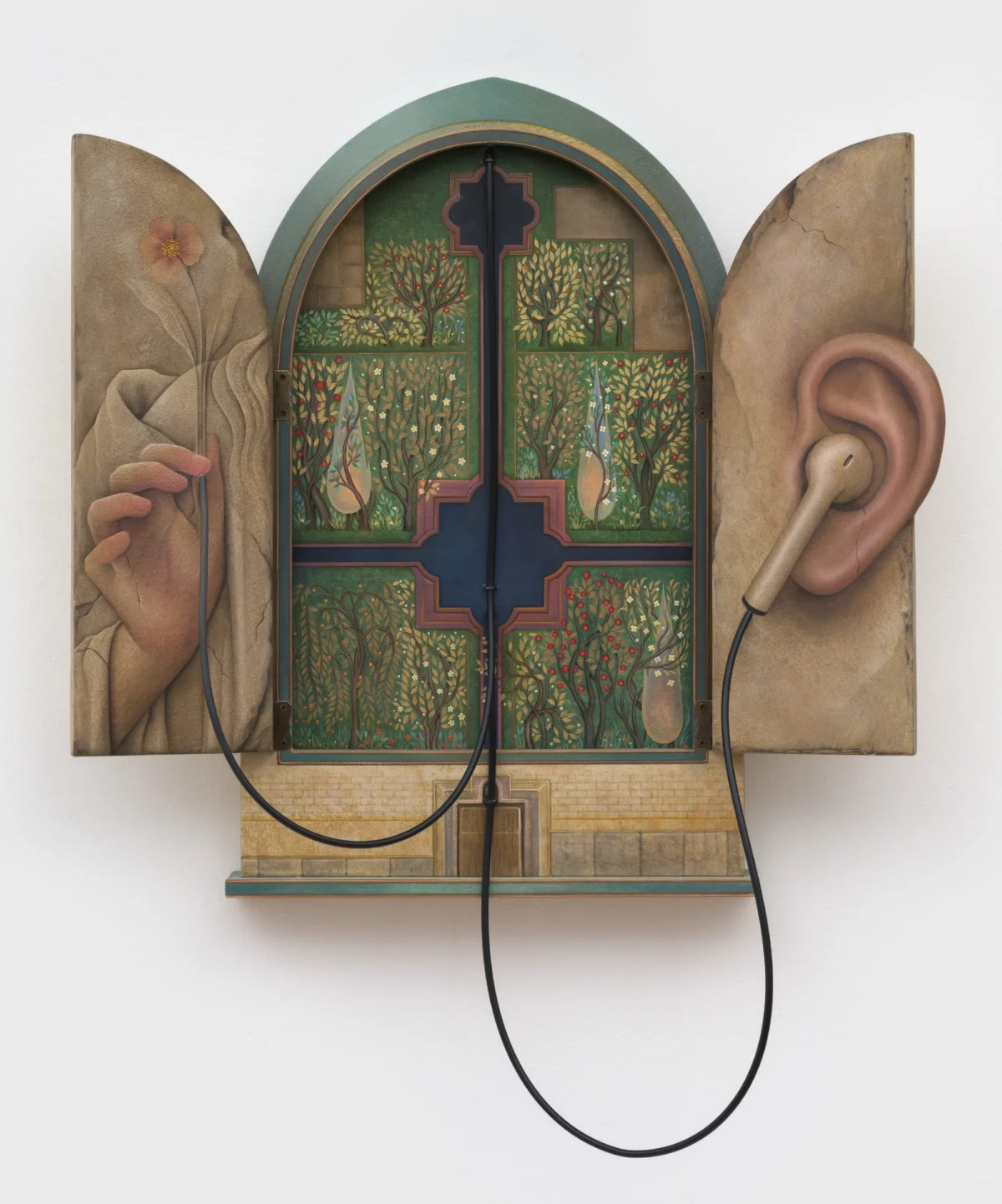
In the quiet, meticulously constructed landscapes of Arghavan Khosravi’s latest exhibition, What Remains, the boundaries between the sacred and the domestic, the political and the personal, blur into a singular, haunting narrative of endurance. Now on view at Uffner & Liu in New York, the exhibition represents a profound evolution in Khosravi’s practice, further cementing her status as a vital voice in contemporary art. By fusing the intricate, geometric elegance of Persian architecture with the narrative weight of European Christian altarpieces, Khosravi creates a visual language that interrogates the structures of power and the resilience of the human spirit—specifically the Iranian woman’s fight for autonomy under the shadow of state-sanctioned censorship.

Main Facts: A Sculptural Confrontation
Arghavan Khosravi’s latest body of work is not merely a collection of paintings; it is an immersive exploration of confinement and resistance. Through vibrant gradients and innovative mixed-media techniques, the artist utilizes sculptural elements—hinged shutters, suspended cords, plexiglass, and wood cutouts—to disrupt the traditional two-dimensional canvas.

These works function as vessels for the unspoken. Figures within the pieces are often fragmented, partially obscured by their surroundings, or physically tethered to domestic objects. In works such as Suspended (2026), a woman’s silhouette is bound by gold cords atop a stack of books, serving as a visceral metaphor for the intellectual and physical restrictions imposed by religious and political dogma. The exhibition demands that the viewer engage not just with the aesthetic beauty of the pieces, but with the urgent, ongoing reality of life in a society governed by restrictive control.

Chronology: The Evolution of a Visual Language
Khosravi’s artistic trajectory has always been deeply rooted in the sociopolitical climate of her native Iran. Since moving to the United States—she currently resides and works in Stamford, Connecticut—her practice has undergone a thematic shift, moving from direct commentary to a more nuanced, psychological introspection.

- Formative Years: Khosravi’s early work focused heavily on the overt suppression of women, often utilizing stark, symbolic imagery to depict the struggle against patriarchal authority.
- The Shift to Sculpture: Over the last three years, the artist began integrating structural components into her paintings. The introduction of "altarpiece" formats allowed her to create intimate, hidden spaces within her art—drawers that open, shutters that reveal fragments of faces, and hidden compartments that mirror the secrets kept in domestic spheres.
- The Development of What Remains: This current exhibition, which opened in May 2026, represents the culmination of a multi-year development process. The gallery notes that the works were conceptualized and executed prior to recent geopolitical escalations involving the U.S. and Iran, marking these pieces as a sustained, long-term reflection on living in a state of permanent crisis rather than a reactive response to any single news cycle.
Supporting Data: The Anatomy of the Pieces
The technical complexity of What Remains serves to mirror the complexity of the artist’s subject matter. Khosravi’s work is characterized by its high level of craftsmanship and structural ambition:

- Materials: The exhibition employs a vast array of media, including acrylic on canvas, shaped wood panels, leather and rubber cords, plexiglass, wire mesh, and, in pieces like Counting, even styrofoam and glass beads.
- The Altarpiece Influence: By adopting the format of the Christian altarpiece, Khosravi subverts a tradition historically designed to honor divine figures and instead directs that reverence toward the lived experience of the individual. In The Listener, a Persian architectural window opens to reveal a hand connected to an ear by a headphone cord, suggesting a desperate attempt to hear or communicate in a landscape of enforced silence.
- The "Bearing" Motif: Perhaps the most striking example of her current direction is the piece Bearing. A seated woman is depicted as the literal foundation for a massive, traditional Persian building. From this foundation, a thick, black, oil-like liquid seeps out, symbolizing the corruption and heavy burden of history and government overreach that threatens to collapse the structure of domestic life.
Official Responses and Curatorial Perspectives
The response from the art community and the gallery has been one of profound recognition regarding the timeliness of the work. Uffner & Liu has positioned What Remains not as a protest exhibition in the traditional sense, but as a meditation on the persistence of beauty under duress.

In discussions surrounding the exhibition, curators have highlighted that while the imagery is deeply specific to the Iranian experience, the themes of surveillance, restriction, and longing resonate on a universal level. The gallery has emphasized that Khosravi’s ability to weave the personal—her own homesickness and longing for a transformed homeland—into the structural critique of the state is what gives the exhibition its emotional resonance.

Critics have noted that the "fragmentation" seen in these new works—the glimpses of faces tucked into unassuming openings—speaks to the way identity is often forced into hiding under authoritarian regimes. By physically separating figures within her work, Khosravi captures the psychological isolation of those living under constant surveillance, where every movement is measured and every expression is a form of risk.

Implications: The Paradigm of Resistance
The implications of What Remains extend far beyond the gallery walls in New York. The exhibition forces a confrontation with the reality of living in a "region in crisis." It challenges the viewer to consider how power is exercised, not just through violence, but through the shaping of space, the restriction of movement, and the silencing of voices.

- The Persistence of Self-Empowerment: Despite the heavy themes of conflict and destruction, the exhibition is not one of despair. The sheer, vibrant intensity of the color palettes and the complexity of the structures suggest that, even when an environment is hostile, the human spirit continues to carve out spaces for self-expression.
- The Redefinition of Home: Khosravi’s work forces an examination of what it means to be in exile. As she operates from her studio in Connecticut, the "homesickness" mentioned by the gallery acts as a driving force for her creativity. The Iran she paints is both the one she remembers and the one she hopes for, creating a temporal dissonance that defines the work.
- A New Artistic Paradigm: By breaking the frame—literally and metaphorically—Khosravi is pushing the boundaries of what "painting" can achieve in a modern context. Her work suggests that the canvas is no longer enough to contain the realities of contemporary life; it must become a structural, multi-dimensional entity that demands the viewer move around it, look behind it, and engage with its hidden components.
What Remains is a testament to the fact that art, when stripped of its purely decorative function, acts as a primary tool for survival and memory. Arghavan Khosravi has crafted an exhibition that does not provide easy answers; instead, it provides a mirror for the viewer to examine their own relationship to control, silence, and the resilience of the human identity.

The exhibition runs through July 2 at Uffner & Liu in New York. For those unable to visit in person, the artist’s ongoing dialogue with the public continues through her social media channels, where she remains a vocal advocate for the politically attuned, providing context to the symbols and cultural signifiers embedded within her extraordinary sculptural landscapes. In a world of increasing instability, What Remains serves as a poignant reminder that even when the foundations are leaking black oil and the windows are bolted shut, the act of creation remains the ultimate, final act of defiance.

 Neng Nana
 Reynand Wu