

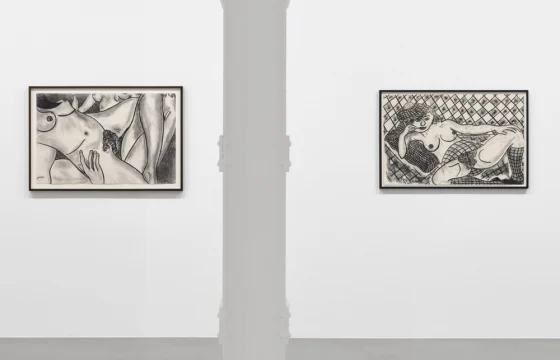
Galerie Max Hetzler in Berlin has unveiled a significant retrospective, X-Rated (1972–1974), an expansive solo exhibition dedicated to the mid-career output of William N. Copley. Marking the gallery’s fourth presentation of the artist’s work, the exhibition offers a rare, deep-dive exploration of one of the most provocative and historically misunderstood chapters in late 20th-century American art. The show is scheduled to remain on view through April 22, 2026, providing a multi-year window to engage with canvases that, decades after their creation, continue to challenge the boundaries of taste, eroticism, and the painterly tradition.
The Genesis of an Outsider: Chronology and Context
To understand the audacity of the X-Rated series, one must first understand the idiosyncratic path Copley—who adopted the moniker CPLY—carved for himself. Unlike many of his contemporaries who emerged through the traditional MFA-to-gallery pipeline, Copley’s entry into the art world was unconventional, rooted in literature and high-stakes entrepreneurship.
In the late 1940s, Copley co-founded the Copley Galleries in Beverly Hills alongside his brother-in-law, the artist John Ployardt. Though the venture was short-lived, it served as a crucible for his aesthetic development. The gallery became a West Coast sanctuary for exiled Surrealists fleeing the ravages of war in Europe. Through close associations with figures such as Man Ray, Max Ernst, and Marcel Duchamp, as well as the influential dealer Alexander Iolas, Copley was indoctrinated into the Surrealist ethos of subversion, dream-logic, and the destabilization of reality.
By 1951, having moved to France and solidified his artistic identity as CPLY, he began to reconcile his literary ambitions with the visual medium. His work became a bridge between the intellectual rigor of European Surrealism and the burgeoning, vibrant energy of American Pop art. While he remained a generation younger than his mentors, he successfully synthesized their psychological depth with a self-taught, comic-strip aesthetic that favored bold outlines and flat, punchy planes of color.
The ‘X-Rated’ Series: Transgressing the Pornographic
The centerpiece of the current exhibition is the X-Rated series, a collection of works created between 1972 and 1975. When these works were first unveiled at the New York Cultural Center in 1974, they arrived in a social climate where the sale of hardcore pornography was still largely illegal in the United States. Copley famously sourced his imagery from "under the counter" adult magazines, effectively smuggling the iconography of the illicit into the hallowed, often sanitized, spaces of the museum.
Copley’s stated intention was not to shock for the sake of titillation, but to "break through the barrier of pornography into the area of joy." This is a crucial distinction. Where the source material aimed for immediate physiological arousal, Copley’s paintings aim for intellectual and emotional liberation. By transposing these "ritualized" sexual acts onto canvas, he stripped them of their sordid context, reframing them as part of a grand, humanistic inquiry into pleasure and sexual politics.
The Anatomy of the Work
Copley’s process was as deliberate as his final results appeared effortless. He typically employed a two-stage preparatory method:
- Small-Scale Studies: Quick, gestural sketches that captured the core narrative or composition.
- Large-Scale Refinements: Larger drawings where he heightened the pictorial dynamism, introduced geometric complexities, and tweaked the interactions between figures.
The exhibition at Galerie Max Hetzler uniquely highlights this process by displaying pairings of these preparatory drawings alongside their completed, final canvases—such as Calcutta (1973) and its counterpart, Untitled (1973). This juxtaposition reveals that the "slapdash" quality often attributed to Copley was, in fact, a carefully cultivated stylistic choice. By treating his figures with a loose, schematic hand, he avoided the stifling realism that often renders sexual art static or overly clinical.
Critical Reception and Cultural Implications
The 1974 premiere of these works was helmed by the progressive director of the New York Cultural Center, Mario Amaya. Despite the volatility of the subject matter, the critical reception was surprisingly sophisticated. Peter Schjeldahl, writing for Art in America, hailed the show as a "uniformly gorgeous exhibition," recognizing it as a pivotal evolution in Copley’s career.
The critics of the era often drew parallels between Copley and Henri Matisse, noting the interplay of contorted, attenuated bodies against flattened, decorative backgrounds. However, where Matisse used the female nude as a vessel for formalist color exploration, Copley used the sexual act as a vehicle for narrative irony. His titles, often lifted from cinema—The Exorcist, Tobacco Road, Les Quatre Cent Coups—create a "Surrealist disjunction." By naming an explicit scene after a famous Hollywood drama, Copley forces the viewer into a state of cognitive dissonance, where the title provides a layer of cultural commentary that prevents the viewer from viewing the image as mere pornography.
Why Copley Matters Today
In an era of hyper-connectivity and the relentless, often desensitizing saturation of sexual imagery online, one might assume Copley’s X-Rated series would have lost its edge. Yet, the work remains remarkably potent.
1. Challenging Artistic Neutrality
Copley rejected the "neutrality" of the artist. He believed that art should not be passive; it should engage with the messiness of human desire. By turning the lens on the taboo, he challenged the conservative norms of his era—and, by extension, the sanitized standards of contemporary institutional curation.
2. The Playfulness of the Unknown
Copley’s philosophy regarding sex was profoundly optimistic: "That’s what makes sex so much fun: since nobody really understands it, the possibilities for originality are endless." This sentiment is baked into every canvas in the exhibition. The paintings are, at their core, humorous. They possess a buoyancy that elevates them above the moralistic weight of their subject matter.
3. Subversive Legacy
The "X-rated" label, once a restrictive classification that limited access to content, is reclaimed by Copley as a badge of subversive potential. His work serves as a reminder that the act of painting can still be a radical reclamation of human experience. He does not aim to idealize the body—he treats it with the same playful, graphic honesty as a cartoon. By doing so, he bypasses the moral panic associated with sexual art, inviting the viewer into a space that is both visually daring and intellectually accessible.
Conclusion
The exhibition at Galerie Max Hetzler is more than a historical look back at the 1970s; it is a testament to the enduring power of an artist who refused to categorize his work within the narrow confines of "high art." Through his X-Rated series, William N. Copley proved that the most provocative subjects are often those that require the most joy, the most wit, and the most courage to depict.
As we navigate an era where the lines between the public and the private are increasingly blurred, Copley’s invitation to "break through the barrier" remains an essential mandate. His work demands that we look not just at the figures on the canvas, but at the societal structures that govern what we are allowed to see, how we are allowed to feel, and how we might find, even in the most unconventional of places, the pursuit of genuine human joy. The exhibition serves as a definitive argument for Copley’s place in the pantheon of 20th-century masters—an artist who used the brush to dismantle barriers and replace them with the vibrant, messy, and endlessly original possibilities of the human experience.











No comments yet. Be the first to join the conversation!