

Introduction: A Chromatic Descent into the Uncanny
Harper’s gallery has officially unveiled Prussian Blue, a highly anticipated solo exhibition featuring the latest body of work by New York-based artist Sophia Huitema. Running through April 25, 2026, the exhibition marks a significant milestone in Huitema’s career, serving as her inaugural solo presentation with the gallery. Comprising seven new oil paintings, the collection invites viewers into a claustrophobic yet seductive realm where the line between the protector and the predator is perpetually blurred.
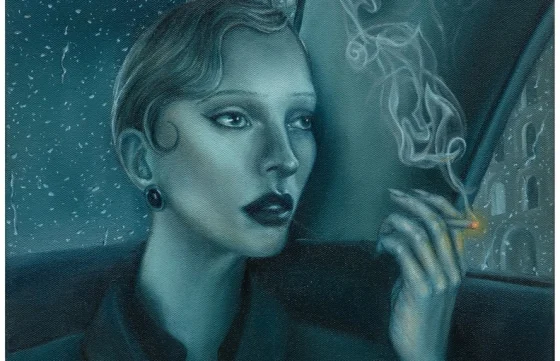
At the heart of the exhibition lies the pigment itself: Prussian Blue. Historically complex, the chemical compound is synonymous with both the industrial revolution and the darker undercurrents of toxicology. It is this duality—a substance that can be both a poison and a life-saving antidote—that serves as the metaphorical engine for Huitema’s narrative. Through a restrained palette of cerulean, navy, and muted greens, Huitema constructs a series of atmospheric, noir-inspired vignettes that feel simultaneously timeless and unsettlingly contemporary.
Chronology and Development: The Evolution of a Visual Language
Sophia Huitema’s ascent in the contemporary art scene has been marked by a rigorous, self-directed trajectory. Unlike many of her contemporaries who emerged through traditional MFA programs, Huitema’s practice is rooted in a philosophy of sustained studio immersion and granular observation.
- Early Development: Huitema’s early work began by exploring the intersection of fashion illustration and psychological portraiture. Her initial sketches focused on the elongated, stylized forms that would eventually become her signature.
- The Transition to Oil: In the years leading up to Prussian Blue, Huitema shifted her focus from paper-based illustration to large-scale oil canvases. This transition allowed for the "hazy, dreamlike" textures that define the current exhibition.
- The Conception of Prussian Blue: The current series was developed over the last 24 months. During this period, Huitema deepened her research into the chemistry of pigments, leading to the selection of Prussian Blue as the primary chromatic anchor for the show.
- The Exhibition Opening: Following a period of private previews and studio visits, the show opened to the public at Harper’s, drawing immediate attention from collectors and critics alike for its unique synthesis of historical art references and modern cinematic suspense.
Supporting Data: The Anatomy of a Painting
The power of Prussian Blue lies in its consistency. By limiting her palette, Huitema forces the viewer to focus on the interplay of light, shadow, and gesture. The seven paintings on display share a common DNA:
- The Figure: Each subject is an elongated female form, characterized by slender necks and exaggerated limbs. These figures are not passive; they are "watchful," often engaging in a direct, confrontational gaze with the observer.
- The Setting: The environments are opulent, evoking the decadence of the Gatsby era—pearl-laden gowns, jewel-studded headdresses, and dimly lit, shallow interiors.
- The Technical Approach: The brushwork is deliberate, utilizing a "compressed space" technique that mimics the feeling of stage design. This creates a sense of claustrophobia, where the background acts as a psychological projection of the subject’s inner state rather than a physical location.
Consider the standout piece, Sleeper Car. In this work, the setting is a train carriage, rendered in deep, cool blues. A woman in a backless evening gown looks over her shoulder, her posture relaxed yet her hand poised as if ready to strike. The streaks of rain on the window serve as a visual metaphor for the instability of the moment. It is a masterclass in tension, effectively capturing the "apex of a psychological thriller" within a single, static frame.
Influences: Synthesizing the History of Image-Making
Huitema’s work does not exist in a vacuum. She is a deliberate synthesizer of visual history, drawing from three distinct pillars of 20th-century art:
The Art Deco Legacy
The attenuated proportions of Huitema’s figures bear a striking resemblance to the fashion illustrators of the 1920s and 30s, most notably Erté. The "streamlined finesse" of Art Deco—characterized by elegance, symmetry, and a certain performative vanity—is present in every gown and accessory her figures wear.
Symbolism and Surrealism
The shallow, stage-like interiors of the paintings echo the works of the Symbolist painters, who prioritized the expression of ideas over the representation of objective reality. By removing traditional depth, Huitema turns her interiors into "psychological realms," where the environment reacts to the subject’s subconscious anxieties.
Cinematic Noir
Beyond painting, the influence of film is undeniable. The "femme fatale" trope—a woman who is both the architect of her own fate and a danger to those around her—is central to the exhibition. Huitema’s women are "quietly calculating." They move through their opulent worlds with a poise that suggests they are either luring the viewer into a trap or preparing to evade one.
Official Perspectives: The Philosophy of the Brush
In discussions surrounding the exhibition, Harper’s gallery has emphasized that Huitema’s lack of formal academic training is not a deficiency, but the very source of her originality. By operating outside the established "academic frameworks," she has been able to develop a "self-directed approach to image making."
The gallery notes that the exhibition serves as a dialogue with the past, rather than a mere imitation of it. The "Prussian Blue" element is described by the gallery as a "conceptual throughline." It binds the historical references (the Art Deco aesthetic) to the recurring motifs of danger and protection. The gallery’s press release highlights that the exhibition’s primary goal is to confront the viewer with this "rare duality," forcing a reflection on how we perceive femininity, danger, and the performative nature of the "high-society" persona.
Implications: A New Direction for Contemporary Figuration
The exhibition Prussian Blue arrives at a moment when figurative painting is experiencing a resurgence of interest. However, Huitema’s approach distinguishes itself from the current trend of hyper-realistic portraiture. Instead, she leans into the "phantasmagoric"—the idea that a painting should feel like a half-remembered dream or a scene from a movie that never existed.
The Psychological Dimension
The implications for the viewer are profound. By positioning her figures in moments of "cinematic suspense," Huitema demands an active, rather than passive, viewing experience. We are not just looking at a painting; we are trying to decode a narrative. Are these women victims of their environment, or are they the ones pulling the strings? This ambiguity is the hallmark of the show’s success.
The Future of the "Femme Fatale"
Huitema’s work reclaims the "femme fatale" archetype, stripping it of its misogynistic origins and re-centering it as a symbol of agency. In her world, the "cunning" of the woman is her primary survival mechanism. The pearl necklaces and jewel-studded headdresses are not just symbols of wealth; they are pieces of armor.
A Lasting Impact
As the exhibition travels through the spring of 2026, it is likely to influence a broader discourse on the use of color theory in psychological painting. By selecting a pigment with such a heavy historical and chemical burden, Huitema has successfully elevated her work from simple portraiture to a form of conceptual alchemy.
The exhibition suggests that for Huitema, painting is an act of construction. She is building a world that is "heightened" and "theatrical," yet grounded in the very real, very human tension between wanting to be seen and needing to stay hidden.
Conclusion: The Persistence of the Blue
Sophia Huitema’s Prussian Blue is more than an exhibition; it is an invitation to inhabit a space of extreme tension. Through her disciplined use of color, her masterful command of the human form, and her deep engagement with art history, Huitema has solidified her position as a unique voice in contemporary painting.
As viewers navigate the seven works on display at Harper’s, they are confronted with the reality that beauty often hides a sharp edge. The "hazy, dreamlike" worlds of these women are, upon closer inspection, scenes of survival. By the time the exhibition concludes in April 2026, it will have undoubtedly left a permanent mark on the New York art landscape, serving as a reminder that the most compelling stories are often the ones told in the shadows, painted in the deepest of blues.










No comments yet. Be the first to join the conversation!