

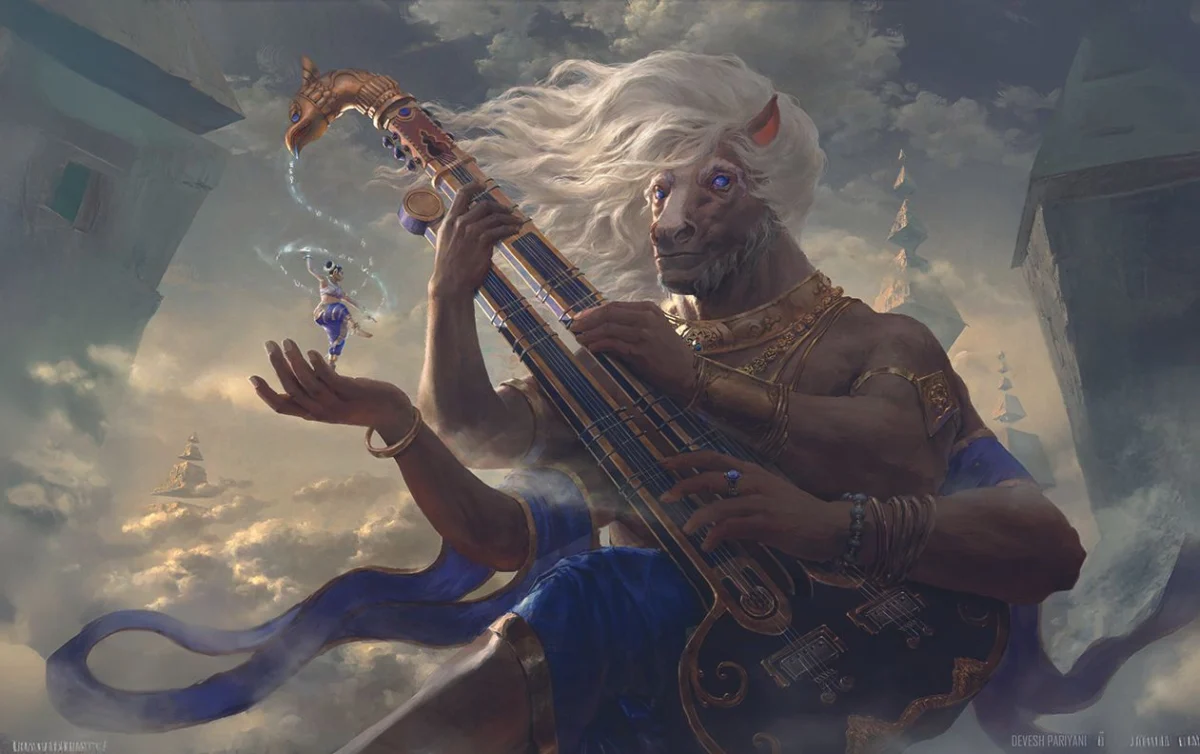
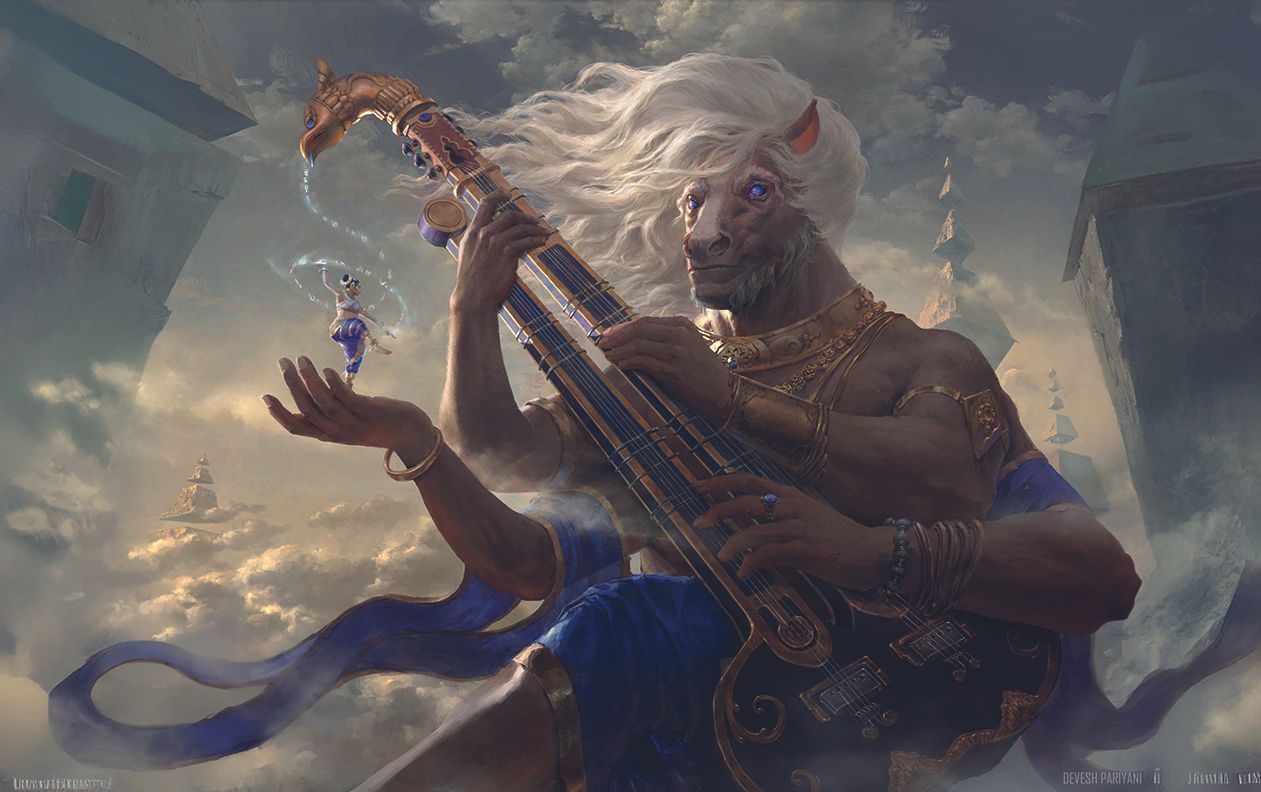
In the realm of contemporary digital illustration, few artists successfully bridge the gap between ancient theological iconography and modern cinematic storytelling. The artwork Sangam stands as a testament to this synthesis, offering a breathtaking re-imagination of Hindu mythology. By depicting the divine union of a Gandharva—the celestial musician—and an Apsara—the celestial dancer—the artist has crafted a visual narrative that vibrates with the rhythmic energy of the heavens.
The piece is more than a static image; it is a complex orchestration of form, anatomy, and cultural reverence. By imbuing the Gandharva with equine features and a formidable four-armed anatomy, the artist creates a literal and metaphorical foundation for the Apsara’s performance. The character’s instrument, a massive, veena-inspired construction, acts as the physical stage, anchoring the ethereal movement of the dancer within the boundless expanse of Svarga (the celestial realm).
The Genesis of a Myth: Core Concepts and Inspiration
The conceptual framework for Sangam was born from a desire to push the boundaries of traditional fantasy art. Rather than relying on generic tropes, the artist sought to ground the celestial subjects in the specificity of classical Indian heritage.
The Gandharva is portrayed not merely as a supernatural entity but as an anatomical marvel. The choice to incorporate equine features—a nod to the traditional mythological depiction of celestial beings—required a meticulous study of facial structure and musculature. The four-armed anatomy was designed specifically to facilitate the balance required for the central instrument, a design choice that echoes the multi-limbed deities of Hindu iconography while serving a distinct narrative purpose: the instrument is not just played; it is held, maintained, and inhabited as a living stage.
By blending this cinematic scale with intricate, bird-headed carvings and traditional ornaments, the artist illustrates the rhythmic harmony of the celestial spheres. Every detail, from the translucency of the hair to the specific geometry of the veena, is a deliberate choice intended to bridge the chasm between fantasy and the grounded reality of Indian art history.
Chronology of Creation: From Vision to Digital Reality
The journey from initial spark to final render was a rigorous, three-stage process, requiring a fusion of traditional sketching, 3D structural planning, and meticulous digital painting.
Phase I: Research and Structural Sketching
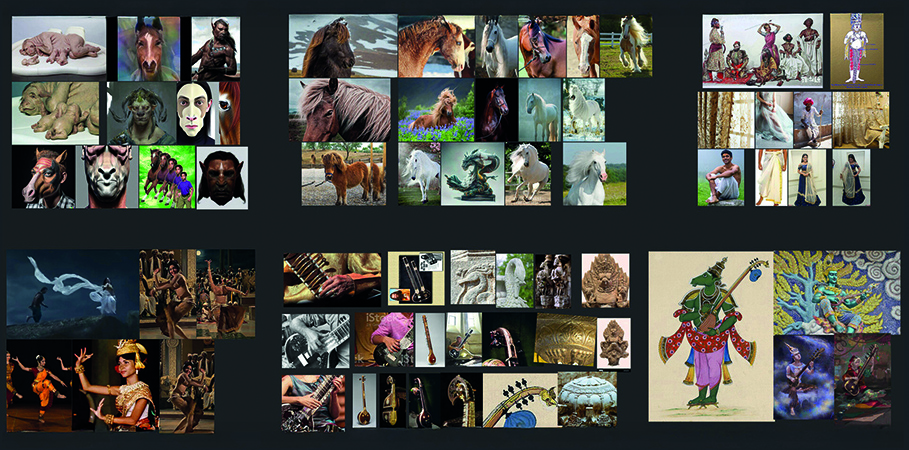
The foundation of Sangam began with extensive research. The artist curated a comprehensive mood board that focused on two primary challenges: the morphing of horse-like facial features onto a human-like base and the historical accuracy of traditional ornamentation.
"I studied structural muscle, hair translucency, and traditional ornaments," the artist notes. This phase was crucial for ensuring that the fantasy elements remained tethered to cultural reality. By analyzing classical Indian dance poses, the artist ensured that the Apsara’s posture was not only graceful but also authentic to the rhythmic traditions of the region. This research phase acted as a safeguard, preventing the piece from drifting into superficial fantasy and ensuring it remained an homage to cultural aesthetic traditions.
Phase II: The 3D Blockout and Value Architecture
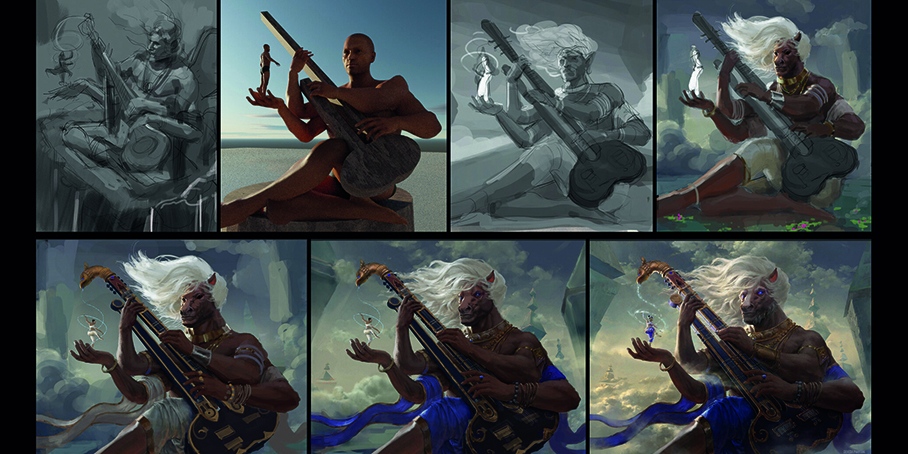
Transitioning from 2D sketches to 3D space, the artist utilized Blender to manage the complex geometry of the piece. The "3D blockout" is a vital stage in modern digital art, particularly when dealing with non-human anatomy and monumental scale.
By creating a rough 3D model, the artist could solve the spatial problems inherent in the four-armed perspective. "This step is vital for managing the multi-armed perspective and the instrument’s massive scale," the artist explains. Once the structure was locked in, the artist imported the render into Photoshop. Here, they performed a greyscale value sketch. This process allowed for the establishment of "broken edges"—a technique used to soften rigid 3D forms, lending the final composition a more organic, painterly quality that feels touched by the human hand rather than generated by a machine.
Phase III: Chromatic Refinement and Atmospheric Depth
The final phase was dedicated to color and atmosphere. The artist applied subtle color glazes to bring the piece to life, focusing heavily on material fidelity—specifically the luster of gold and the fluid drape of silk.
Custom brushes were employed to create the ethereal, glowing effects that surround the Apsara, suggesting a divine aura that distinguishes the characters from the background. The final polish involved the application of sharp specular highlights on the jewelry. These highlights served a dual purpose: they provided a visual "pop" that drew the viewer’s eye to the central figures and created a sense of separation from the atmospheric, swirling clouds of the celestial realm.
Supporting Data: The Convergence of Tools and Techniques
The technical workflow for Sangam highlights the evolution of modern creative software. The use of Blender for spatial management represents a shift in how digital illustrators approach composition. By treating the canvas as a 3D environment, the artist ensures that lighting, perspective, and scale are physically consistent, even when the subject matter is mythological.
Furthermore, the integration of traditional art techniques—such as the layering of glazes and the focus on material light-reactivity—within a digital environment like Photoshop demonstrates a sophisticated hybrid approach. This workflow allows for the "cinematic scale" mentioned in the artist’s notes, where the scope of the piece feels vast, yet the intimate details of the ornaments remain sharp and defined.
Implications for the Digital Art Landscape
Sangam serves as a benchmark for how artists can utilize modern technology to honor traditional narratives. As digital art becomes an increasingly global medium, the fusion of diverse cultural iconographies with advanced rendering techniques offers a new pathway for visual storytelling.
The implications of this process are significant:
- Cultural Preservation through Digital Mediums: By grounding fantasy in historical research, artists can introduce traditional motifs to a global, digitally-native audience in a way that is respectful and authentic.
- The "Painterly" Digital Aesthetic: The move away from "perfectly clean" 3D renders toward a hybrid, painterly approach (using value sketches and custom brushes) suggests a shift in the digital art community. There is an increasing demand for the "human touch," where the digital medium serves the artistic vision rather than dictating the final look.
- Complexity in Composition: The success of Sangam in balancing four-armed characters with complex instrumentation proves that complex, multi-layered storytelling is possible within the digital format without sacrificing clarity or composition.
Conclusion: A New Standard for Mythological Art
Sangam is more than a technical achievement; it is a meditative exploration of rhythm, form, and divinity. By meticulously researching the physical realities of the instruments and the cultural context of the characters, the artist has elevated the piece from a simple illustration to a narrative experience.
For aspiring digital artists, the workflow behind Sangam offers a roadmap: research is the bedrock of fantasy; 3D tools are the foundation of scale; and the final, painterly touches are the soul of the work. As the boundaries between technology and traditional art continue to dissolve, works like Sangam remind us that whether the tools are digital or physical, the heart of great art remains rooted in the human ability to translate myth into visual language.
For those looking to refine their own craft, mastering the integration of 3D structural planning with 2D refinement—as demonstrated in the creation of Sangam—remains one of the most effective ways to elevate digital compositions. Whether you are experimenting with Blender for base shapes or perfecting your brushwork in Photoshop, the synthesis of these tools is the key to unlocking new realms of visual storytelling.









No comments yet. Be the first to join the conversation!