

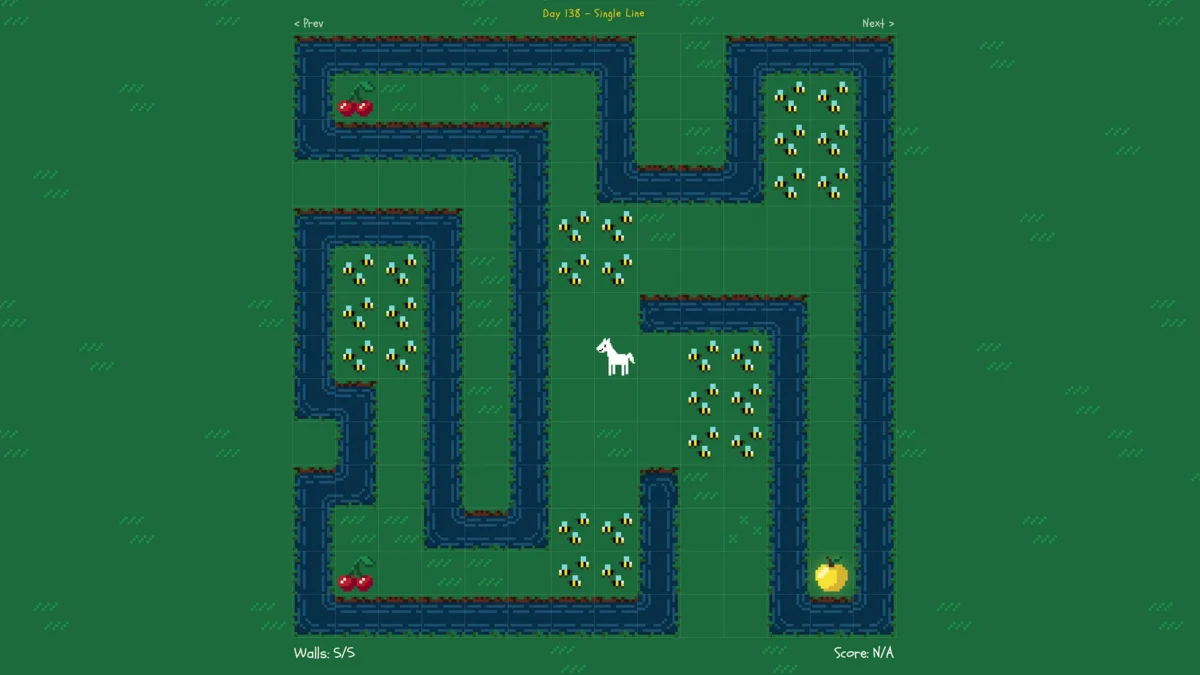
In an era dominated by the high-stakes, once-a-day anxiety of word-guessing games and the rapid-fire stimulation of mobile gaming, a quiet, pixel-art revolution has taken root in the browser. Enter enclose.horse, a deceptively simple yet profoundly challenging spatial puzzle game that tasks players with a singular, rhythmic objective: keep a horse contained within a designated pasture. While the premise sounds pastoral and benign, the mechanics beneath the surface offer a deep, strategic experience that has captivated a growing audience of logic-puzzle enthusiasts.
Main Facts: The Mechanics of Containment
At its core, enclose.horse operates on a 14×14 grid, presenting players with a field populated by the titular horse, various landscape features, and a finite supply of fencing. The objective is not merely to trap the animal, but to optimize the enclosure to maximize a score. When a player successfully surrounds a region of the grid, the grass tiles within that boundary transform into wheat, signaling a successful "harvest" of points.
The scoring system is where the game evolves from a simple spatial challenge into a rigorous exercise in risk management. Each tile enclosed adds to the player’s total, but the board is not merely empty grass. It is scattered with high-value items like cherries and apples, which serve as score multipliers or additive bonuses. Conversely, the inclusion of bees—which act as negative-point hazards—forces players to carefully navigate their wall placement. If a player inadvertently traps a swarm of bees alongside their horse, they face a penalty that can plummet their total score into the negative digits.
Once the walls are placed and the submission is finalized, the results are locked, and the player’s score is sent to a global leaderboard. This "one-shot" submission mechanic mirrors the popular daily puzzle format, ensuring that players cannot simply brute-force the optimal solution through trial and error.
Chronology: From Concept to Cult Classic
The rise of enclose.horse mirrors the trajectory of other "browser-native" hits. While the exact inception date is often obscured by the informal nature of indie web development, the game gained significant traction throughout late 2023 and early 2024.
- The Early Phase: The game began as a lightweight experiment, focusing on the core "fence-in" mechanic. The initial user base consisted of a small community of puzzle aficionados who appreciated the minimalist aesthetic and the immediate gratification of the wheat-transformation mechanic.
- The Expansion: Recognizing the community’s desire for longevity, the developers introduced a "Daily" format. By providing a new, procedurally generated or curated puzzle every 24 hours, enclose.horse secured a place in the daily routines of thousands of players, similar to the "Wordle-effect."
- The Content Explosion: As of the current writing, there are over 138 archived daily puzzles available for retrospective play. Furthermore, the introduction of user-generated content (UGC) features has allowed the community to bypass the daily constraint entirely, fostering an ecosystem where players can design, share, and challenge one another with increasingly complex custom levels.
Supporting Data: Why Players Are Hooked
The allure of enclose.horse lies in its "low floor, high ceiling" design. Data gathered from community forums and social media metrics suggest that players spend an average of seven to twelve minutes on a single daily puzzle—a "sweet spot" for commuters and coffee-break gamers.
The Scoring Dynamics
The game’s mathematical depth is surprising. Because the number of walls is strictly limited, players are forced to perform a mental cost-benefit analysis:
- Efficiency: Can I enclose the maximum number of grass tiles with the minimum number of walls?
- Risk Mitigation: Is the cherry in the top-right corner worth the wall cost, given that it forces me to also enclose two bee hives?
- Spatial Geometry: How do I manipulate the border of the 14×14 grid to maximize the "natural" boundaries already present?
This data-driven approach to puzzle design ensures that no two players arrive at the same solution, even when faced with the same daily layout. The game fosters a competitive environment where players share their "fencing strategies" on platforms like Discord and Reddit, analyzing which path yields the most efficient wheat-to-wall ratio.
Official Responses and Developer Philosophy
The development team behind enclose.horse—credited to Shivers, Ryan, and Praveen—has maintained a refreshingly hands-off approach to the game’s meta-narrative. In brief communications, the creators have noted that the game was designed as a "calm alternative" to the high-pressure environments of modern competitive gaming.
"We wanted something that felt like a quiet Sunday afternoon," one contributor noted in a community thread. The decision to avoid aggressive monetization or intrusive advertisements was a deliberate design choice aimed at preserving the purity of the player experience. By keeping the interface clean and the mechanics transparent, the developers have successfully cultivated a "gentle" competitive space where the primary adversary is not another player, but one’s own ability to plan ahead.
Implications: The Future of Browser Puzzlers
enclose.horse stands as a testament to the enduring power of the "daily browser puzzle" format. It implies a broader trend in the gaming industry: a return to simplicity. As big-budget titles become increasingly complex and demanding of time, players are turning toward "snackable" experiences that respect their schedules while still offering genuine intellectual stimulation.
The Impact on Game Design
The success of this title offers several key takeaways for indie developers:
- Accessibility as a Feature: By limiting the complexity to a 14×14 grid, the game becomes accessible to casual players while remaining deep enough for serious puzzle fans.
- Community-Led Longevity: The inclusion of a level editor has extended the game’s lifespan significantly. When the developers are not creating new content, the community acts as the engine for growth.
- The "Daily" Hook: The psychological impact of a "daily" challenge creates a sense of collective experience. Knowing that thousands of other people are struggling with the same specific grid of bees and apples fosters a sense of digital community that single-player experiences often lack.
Conclusion: A New Daily Ritual
In a landscape crowded with battle royales, endless shooters, and complex RPGs, enclose.horse serves as a meditative palate cleanser. It asks for nothing more than a few minutes of focus, a bit of spatial reasoning, and the willingness to accept that sometimes, the grass isn’t just greener on the other side—it’s full of bees.
As the game continues to evolve, incorporating new tile types and perhaps even more robust social features, it remains a standout example of what can be achieved with a minimalist premise. For those looking to step away from the relentless churn of the news cycle or the stress of modern work, enclose.horse provides a rare, quiet corner of the internet where the only thing that matters is the next fence, the next apple, and the satisfaction of a perfect pasture. Whether it will ever replace the ubiquity of Wordle remains to be seen, but for its dedicated audience, it has already established itself as an essential part of the daily routine.











No comments yet. Be the first to join the conversation!