

In the contemporary art landscape, few painters command the atmospheric depth and existential gravity of South African artist Cinga Samson. His latest exhibition, Ukuphuthelwa, is a profound meditation on the limits of representation and the threshold between the known and the divine. The exhibition, which opened to critical acclaim and will remain on view through April 18, 2026, invites audiences into a nocturnal world where the act of painting becomes a bridge toward the unnameable.
Main Facts: A State of Heightened Perception
The title of the exhibition, Ukuphuthelwa, is derived from the artist’s native isiXhosa. While it translates literally to "unable to sleep," it stands in stark contrast to the clinical, often pathologized English term "insomnia." For Samson, this is not a condition requiring a cure, but a state of spiritual alertness—a hypersensitivity that sharpens in the darkness.
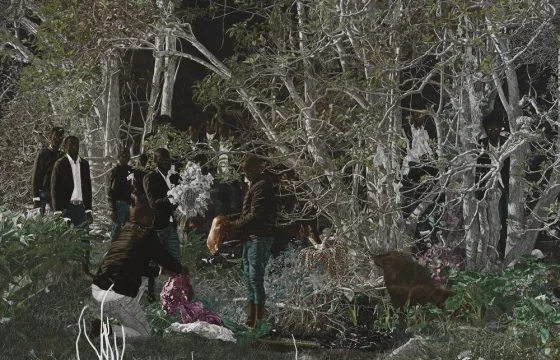
Rendered in his signature, moody palette of carbon, deep Prussian blues, and near-black hues, the collection features enigmatic figures, dogs in untamed landscapes, and indigenous South African flora. These are not merely paintings; they are contemplative spaces. Samson grapples with a fundamental existential quandary: how can an artist create a "true and honest" painting when the very act of representation is inherently flawed? The exhibition serves as a deliberate exploration of this impossibility, challenging viewers to look beyond the surface of the canvas to find the "vast reality" that exists in constant motion.
Chronology of a Creative Philosophy
Samson’s artistic trajectory has always been marked by a move toward the ethereal. While his earlier works toyed with the boundaries of figurative art, Ukuphuthelwa represents a maturation of his technical and philosophical approach.
- Early 2020s: Samson establishes his reputation for using occluded palettes and "pupilless" figures, creating a visual language of mystery and detachment.
- 2024-2025: The artist begins intensive development of the current series, shifting focus from individual identity to the collective energy of the environment.
- January 2026: Preparations for the Ukuphuthelwa exhibition reach their zenith, with the artist focusing on the interplay of light and under-drawing.
- Present (through April 18, 2026): The exhibition is open to the public, offering a comprehensive look at his latest series, including works such as Umlindo (Watcher), Tshee, and Intsingiselo II.
Supporting Data: The Mechanics of Mystery
To understand the impact of Samson’s work, one must examine his technical mastery. He approaches light as a "magic trick," allowing it to flicker across the picture plane to grant visibility to his dark scenes. By leaving sections of his under-drawing exposed, Samson creates a unique transparency that disrupts the viewer’s eye, lending a psychical unsteadiness to the experience.
The Role of the Pupil
Perhaps the most striking feature of his figures is the absence of painted pupils. By leaving the eyes empty, Samson ensures that his figures are not "looking" at the viewer, nor are they personified identities. They are porous forms, "completely one with the whole painting," as the artist puts it. They do not possess the landscape; they are enmeshed within it, reflecting a state where no single element has mastery over the other.
The Language of Symbols
Samson acknowledges that an image can never be the equivalent of reality—it can only ever be a symbol. A prime example is his depiction of the dog in Intsingiselo II (2026). To an international viewer, the dog may represent loyalty; to an amaXhosa observer, the dog may signify the protective guidance of ancestors. By embracing these multiple, subjective interpretations, Samson forces the viewer to confront the instability of meaning. He argues that there is a "gulf" between the static painted sign and the fluid experience it gestures toward, a gulf that no amount of technical realism can fully bridge.
Official Responses and Artistic Intent
In his statements regarding the exhibition, Samson has been transparent about his desire to move beyond the pretense of representation. He does not seek to capture the "thing itself," but rather to harness his skills toward that which exceeds the representable.
"The ritual itself is not the important thing—it’s an opening to what exists beyond," Samson notes regarding his painting Umlindo (Watcher). The ritualistic aesthetics in his work—figures holding bouquets or lengths of fabric—are meant to address a collective human need for orientation in a vast, unknown world.
Regarding the environmental elements of his work, such as the rocky crag in Sithini ngelilitye (2026), Samson highlights the "oscillation between the approachable and the overwhelming." He observes that the sky can be "friendly, but sometimes so heavy, dark, so scary." This duality is central to his work: the divine is not found in some distant, separate realm, but is instead embedded in the vernacular of the everyday.
Implications: The Sublime in the Ordinary
The implications of Ukuphuthelwa for contemporary art are significant. In an era often defined by high-speed digital consumption, Samson demands "slow, contemplative looking." He suggests that the mystery we often seek in grand narratives is, in fact, present in ordinary forms—in the bowing of foliage, the vigilant posture of a dog, or the foreboding of a night sky.
The Interstice of Languages
The titles of his works—Imfihlo (Secret), Intsingiselo (Meaning), Isiganeko (Event)—carry a weight that English translations cannot fully replicate. This linguistic gap mirrors the gap in his paintings: the realization that true meaning often "slips between the interstice" of two worlds.
A Theology of Everything
Ultimately, Samson’s work reaches toward a "thing that links us to God—and by God, I mean everything." His figures, devoid of pupils, do not look outward because their knowing comes from within the world they inhabit. They are part of a shared consciousness that encompasses the bird in flight and the murky, moonwashed clouds of a night scene.
By revealing the "trick" of his own painting—the deliberate exposure of the canvas and the manipulation of light—Samson invites the viewer to look past the artifice. Ukuphuthelwa is an invitation to inhabit the darkness, to embrace the sleepless, hyper-aware state of the watcher, and to find the sublime in the silence of the mundane.
For those who visit the exhibition before it concludes in April 2026, the experience is not one of visual recognition, but of feeling. It is a reminder that while images may fail to represent the whole truth of reality, they remain the most potent tools we have for gesturing toward the mystery that binds us all. Samson does not offer answers; he offers an opening. In the vastness of his dark canvases, the viewer is left with the haunting realization that everything is watching, everything is connected, and everything is waiting to be understood by those with the patience to stay awake.










No comments yet. Be the first to join the conversation!