

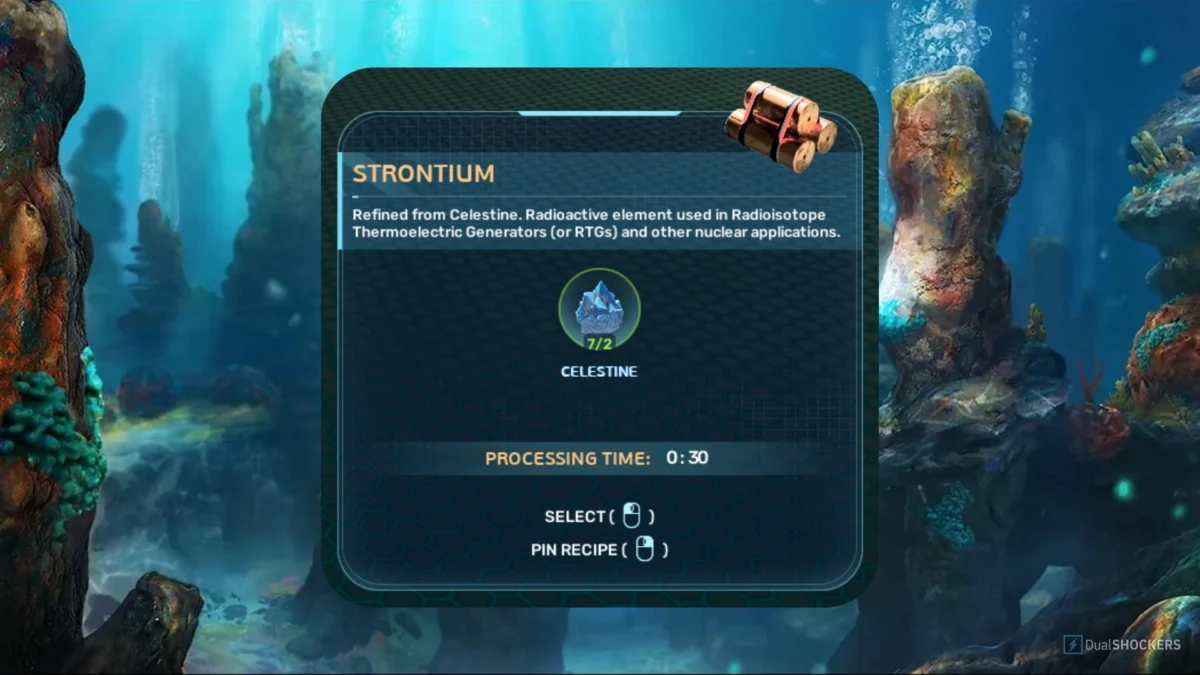
As players venture deeper into the perilous, alien oceans of Subnautica 2, the survival loop shifts from simple hunger and thirst management to complex technological advancement. While the early game is defined by gathering limestone and salt, the mid-to-late game introduces exotic minerals that require more than just a standard knife or mineral detector. Among these, Strontium stands out as a cornerstone of high-tier engineering.
For those navigating the treacherous waters beyond the Graveyard biome, understanding how to source and refine this radioactive material is no longer optional—it is a requirement for survival. This guide serves as a deep dive into the logistics of Strontium, the extraction of its precursor, Celestine, and the strategic implications for your base development.
The Essentials: What is Strontium?
In the logic of Subnautica 2, Strontium is classified as a rare, radioactive mineral compound. Unlike raw materials that can be scooped up from the seabed, Strontium is a refined product. It serves as a vital reagent in the creation of advanced equipment, specifically items designed to withstand extreme pressure, intense thermal conditions, and the high-energy requirements of late-game alien architecture.
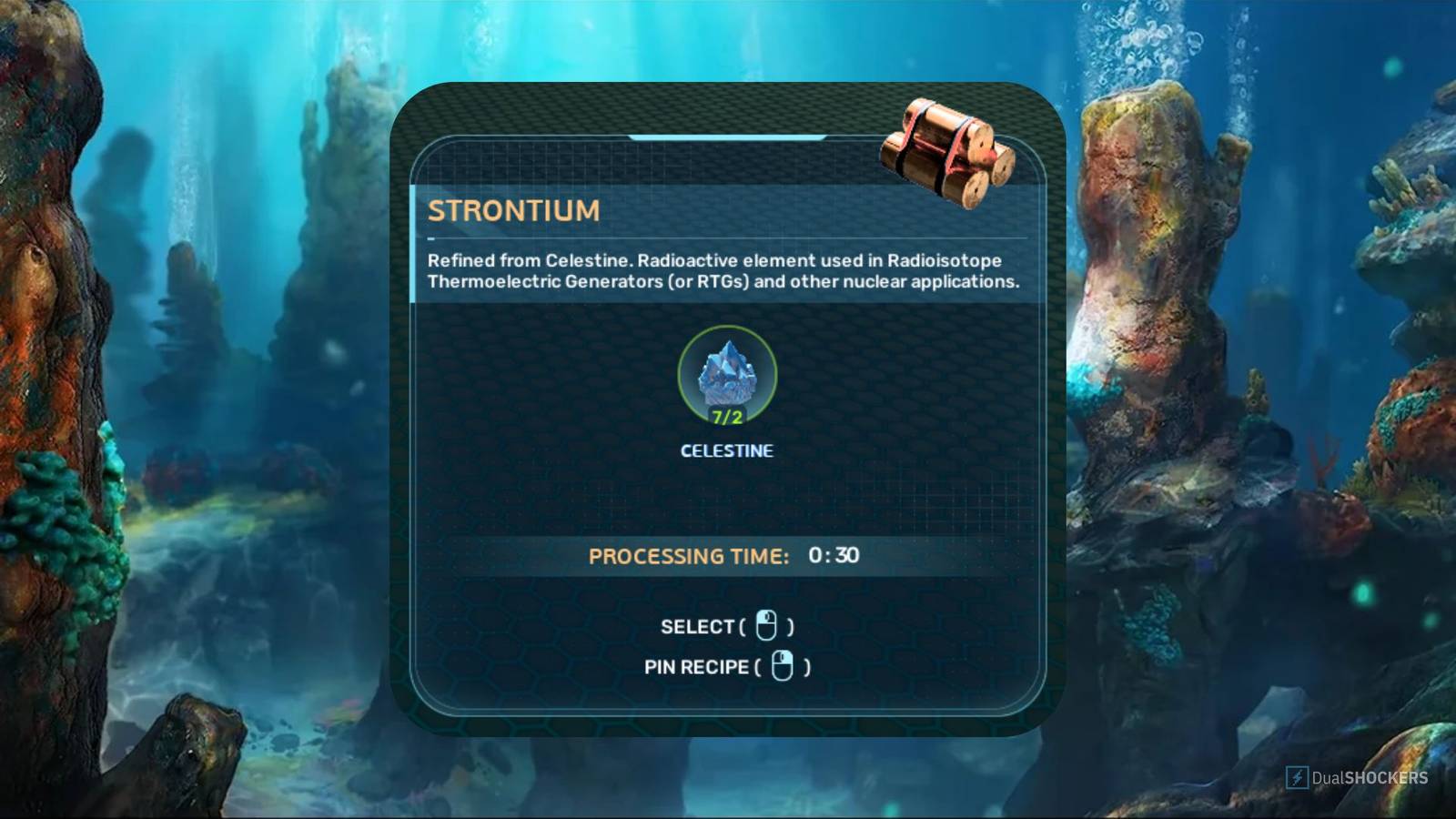
Without a consistent supply of Strontium, players will find themselves unable to upgrade their vehicle depth modules or synthesize high-capacity energy cells. It is, effectively, the gatekeeper to the deepest, most resource-rich zones of the game.
Chronology of Acquisition: From Celestine to Strontium
To understand the acquisition of Strontium, one must follow a clear, step-by-step industrial chain. The process is not found in the wild; it must be manufactured.
1. The Precursor: Identifying Celestine
Before you can hold a bar of Strontium, you must locate Celestine. This mineral is characterized by its distinct silver-blue, spiky crystalline structure. It is typically found embedded in the volcanic or tectonic rock formations in the mid-to-late game regions.

2. The Tooling: The Sonic Resonator
A common point of frustration for new explorers is attempting to mine Celestine with standard tools. Celestine is too dense for a standard thermal blade or reinforced pickaxe. Players must first acquire and equip the Sonic Resonator. This specialized tool uses high-frequency sound waves to fracture the molecular bond of the mineral, allowing you to harvest it without shattering the crystal into useless dust.
3. The Refinement: Using the Processor
Once you have secured at least two units of raw Celestine, the final step takes place within the confines of your base. You must have a Processor constructed and fully powered. By feeding two units of Celestine into the Processor, the machine will refine the raw ore into one unit of stable Strontium.
Supporting Data: Regional Riches and Distribution
The eastern portion of the map in Subnautica 2 is currently the most documented area for Celestine deposits. While generation can vary slightly based on specific world seeds, geological surveys suggest that the tectonic shifts near the eastern trenches have exposed significant veins of the mineral.
Optimal Harvesting Routes
For players looking to maximize efficiency, a typical run involves:
- Preparation: Ensure your base power grid is stable. A failing power supply during the processing phase is a common cause of wasted materials.
- The Scouting Phase: Utilize the Seaglide or a submersible to navigate the eastern shelf. Keep an eye out for the characteristic blue glow of Celestine deposits, which are often found near geothermal vents.
- The Extraction: Utilize the Sonic Resonator to clear the vein. Do not leave the area until your storage modules are full, as the transit time to the eastern zones can be significant.
The Role of the Modification Station
Acquiring Strontium is only the first half of the equation. To actually utilize this material, you must be in possession of a Modification Station.
In Subnautica 2, the Modification Station functions as the primary hub for all high-level upgrades. It is here that Strontium is integrated into alloy matrices and energy-conductive housings. If you have not yet discovered the Modification Station fragment at the Alien Base, your stash of Strontium will remain inert, taking up valuable inventory space without providing any utility.
Crafting Requirements
To successfully complete the endgame suite of upgrades, a player should aim for a stockpile of at least nine units of Strontium. This inventory allows for the crafting of:
- Mk. III Depth Modules: Essential for pushing your submersible into the abyssal zones.
- High-Capacity Power Cells: Required for long-duration expeditions away from base charging stations.
- Thermal Displacement Plating: A necessary component for surviving the proximity of volcanic activity near end-game story locations.
Official Developer Insights: The Design Philosophy
According to communication from Unknown Worlds Entertainment, the inclusion of refined materials like Strontium was a deliberate design choice to slow the pacing of the game during the mid-game transition. By requiring players to build a "Processor" and utilize specific mining tools, the developers ensure that the player feels a sense of progression from a simple scavenger to an industrial operator.
The radioactive nature of the material also serves as a subtle environmental hazard. While the game does not explicitly punish the player for carrying Strontium, the lore entries found in the PDA suggest that long-term storage of these materials requires lead-lined containers, adding a layer of immersion and "soft" survival mechanics to the base-building aspect of the experience.
Strategic Implications: Why It Matters
The transition to using Strontium represents a fundamental shift in how you play Subnautica 2.
Escalating Risk and Reward
When you are only dealing with Titanium and Copper, the loss of your inventory upon death is a minor setback. Once you begin carrying rare materials like Strontium, the stakes increase. The deep-sea environments where Celestine is found are often home to apex predators. The necessity of mining in these zones forces the player to engage with the game’s combat and evasion mechanics in ways that early-game resource gathering does not.
Base Infrastructure
The reliance on the Processor and, by extension, a robust power grid, forces players to think about their base as a power plant rather than just a home. You will find yourself balancing your oxygen production, desalination units, and your material processors. This strategic management is the heart of Subnautica 2‘s survival loop.

Troubleshooting and FAQ
Q: I have the Celestine, but the Processor won’t accept it. Why?
A: Ensure your base is powered. If the Processor lacks energy, it will remain idle. Check your power transmitters or thermal generators to ensure the grid is active.
Q: Can I find Strontium already refined?
A: Rarely, and usually only in high-risk areas like the interior of derelict Alien Bases. It is not recommended to rely on finding refined Strontium; self-sufficiency through mining and processing is the intended path.
Q: My Sonic Resonator keeps running out of charge. How do I mitigate this?
A: Carry at least two spare energy cells specifically for your tools. When mining in the eastern zones, consider building a small, temporary "outpost" base with a solar charger or thermal generator to recharge your equipment on the fly.

Conclusion: The Path Forward
As you move through the Early Access journey of Subnautica 2, the acquisition of Strontium will likely be the moment you stop feeling like a survivor and start feeling like an explorer. It is a material that demands preparation, infrastructure, and technical skill.
By mastering the extraction of Celestine and the operation of the Processor, you are securing the future of your base and your ability to explore the deepest mysteries the game has to offer. Keep your sensors sharp, your power grid stable, and your Sonic Resonator charged—the depths are waiting.
Disclaimer: This guide is based on the current state of Subnautica 2 in Early Access. As the game continues to receive updates from Unknown Worlds Entertainment, crafting recipes and resource locations may be subject to change. Always check your in-game PDA for the most current data.












No comments yet. Be the first to join the conversation!