

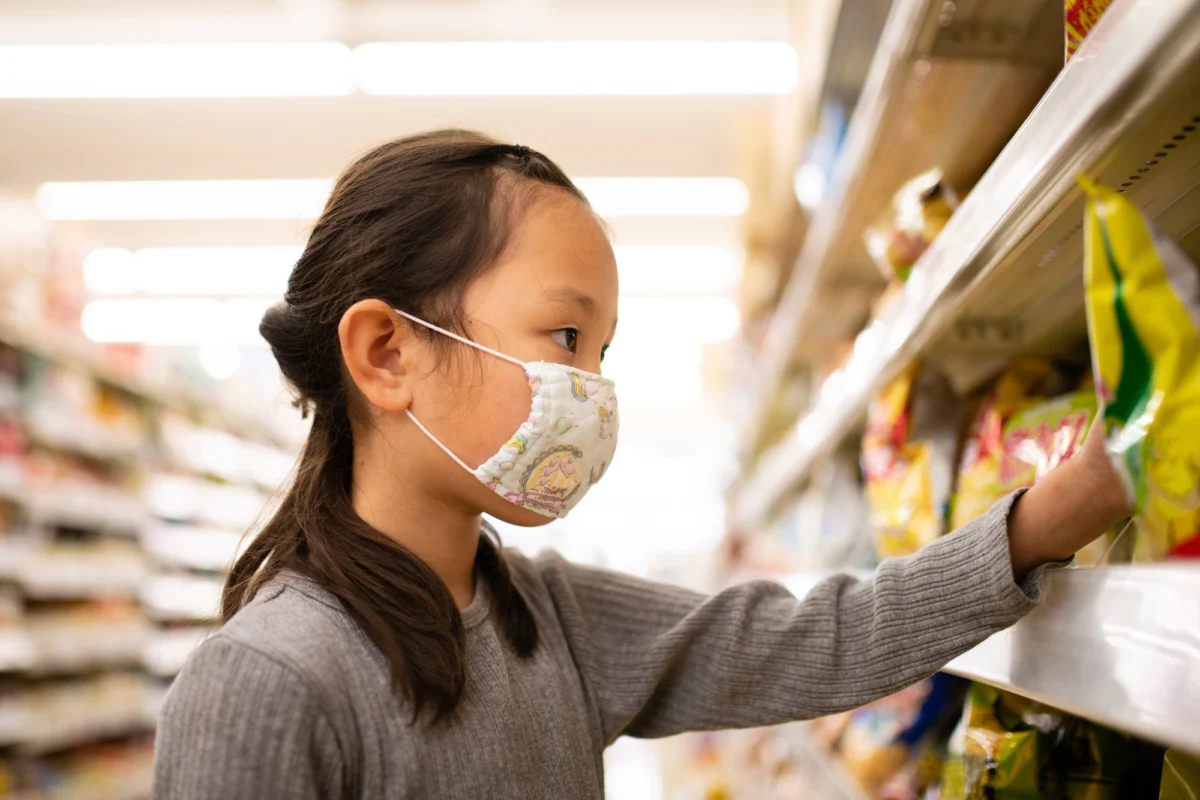
For decades, the Japanese konbini (convenience store) experience has been defined by a kaleidoscope of vibrant, eye-catching packaging. From the bright red and gold of Calbee’s iconic prawn crackers to the nuanced, glossy aesthetics of premium potato chip bags, the visual landscape of Japanese retail is a masterclass in consumer marketing. However, as of late May, that landscape is undergoing a stark, colorless transformation.
In a development that feels more like a dystopian satire than a supply chain report, Calbee—the titan of the Japanese snack industry—has announced that 14 of its most popular products will move to black-and-white, text-heavy packaging. The culprit behind this monochromatic shift is not a design trend, but a tightening global supply chain crisis originating in the Middle East, specifically the closure of the Strait of Hormuz.
The Naphtha Nexus: From Geopolitics to Potato Chips
The crisis began in late February, when escalating conflict in the Middle East led to the effective closure of the Strait of Hormuz. This maritime choke point is a vital artery for the global energy trade, and its disruption has sent shockwaves through industries far removed from the oil fields.
For the Japanese consumer, the first ripple was felt in the price of natto—the beloved, fermented soybean dish that is a staple of the Japanese diet. As packaging manufacturers struggled to secure the plastic resins derived from naphtha, a primary byproduct of petroleum refining, the costs of the containers used to house these fermented beans skyrocketed.
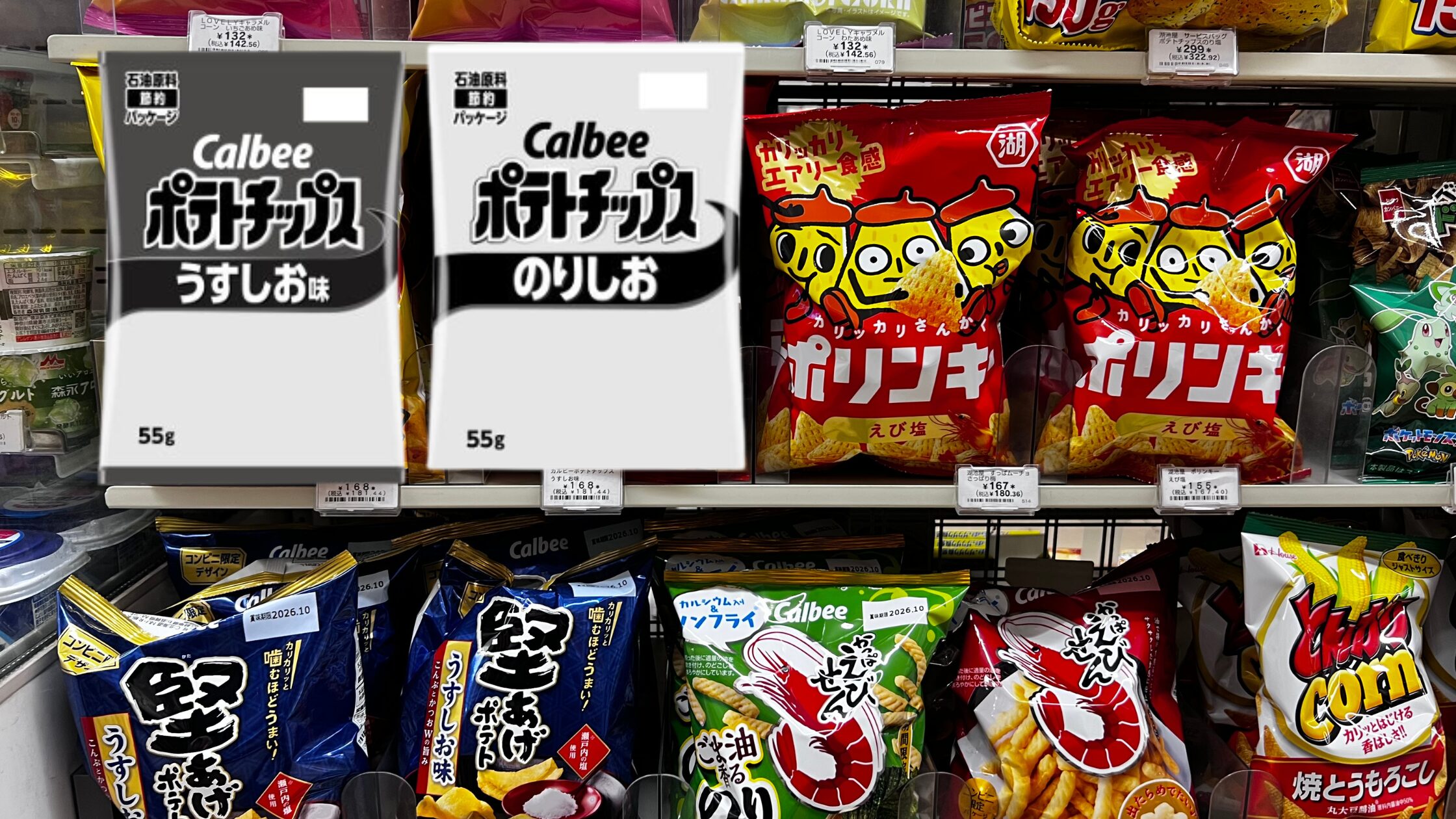
However, if natto price hikes were a quiet frustration, the news from Calbee has proven to be a seismic cultural event. On May 25th, Calbee began rolling out its "monochrome" initiative. Products including the ubiquitous Potato Chips Usushio, Kappa Ebisen, and the breakfast staple Frugra are now hitting shelves stripped of their iconic full-color printing. The transition will continue throughout the summer, with the popular Kataage Potato line set to adopt the drab, minimalist aesthetic in late June.
A Monopoly of Market Presence
To understand the gravity of this announcement, one must consider Calbee’s position within the Japanese economy. Founded in 1949, the company is not merely a snack manufacturer; it is a market behemoth. Holding over 50% of the total domestic snack market and a staggering 70% of the potato chip segment, Calbee functions as the Japanese equivalent of Frito-Lay in the United States.
When a company of this magnitude alters its fundamental visual identity, it is not merely a logistical shift—it is a national signal. These monochrome bags will be inescapable, appearing on shelves in every neighborhood konbini and supermarket from Hokkaido to Okinawa. The visual jarring of seeing a traditionally vibrant brand reduced to stark black-and-white has prompted widespread concern, with many social media users initially dismissing the reports as a hoax.
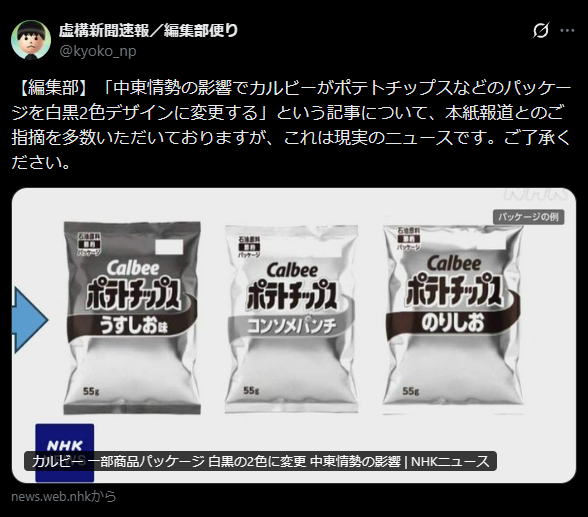
The disbelief was so profound that even Kyoko Shimbun—Japan’s premier satirical news outlet, often compared to The Onion—had to issue a formal disclaimer on X (formerly Twitter) to confirm that the Calbee situation was, in fact, entirely legitimate.
The Hidden Costs: Cancelled Launches and Silent Cancellations
The visible change in packaging is only the tip of the iceberg. Industry insiders and exclusive reports from outlets like FNN Prime Online suggest that the impact of the Middle East conflict is forcing companies to make difficult, often invisible, choices.
One such casualty is the planned July launch of a new, highly anticipated line of Sour Cream-flavored potato chips. The company silently pulled the plug on the project, a strategic retreat that highlights the severe constraints on resources. Printing ink requires specific pigments that are chemically derived from naphtha-based feedstocks. When those feedstocks become scarce or prohibitively expensive, companies must prioritize their core legacy products, sacrificing innovation and new product development to maintain a baseline of availability for existing favorites.
Government Denial and the "Hearing" Contradiction
The situation has created a tense standoff between the private sector and the government of Prime Minister Takaichi Sanae. In the days following Calbee’s announcement, members of the Takaichi administration were quick to downplay the crisis.
Satō Kei, the Deputy Chief Cabinet Secretary, addressed the media with a tone of managed calm, insisting that there was "no issue" with Japan’s overall naphtha supply. He pointed to a tripling of imports from non-Middle Eastern sources throughout May as evidence that the supply chain was robust. According to government figures, Japan’s supply is diversified: 40% comes from the Middle East, 40% is produced domestically, and 20% is sourced from other foreign partners.
However, in a move that signals either a genuine lack of insight or a desperate attempt to maintain public confidence, the government has announced it will hold a "hearing" with Calbee executives to discuss their decision.
Industry analysts suggest the government is missing the point. While aggregate tonnage of naphtha may be sufficient on a national level, the specific downstream inputs required by high-speed printing presses are specialized. The problem is not necessarily a lack of crude oil, but a breakdown in the specific chemical supply chains that refine those base materials into high-quality printing inks.
A Systemic Crisis: Is This the New Normal?
Calbee is not acting in a vacuum. Other major players in the Japanese food industry are beginning to follow suit. Ito Ham, a major meat processor, has reportedly signaled to the Nikkei that it is actively considering "lower-color" runs for its product packaging to mitigate rising costs and supply shortages.
The fact that multiple major corporations—including several natto manufacturers and now giants like Calbee and Ito Ham—are making near-identical adjustments within a two-week window suggests that the fragility is located at the very foundation of Japan’s manufacturing supply chain. When the government insists that "everything is fine" while the nation’s largest food producers are scrambling to change their packaging, it raises uncomfortable questions about the quality of communication between Tokyo and the corporate sector.
The Inflationary Specter
The broader economic implications of these packaging shifts are sobering. For the past two years, Japanese consumers have been battered by a relentless wave of inflation. Following the pandemic and the subsequent war in Ukraine, the cost of living has surged, driven primarily by energy and transportation expenses.
The most dramatic shock occurred in the domestic rice market, where a poor harvest combined with logistical bottlenecks sent prices into a tailspin, forcing the government to tap into its strategic reserves. While the price of rice has stabilized—and some analysts even fear a crash due to oversupply—the relief is arguably too little, too late for the average household.
Companies have already hiked prices on over 6,000 products in the last year, and "shrinkflation"—the practice of reducing product volume while maintaining the same retail price—has become the standard strategy for maintaining margins.
Economists are now warning that if the naphtha shortage persists, the pain will ripple far beyond the snack aisle. Packaging is an essential cost component for everything from dried noodles and seasonings to toiletries and cosmetics. If manufacturers cannot print their labels, they may soon find themselves unable to ship their goods at all, or forced to pass the soaring costs of alternative materials directly to the consumer.
Conclusion: The Path Ahead
The monochrome Calbee bags are a poignant metaphor for a nation facing a new era of geopolitical vulnerability. Japan, an island nation that relies heavily on stable maritime trade routes, is finding that the "Middle East situation" is not just a distant news story—it is a tangible, visible force that is reshaping the daily lives of its citizens.
As the government prepares for its "hearing" with Calbee, the Japanese public is left to wonder if these grey, minimalist bags are merely a temporary inconvenience or a harbinger of a deeper, more permanent economic contraction. With the consumption tax debate stalled in the legislature and the cost of essential goods remaining high, the average consumer is bracing for what may be a long, challenging summer.
The snack aisle, once a source of colorful comfort, now stands as a quiet warning: in an interconnected global economy, when the flow of energy is disrupted, the colors of everyday life are often the first things to fade.












No comments yet. Be the first to join the conversation!