

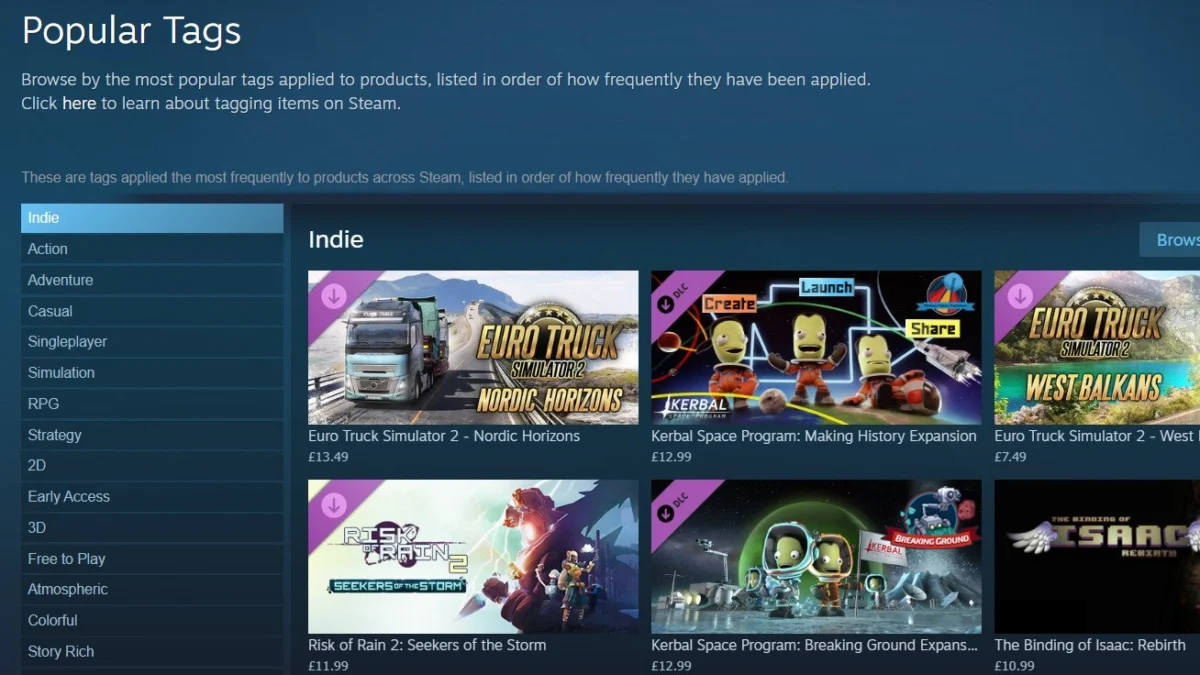
[City, State] – [Date of Publication, e.g., May 20, 2026] – Valve, the digital storefront giant behind Steam, has rolled out a significant update to its platform’s game tagging system, ushering in a new era of content classification designed to enhance discovery and improve user experience. The comprehensive overhaul introduces 17 new descriptive labels, eliminates 28 older ones, and consolidates or renames numerous others, signaling a strategic shift towards more precise and less ambiguous content categorization. Terms like ‘NSFW’ (Not Safe For Work) and ‘Mature’ have been retired, replaced by granular descriptors that aim to provide players with clearer insights into a game’s content and themes.
This latest refinement builds upon Valve’s ongoing efforts to optimize its vast library for both players and developers, following last year’s introduction of accessibility tags. The move underscores the critical role that effective metadata plays in navigating the ever-expanding universe of digital games and ensuring that content reaches its intended audience while respecting individual preferences.
The Great Tagging Transformation: Main Facts of Valve’s Latest Update
The core of Valve’s recent announcement centers on a substantial re-evaluation and restructuring of the tags used to categorize games on Steam. The primary objective, as stated by Valve, is to help "players identify the games that best fit their interests, and helping Steam generate appropriate recommendations." This objective is being met through a multi-pronged approach:
Firstly, a considerable number of existing tags have been deemed redundant, subjective, or inconsistently applied, leading to their removal. A total of 28 tags have been eliminated from the system. Among these, the most notable removals are the broad content warnings ‘NSFW’ and ‘Mature.’ Valve explained that these terms often overlapped significantly with more specific, descriptive options already in place, such as ‘Gore,’ ‘Violent,’ and ‘Sexual Content.’ The company believes that these granular tags offer a more accurate and actionable understanding of a game’s themes.
Secondly, several tags that conveyed subjective quality judgments, such as ‘Well-Written’ and ‘Masterpiece,’ have also been removed. Valve cited "disagreements and inconsistent application" as the reason, highlighting the inherent difficulty in maintaining objective standards for such qualitative descriptors within a community-driven tagging system. Similarly, niche or rarely used genre tags like ‘Drama’ and ‘Ambient’ were culled due to their limited applicability across the Steam catalog. Even terms related to specific intellectual properties, such as ‘Lego’ and ‘Warhammer 40k,’ have been phased out, as dedicated franchise pages on Steam already serve to group these titles effectively, rendering the tags redundant.
Conversely, the update introduces 17 new classifications designed to capture emerging genres, niche interests, and specific gameplay mechanics. These additions span a wide spectrum, from highly specific content-focused keywords like ‘Wolves’ and ‘Zoo’ to broader genre descriptors such as ‘Bullet Heaven’ (a subgenre of bullet hell games focused on dodging rather than shooting) and ‘Desktop Companion’ (referring to interactive applications that reside on a user’s desktop). New gameplay elements like ‘Organising’ and ‘Decorating’ also reflect the growing popularity of simulation and management titles centered around these activities.
Finally, a significant portion of the update involved renaming or merging existing entries to eliminate overlap and enhance clarity. A prime example provided by Valve is the tag ‘Pool,’ which was frequently (and incorrectly) assigned to games featuring swimming pools. This tag has now been clarified and renamed to ‘Billiards,’ precisely indicating games that involve cue stick sports. This level of precision is indicative of Valve’s commitment to ensuring tags accurately reflect game content and mechanics.
Chronology of Steam Tagging Evolution: A Platform’s Journey Towards Precision
The evolution of Steam’s tagging system is a testament to the dynamic nature of digital content platforms and the continuous effort required to refine user experience. When Valve first introduced community-generated tags, it was revolutionary. It empowered players to categorize games in ways that official descriptors might miss, fostering a grassroots approach to discovery.
Early Days and Community Contribution:
Initially, the strength of Steam’s tagging system lay in its flexibility and responsiveness. Users could apply any tag they deemed relevant, quickly highlighting emerging genres, gameplay styles, or even humorous descriptors that resonated with the community. This democratic approach allowed for rapid adaptation to new game trends and provided a rich, albeit sometimes chaotic, source of metadata. However, this freedom also came with inherent weaknesses. The system was prone to inconsistencies, with different users applying tags based on varying interpretations. Subjective tags, as Valve has now acknowledged, led to "disagreements and inconsistent application," diminishing their utility as reliable filters. Furthermore, the potential for misuse, including the application of irrelevant or misleading tags, posed challenges for content moderation and genuine discovery.
Previous Major Updates and Strategic Refinements:
Valve has not been static in its approach to tagging. The recent overhaul is part of a broader, ongoing strategy to refine and optimize the system. A significant precursor to this update occurred last year with the introduction of new accessibility tags on Steam. This initiative was a landmark effort aimed at helping disabled players find inclusive games while simultaneously empowering developers to communicate their games’ accessibility features more effectively. Tags like ‘Full Controller Support,’ ‘Subtitles,’ ‘Colorblind Mode,’ ‘Customizable Controls,’ and ‘One-Handed Mode’ provided invaluable information, transforming the platform into a more inclusive space. This move demonstrated Valve’s commitment to catering to specific user needs and leveraging tags as a powerful tool for inclusivity, setting a precedent for the current wave of content-focused refinements.
Other, less publicised, tweaks and adjustments have likely occurred over the years, as Valve continually monitors tag usage, efficacy, and community feedback. Each iteration, including the present one, moves the platform further away from a purely free-form, community-driven system towards a more curated, yet still responsive, hybrid model. This balance seeks to retain the agility of user input while ensuring the reliability and accuracy necessary for effective content discovery.
Supporting Data and Industry Context: The Critical Role of Discovery
In the vast and competitive landscape of digital game distribution, effective discovery mechanisms are paramount for both players seeking new experiences and developers striving for visibility. Steam, with its catalog of tens of thousands of titles, relies heavily on its tagging system to help users navigate this immense library.
The Power of Discovery in Digital Storefronts:
The sheer volume of games released daily on platforms like Steam means that traditional marketing alone is often insufficient for independent and even mid-tier developers. This is where robust storefront algorithms and accurate metadata, such as tags, become critical. Tags act as keywords, allowing players to filter searches, explore categories, and receive personalized recommendations. A well-tagged game is a discoverable game; a poorly or ambiguously tagged game risks being lost in the digital ether.
For players, accurate tagging translates directly into a more efficient and satisfying browsing experience. It allows them to quickly home in on genres they enjoy, avoid content they dislike, and discover niche titles they might otherwise never encounter. This precision saves time and reduces frustration, ultimately enhancing their overall perception of the platform.
For developers, the stakes are even higher. In an era where game discoverability is often cited as one of the biggest challenges for studios, particularly smaller ones, tags are a vital tool for audience targeting. By applying the most relevant and precise tags, developers can ensure their game appears in front of players who are already predisposed to enjoy that type of content. This leads to higher conversion rates, more engaged players, and ultimately, greater commercial success.
Developer Perspective: The TinyBuild Case Study:
The importance of a refined tagging system is perhaps best articulated by those on the front lines of game development and publishing. Alex Nichiporchik, CEO and founder of TinyBuild, a prominent indie publisher, has previously spoken extensively about the impact of Steam tags on game performance. His insights provide crucial supporting data for Valve’s latest changes.
"Based on the games that you play and the tags associated with those games, you are given a lot of personalised recommendations," Nichiporchik explained in an interview with GamesIndustry.biz. This statement directly underpins Valve’s stated goal of improving recommendations. Nichiporchik highlighted a specific example with one of TinyBuild’s titles: "If we were to launch [The King is Watching] three or four years ago, it probably wouldn’t have done as well, because the wish lists that we have accumulated were directly targeted for this very specific target audience."
This anecdote is powerful. It illustrates how the evolution of Steam’s tagging system, and developers’ understanding of it, has created opportunities for games to find their dedicated audience. The ability to precisely target a "very specific target audience" through nuanced tags means that marketing efforts become more efficient, and the likelihood of a game resonating with its players increases significantly. Nichiporchik further elaborated, stating, "Valve’s decision-making was initially surprising to developers and publishers, but now you can really find a concrete niche for your game." This acknowledges that while changes may initially require adaptation from developers, the long-term benefits of a more sophisticated system—the ability to carve out a "concrete niche"—are undeniable.
The success of "The King is Watching," which achieved 500,000 sales, serves as empirical evidence for the commercial value of effective tagging. It demonstrates that when players receive personalized recommendations based on accurate and granular tags, it translates into tangible sales figures and sustainable growth for developers. This real-world impact reinforces Valve’s decision to continually refine its tagging infrastructure.
Official Responses and Future Outlook: Valve’s Commitment to Refinement
Valve’s official announcement regarding the tag changes reiterates its core motivation: "These changes are made with the goal of helping players identify the games that best fit their interests, and helping Steam generate appropriate recommendations." This clear statement positions the update as a user-centric initiative, focused on enhancing the overall experience on its platform.
Valve’s Stated Objectives Reiteration:
The emphasis on "appropriate recommendations" is particularly significant. In an age of information overload, personalized and relevant content suggestions are key to user retention and satisfaction. By refining the underlying metadata, Valve aims to make its recommendation engine more intelligent and less prone to misinterpretations caused by ambiguous tags. The removal of ‘NSFW’ and ‘Mature’ is a prime example; while seemingly a reduction in options, it’s actually an upgrade in specificity, allowing the system to understand and categorize potentially sensitive content with greater nuance. This precision helps in both recommending content to interested parties and filtering it for those who wish to avoid it, aligning with broader industry trends towards more transparent content descriptors.
Community Reception and Potential Impact:
Initial community reception to such changes is often mixed. While many players and developers will likely welcome the increased clarity and precision, some users habituated to the older, broader tags might experience a brief period of adjustment. However, the overall trend in user feedback for platform enhancements that improve discovery and filtering capabilities tends to be positive. The detailed explanations provided by Valve for each change, including the "Pool" to "Billiards" example, suggest a proactive approach to communicating the rationale and minimizing confusion.
Looking ahead, it is highly probable that this will not be the final iteration of Steam’s tagging system. The digital game landscape is constantly evolving, with new genres emerging, player preferences shifting, and technological advancements creating new forms of interactive entertainment. Valve’s history of continuous improvement, as evidenced by the accessibility tags and now this latest overhaul, indicates a long-term commitment to adapting its platform to these changes. The dynamic nature of gaming demands a flexible and intelligent classification system, and Valve appears dedicated to maintaining that standard. This ongoing refinement ensures that Steam remains a cutting-edge platform for both content creators and consumers.
Implications for Players, Developers, and the Platform
The comprehensive update to Steam’s tagging system carries significant implications across the entire ecosystem, profoundly affecting how players discover games, how developers market their creations, and how the Steam platform itself functions.
For Players:
The most immediate and tangible benefit for players will be improved search and filtering capabilities. With more precise tags replacing vague or subjective ones, players can expect their search queries to yield more accurate and relevant results. For instance, a player specifically looking for games involving ‘Billiards’ will no longer have to sift through titles featuring ‘swimming pools’ or other unrelated content. This enhanced precision extends to Steam’s recommendation engine, leading to more genuinely personalized suggestions that align with individual preferences. The elimination of ambiguous terms like ‘NSFW’ and ‘Mature’ in favor of specific tags like ‘Gore,’ ‘Violent,’ and ‘Sexual Content’ also provides players with a clearer understanding of a game’s potentially sensitive themes, allowing them to make more informed choices about what content they engage with, thereby reducing the risk of encountering unwanted content. This transparency fosters a more comfortable and trustworthy browsing environment.
For Developers:
For game developers, these changes present both opportunities and responsibilities. The primary opportunity lies in better tools for categorizing their games, leading to more precise audience targeting. Developers can now use the new, granular tags to articulate the unique aspects of their games with greater accuracy, ensuring their titles are presented to players actively searching for those specific experiences. This precision can significantly boost increased discoverability for niche titles, which often struggle to stand out in a crowded market when only broad categories are available. As TinyBuild CEO Alex Nichiporchik highlighted, this allows developers to find a "concrete niche" for their game, translating into potential for higher conversion rates from wishlists to sales, as the audience reached is inherently more qualified. The challenge, however, lies in adapting to the new tag sets and understanding their nuances. Developers will need to carefully review and update their game’s tags to leverage the new system effectively, ensuring their games are optimally positioned for discovery under the refined classification scheme.
For Steam as a Platform:
From Valve’s perspective, this update is a strategic investment in the long-term health and competitiveness of Steam. By enhancing the user experience through superior discovery mechanisms, the platform aims to achieve increased engagement and time spent on the platform. When players can more easily find games they love, they are more likely to return and interact with the storefront. This continuous improvement of its discovery infrastructure strengthens Steam’s position as a leading PC gaming storefront, reinforcing its reputation for innovation and user-centric design. Furthermore, by implementing a more sophisticated content classification system, Steam can better adapt to evolving game genres, player expectations, and societal discussions around content appropriateness. The move to more descriptive content tags also allows Valve to address concerns about user safety and content moderation with greater transparency and precision, fostering a more responsible and mature digital ecosystem for its vast global audience.












No comments yet. Be the first to join the conversation!