Nana
Nana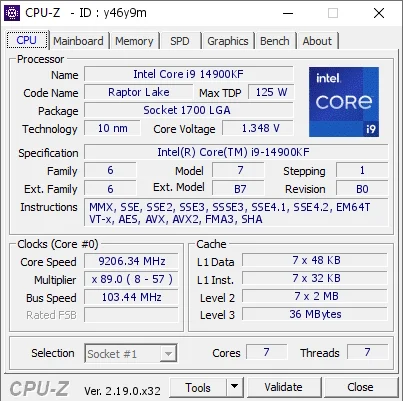
In the high-stakes world of competitive overclocking, frequency is the ultimate metric of performance. For years, engineers and enthusiasts have engaged in a relentless pursuit to push silicon beyond its design specifications, utilizing everything from liquid nitrogen to custom-built hardware platforms. This week, that ceiling was pushed significantly higher as the Intel Core i9-14900KF officially became the first processor in history to break the 9.2GHz threshold.
Achieved by the acclaimed Chinese overclocker "wytiwx," this feat represents a landmark moment in the history of x86 architecture. By clocking the processor at 9,206MHz, the team behind this achievement has solidified the Intel 14th Gen platform’s reputation as a powerhouse for extreme overclocking, eclipsing previous records and setting a new benchmark that may stand for years to come.
The Main Facts: A New World Record
The validation, officially recorded on the HWBOT database, confirms that the Intel Core i9-14900KF reached a staggering frequency of 9,206MHz. To put this into perspective, a stock i9-14900KF operates with a maximum turbo boost of 6.0GHz. The overclocker managed to push the silicon 3.2GHz beyond its factory-rated limit—a feat that requires not only exceptional hardware binning but also precise environmental control.
To achieve this, wytiwx employed extreme cooling measures, specifically utilizing liquid nitrogen (LN2) to bring the CPU temperatures down to sub-zero levels, preventing the thermal throttling that would normally occur at such high voltages. To ensure stability for the validation process, the processor was down-configured to seven active cores and seven threads. The voltage was pushed to 1.348V, a delicate balancing act that provided enough power to sustain the massive frequency without instantly destroying the circuitry through electromigration.
The test bench was anchored by the Asus ROG Maximus Z790 Apex, a motherboard specifically engineered for overclockers who demand extreme power delivery and signal integrity. The system was paired with 16GB of DDR5 memory running at 5,792MHz with CL32 timings, ensuring that the memory controller could keep pace with the hyper-fast processing core.
Chronology: The Road to 9GHz
The journey to the 9GHz milestone has been a gradual, multi-year escalation in the overclocking community. For decades, the 8GHz barrier was the "holy grail" of the hobby, a point of contention that many believed might be the physical limit of traditional silicon fabrication.
The Early Days of Extreme Overclocking
In the early 2010s, overclocking was defined by the legendary AMD FX series. The FX-8370, for instance, held the record for years, eventually peaking at 8,722MHz. While impressive for its time, the architectural limitations of the era prevented the industry from consistently crossing the 9GHz mark.
The Intel 13th and 14th Gen Renaissance
The introduction of Intel’s Raptor Lake architecture changed the game. With the launch of the Core i9-13900K and subsequently the 14900K and 14900KS, the overclocking community found a new "golden" architecture. These chips were built with a high-performance process node capable of handling high voltages and maintaining stability at high clock speeds.
In early 2023, the community saw a flurry of activity as top-tier overclockers began hitting the 8.5GHz, 8.7GHz, and finally the 9GHz barrier. The previous record-holder, Elmor, achieved 9,117MHz with the Core i9-14900KS. The transition from 9.1GHz to 9.2GHz—while seemingly small in numerical terms—represents a monumental increase in complexity. At these frequencies, the margin for error is measured in microseconds, and the heat dissipation requirements are exponentially more difficult to manage.
Supporting Data and Hardware Analysis
To understand the magnitude of this achievement, one must look at the specifications of the Intel Core i9-14900KF under normal operating conditions compared to its record-breaking state.
Stock Specifications
- Architecture: Raptor Lake Refresh
- Core Configuration: 24 Cores (8 P-Cores, 16 E-Cores)
- Threads: 32
- L3 Cache: 36MB
- Base Power (TDP): 125W
- Max Turbo Power: 253W
- Stock Turbo Frequency: 6.00GHz
Record-Breaking Configuration
- Active Cores/Threads: 7 Cores / 7 Threads
- Core Voltage: 1.348V
- Frequency: 9,206MHz
- Motherboard: Asus ROG Maximus Z790 Apex
- Cooling: Liquid Nitrogen (LN2)
The choice to disable 17 of the 24 cores is a standard practice in extreme overclocking. By reducing the core count, the overclocker lowers the overall power draw and thermal output of the package, allowing the remaining cores to draw more current and achieve higher stability at peak frequencies. Furthermore, the Asus ROG Maximus Z790 Apex is critical here; its specialized VRM (Voltage Regulator Module) configuration is designed to deliver "clean" power, which is essential when the CPU is running at nearly 150% of its rated turbo speed.
Official Responses and the HWBOT Community
The HWBOT database has verified the submission, confirming its status as the world record. Within the community, the reception has been one of awe, mixed with speculation about the future.
While Intel has not released an official statement regarding this specific record, the company has historically embraced the overclocking community, often providing engineering samples to top-tier overclockers to see how far their silicon can be pushed. The "KF" designation in the processor name—which denotes a high-performance part without integrated graphics—is often preferred by enthusiasts because it eliminates the heat and power overhead associated with the iGPU, allowing for slightly better thermal headroom.
Implications: The 10GHz Horizon
The question that now occupies the minds of the enthusiast community is simple: What comes next?
Can We Reach 10GHz?
The pursuit of 10GHz is the new Everest. Whether it is achievable on current 14th-generation architecture remains a subject of intense debate. As frequency increases, the voltage required to maintain stability increases, which in turn increases the risk of "catastrophic failure" (often referred to as "killing the chip"). At 9.2GHz, the processor is already operating at the absolute edge of what silicon can physically sustain before the transistors fail to switch accurately.
Impact on Future Architectures
This record serves as a valuable stress test for Intel’s engineers. By observing how these chips behave under extreme conditions, manufacturers gain insights into signal propagation, thermal density, and power delivery efficiency. While 9GHz is not a practical speed for a consumer PC—which would require a massive cooling tank of liquid nitrogen—the lessons learned here often filter down into the design of future high-performance cores, helping Intel push the "stock" performance of their next-generation CPUs higher.
A New Era of Benchmarking
This achievement also highlights the continued relevance of competitive benchmarking. Despite the rise of AI-driven optimization and software-side performance tuning, the raw "clock speed" race remains a fundamental test of engineering excellence. It reminds us that at the heart of our computing experience, there is still a physical, tangible piece of silicon that can be pushed to its limits through human ingenuity.
Conclusion
The 9,206MHz record set by wytiwx is more than just a number on a leaderboard. It is a testament to the synergy between modern semiconductor manufacturing and the relentless spirit of the overclocking community. As we look toward the future, the 10GHz barrier looms large. Whether it is achieved on the current 14th Gen architecture or a future node remains to be seen, but one thing is certain: the race to the top of the clock speed mountain is far from over.
For the everyday user, these records provide a glimpse into the hidden potential of their own hardware. While your i9-14900KF might be running at a modest 5.5GHz, it is built on the same foundation as the record-breaking chip that defied the laws of physics this week. In the world of high-performance computing, the boundary between what is "possible" and what is "probable" continues to shift, one megahertz at a time.

 Nila Kartika Wati
 Laily UPN