

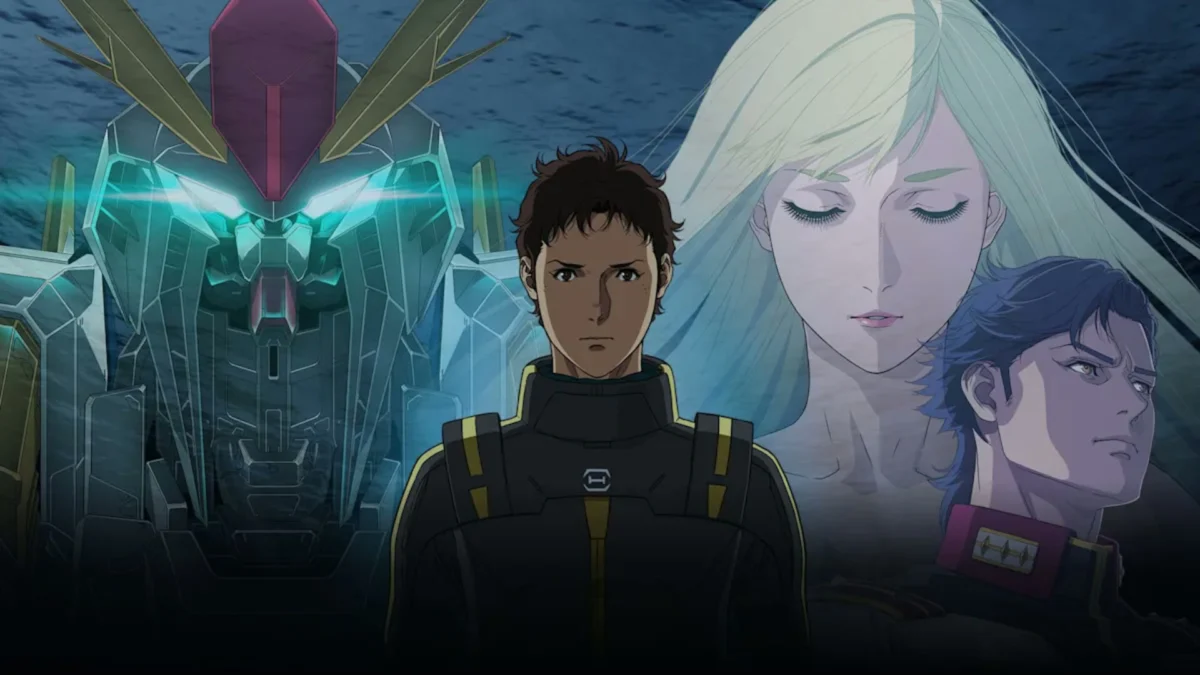
After years of anticipation that felt, to the most dedicated fans, like an eternity, the second installment of the Hathaway trilogy has finally arrived on international shores. Gundam Hathaway: The Sorcery of Nymph Circe has hit global theaters, carrying the immense weight of the franchise’s legacy and the high expectations set by its 2021 predecessor.
Following a successful domestic run in Japan that saw it gross over 2.7 billion yen—surpassing the 2.23 billion yen benchmark established by the first film—the sequel is now under the global microscope. Does it maintain the prestige of the Universal Century, or does it buckle under the pressure of being the dreaded "middle child" of a trilogy?

Main Facts: The Evolution of a Legend
Gundam Hathaway: The Sorcery of Nymph Circe continues the narrative directly following the events of the first film. The protagonist, Hathaway Noa, has been unmasked as Mafty Navue Erin, the leader of the insurgent terrorist organization known as "MAFTY." With his identity compromised, the film shifts from a covert operation thriller into a high-stakes psychological drama.
Director Shukou Murase, known for his work on Ergo Proxy, has returned to the helm, demonstrating a clear commitment to the "Tomino Style"—a narrative approach defined by Yoshiyuki Tomino, the creator of the Gundam franchise. In this style, the audience is treated as an observer of an existing, breathing world. Characters do not explain their histories or motivations to the viewer; they interact as if the audience were merely a fly on the wall, leaving the viewer to piece together the socio-political tapestry of the Earth Federation’s decline.

The Chronology of Conflict
The narrative structure of The Sorcery of Nymph Circe is arguably its most divisive element. The film begins with the fallout of the previous skirmishes, with Hathaway regrouping with his crew to strategize for future conflicts. However, the film frequently bifurcates its narrative focus.
The first two-thirds of the runtime are characterized by a disjointed, non-linear progression. The camera jumps between Hathaway’s internal mental degradation, the political maneuvering of the enigmatic Gigi Andalucia, and the tactical frustrations of Kenneth Sleg. While this serves to deepen the character studies, it creates a palpable sense of stagnation in the primary plot.

Fans expecting the rapid-fire escalation of a typical blockbuster will find this film’s pace sluggish. It is a slow burn that prioritizes the existential dread of its protagonist over the kinetic thrill of mobile suit combat. It is not until the final act that the film pivots, delivering a payoff that reconciles Hathaway’s internal psychological warfare with the physical manifestation of his past.
Supporting Data and Production Values
From a visual standpoint, the film is an undisputed triumph. The production team’s decision to scout and reference real-world locations—specifically the urban density of Hong Kong and the sprawling, scenic architecture of Adelaide—adds a layer of grounding that elevates the scale of the conflict.

The Technical Marvel of Animation
The blend of 2D character designs with high-fidelity 3D mobile suit animation remains industry-leading. The opening sequence is particularly notable; it frames the scale of the Gundam universe through the eyes of a common soldier on the ground. When a mobile suit towers over the infantry, the sense of hopelessness is visceral.
The animation team has successfully corrected one of the most frequent complaints regarding the first film: the lighting of the final battle. While Murase maintains his penchant for moody, high-contrast, and occasionally pitch-black interior scenes, the climactic mobile suit engagements are bright, crisp, and fluid, allowing the audience to fully appreciate the intricate mechanical design and the physics of high-speed dogfights.

The Auditory Experience
The sound design is where the film finds itself in controversial territory. Hiroyuki Sawano, the maestro of modern mecha scores, returns with his signature techno-orchestral compositions. The sound effects—from the tactile, crunching ASMR of cockpit interactions to the bone-rattling bass of missile impacts—are best experienced in an IMAX environment.
However, the "needle drops" have sparked significant debate. The choice of SZA’s "Snooze" for the opening is a bold, if arguably tonally dissonant, decision. Even more jarring is the use of Guns N’ Roses’ "Sweet Child O’ Mine" during a critical emotional juncture. While the song is a classic, its deployment in the film’s climax shifted the theater atmosphere from somber tension to audible laughter. While the lyrics of these tracks arguably mirror the narrative themes, the sonic incongruity with Sawano’s score creates an uneven experience that feels at odds with the film’s otherwise grim tone.

Official Responses and Industry Context
The production team has maintained that the film is a faithful expansion of the source material’s spirit, even as they take creative liberties with the adaptation. While this reviewer has chosen to assess the film on its own merits rather than as a 1:1 adaptation of Tomino’s novels, the sentiment among the broader Gundam community is one of appreciation for the risk-taking.
Industry analysts note that the 2.7 billion yen domestic performance is a significant indicator of the "Gundam Renaissance." The franchise, once considered niche outside of Japan, is seeing a surge in global interest. This success has prompted Bandai Namco to fast-track marketing for the final installment, signaling that the studio is confident that despite the pacing issues of the second act, the audience loyalty remains unshakable.

Implications: The Middle-Child Syndrome
The ultimate takeaway from The Sorcery of Nymph Circe is that it serves as a bridge, albeit a somewhat wobbly one. Being the middle chapter of a trilogy, the film suffers from the inevitable "middle-child syndrome." It is burdened with the responsibility of laying the groundwork for the inevitable climax while lacking the fresh impact of the introduction or the cathartic resolution of the finale.
There are missed opportunities here. Many supporting characters, such as the crew of the Valiant, are relegated to the background, receiving only fleeting screen time. For a franchise built on the strength of its ensemble casts, this is a notable deficiency.

However, the film succeeds where it matters most: the deconstruction of Hathaway Noa. His journey—from a disillusioned idealist to a man haunted by the shadow of Amuro Ray and the weight of his own violent choices—is handled with masterful restraint. The psychological payoff in the final moments of the film is a testament to the potential of this trilogy.
Final Verdict
Gundam Hathaway: The Sorcery of Nymph Circe is a visually breathtaking, technically superior film that occasionally trips over its own ambition. It does not consistently reach the heights of the first movie, primarily due to erratic pacing and questionable musical choices that threaten to pull the viewer out of the immersion.

Despite these flaws, it remains a "pretty good" entry that is essential viewing for any Gundam enthusiast. It is a bold, albeit uneven, exploration of the cost of revolution and the isolation of leadership. As the franchise prepares for the final act, the pieces are now firmly in place for a potentially explosive conclusion. If you are a fan of the Universal Century timeline, the flaws in the bridge are worth overlooking to see where the path finally leads.
Gundam Hathaway: The Sorcery of Nymph Circe is currently screening in over 800 theaters across the United States and select international markets. Check your local listings for showtimes.












No comments yet. Be the first to join the conversation!