


In the intricate tapestry of Japanese culture, few regional rivalries are as deeply embedded as the dichotomy between Kanto—the eastern hub centered on the Tokyo Metropolis—and Kansai, the western heartland encompassing Osaka, Kyoto, and Kobe. While they share a national language, the two regions often feel like distinct nations separated by a common tongue. Nowhere is this cultural friction more palpable—or more delicious—than in the breakfast habits of their citizens.
A recent stir on social media has once again illuminated this divide, centered on a seemingly innocuous phrase: ashita no pan (明日のパン), or "tomorrow’s bread." To the residents of Osaka and Kyoto, this is a common, almost subconscious household mantra. To those in Tokyo and the surrounding Kanto prefectures, it is a puzzling, alien expression that highlights a fundamental divergence in domestic priorities and culinary identity.
The Linguistic Shorthand of Domestic Life
The phrase ashita no pan is more than a shopping list item; it is a cultural institution. It refers to the deliberate act of securing bread for the following morning’s breakfast. While it sounds literal, the term functions as a psychological anchor for many Kansai residents, ensuring that the day begins with a sense of order and preparedness.
The confusion arises when this phrase travels east. For a Kanto resident, bread is often an optional snack or a secondary choice. When a Kansai native expresses concern over "tomorrow’s bread," their Kanto counterparts are frequently left bewildered, often asking, "But you eat rice sometimes, too, right?" or "Is ‘bread’ just a metaphor for breakfast?"
This misunderstanding is not merely about semantics; it is a reflection of a deeper regional ethos. For the Kansai household, the breakfast menu is often pre-determined by the availability of bread. The phrase has become so ingrained in the Kansai dialect that it serves as a regional identifier, separating the "bread-first" culture of the west from the more traditional, rice-centric or varied habits of the east.
Chronology of a Viral Debate
The friction between Kanto and Kansai is an age-old story, but the discourse surrounding ashita no pan has gained significant momentum in the digital age.

- Pre-2020: The term exists as an unchallenged, everyday colloquialism in Kansai homes, particularly among mothers managing household logistics.
- 2022: The phrase gains national attention after going viral on social media platforms. Anecdotal evidence from residents moving between regions reveals that the phrase is, for many, a "hidden" regionalism they didn’t realize was unique to the west.
- 2025: A nationwide survey of 1,077 subscribers to Pansuku (a dedicated bread subscription service) provides empirical weight to the anecdotal evidence. When asked to complete the phrase "ashita no…" (tomorrow’s…), 38.6% of Kansai respondents immediately filled in the blank with "pan" (bread). Conversely, in Kanto, only 6.6% chose "bread," with the vast majority opting for "tomorrow’s weather"—a testament to the mundane, functional focus of the eastern region.
Supporting Data: Bread vs. Rice
The rivalry is backed by compelling data that suggests the "Kansai is Breadland" moniker is far more than a stereotype. While Japan has historically been synonymous with rice consumption, the post-war era saw a steady shift toward Western-style diets. Today, national statistics show a near-deadlock, with roughly 50.2% of the population favoring rice for breakfast and 49.8% opting for bread.
However, zooming in on the Kansai region reveals a dramatic skew:
- The Bread-First Region: A 2021 J-Town survey of 1,204 residents found that 61.1% of Kansai respondents preferred bread for breakfast.
- The Leaders of the Loaf: Hyogo Prefecture leads the nation with a staggering 77.6% bread preference, followed closely by Nara (76.5%) and Kyoto (67.7%).
- Economic Impact: The devotion to bread is reflected in household spending. Kobe, the capital of Hyogo, consistently ranks as the nation’s top spender on bread, with the average household shelling out 41,183 yen ($259 USD) annually. The top five cities for bread spending are exclusively in the Kansai region: Kobe, Wakayama, Otsu, Kyoto, and Osaka.
Historical Roots and the "Bread-Crazy" Culture
Why did the Kansai region diverge so sharply from the national average? Historians and sociologists point to the opening of the Port of Kobe in 1868. As one of the first ports to open to foreign trade during the Meiji Restoration, Kobe became a gateway for Western influence. Bread was introduced not as an exotic novelty, but as a staple of the international lifestyle that Kobe sought to emulate.
This early exposure evolved into a solidified food culture. By the 1960s, the mass-market introduction of shokupan (thick-sliced white bread) by the Kobeya Baking Company cemented bread as a domestic breakfast essential.
This cultural entrenchment even influences the physical product itself. In Kanto, where bread is often consumed as a quick snack or side, supermarket loaves are typically sliced thinner—into six or eight pieces—at roughly 20mm per slice. In contrast, the Kansai standard is a thicker, more substantial five-slice cut, measuring approximately 24mm. This preference for a "heartier" slice is a direct manifestation of treating bread as a main course rather than a peripheral item.
Official and Societal Implications
The persistence of these regionalisms is a fascinating subject for linguists and sociologists alike. While the Meiji era standardized Japanese as a national language, the "hidden dialects" and regional idiosyncrasies remain vibrant.
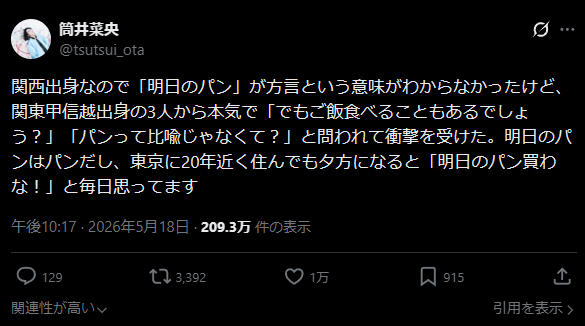
The ashita no pan debate is a microcosm of a larger phenomenon: the persistence of regional identity in a globalized, homogenized world. When X user @tsutsui_ota shared their confusion at being misunderstood by colleagues in Tokyo, it sparked a national conversation about how even a simple trip to the supermarket can reveal the invisible borders of regional culture.
Beyond bread, these linguistic markers continue to define the Japanese experience:
- The "Nande ya nen" Factor: Phrases like nande ya nen (a signature Kansai retort) or ookini (thank you) act as instant social signals.
- The Aichi Anomaly: In Aichi Prefecture, the word chin-chin is used to describe extreme heat, a phrase that carries an entirely different, highly offensive meaning in the rest of the country, highlighting the dangers of assuming linguistic universality.
- The Shizuoka Mystery: Phrases like ii ni suru in Shizuoka serve as linguistic "wildcards," with multiple, often contradictory meanings—compromise, permission, or simply giving up—depending on the speaker’s intent and the listener’s interpretation.
Conclusion: A Nation of Differences
The debate over "tomorrow’s bread" serves as a reminder that Japan is not a monolith. The tension—or, more accurately, the playful rivalry—between Kanto and Kansai is what keeps the social fabric of the country dynamic. Whether one starts their day with a steaming bowl of rice or a thick, buttered slice of shokupan, these daily rituals are the bedrock of local identity.
As long as the sun rises, the residents of Osaka will continue to look ahead to their breakfast, ensuring that ashita no pan is accounted for. And as long as they do, the rest of the country will likely continue to look on with a mix of bemusement and curiosity, proving that even the most mundane of breakfast items can sustain a lifetime of cultural conversation.












No comments yet. Be the first to join the conversation!