Neng Nana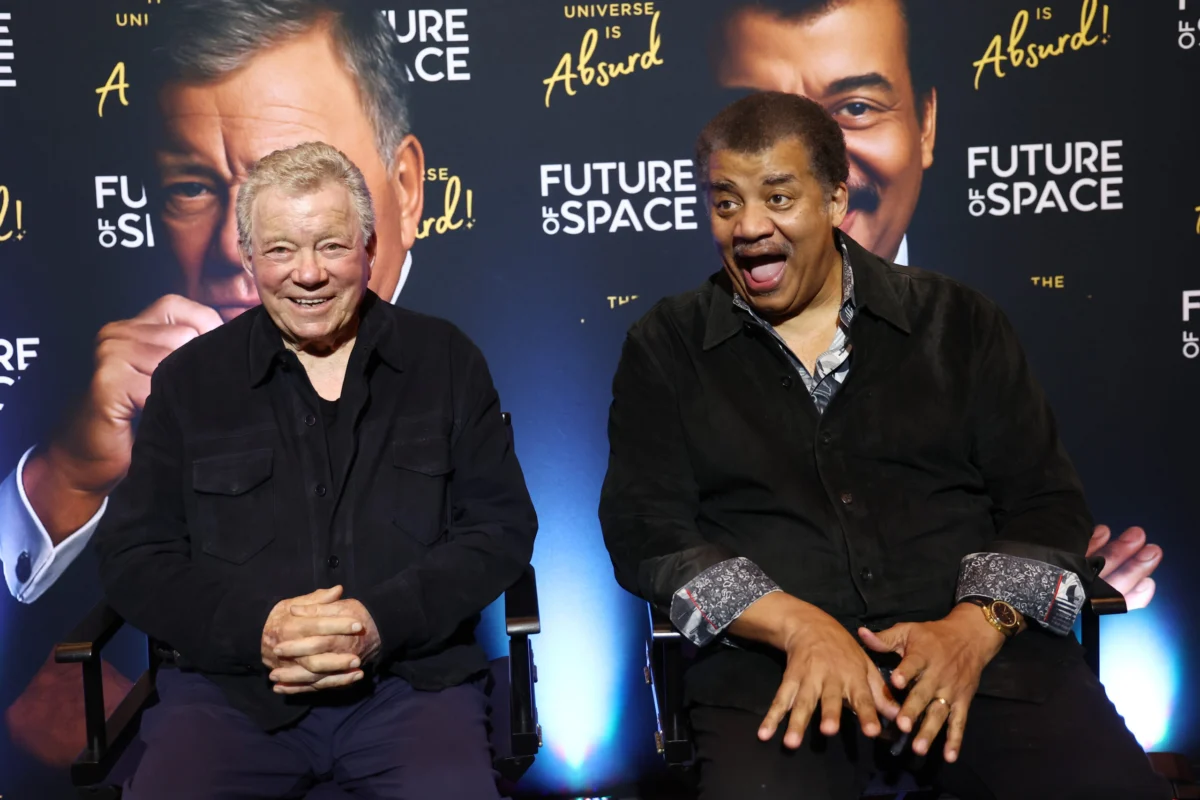
In an era where the boundaries between science and entertainment continue to blur, few pairings could capture the imagination quite like the legendary William Shatner and preeminent astrophysicist Neil deGrasse Tyson. On Wednesday night, the Saban Theatre in Beverly Hills became the epicenter of an intellectual and comedic collision. The event, aptly titled "The Universe Is Absurd!", served as the second installment of a two-night residency that saw the duo dissecting the mysteries of existence, the mechanics of quantum physics, and the sheer unpredictability of life—all while maintaining the rapport of old friends who have seen the ends of the Earth together.
A Meeting of Minds at the Edge of the World
The camaraderie between the 95-year-old Star Trek icon and the celebrated scientist is more than just a stage-managed gimmick; it is rooted in genuine adventure. The audience was treated to behind-the-scenes anecdotes from the pair’s 2024 expedition to Antarctica, the location where their unlikely friendship first took root.
Throughout the evening, the conversation shifted fluidly from the macroscopic—the vastness of space—to the microscopic, where Tyson offered a humbling perspective on the fundamental building blocks of matter. "The electron is so small, we do not know how small it is," Tyson explained to a captivated crowd. "Every measurement of the electron is smaller than our attempts to measure it. As far as we’re concerned, it’s infinitesimally small."
Shatner’s Latest Frontier: Heavy Metal
Despite his legendary status in science fiction, Shatner is currently pivoting toward a frontier that few expected: heavy metal. With a new album dropping in October, the actor faced the audience’s amusement with a characteristic deadpan delivery. "Why does everyone approach me with a smile when they hear ‘heavy metal album’?" he asked, refusing to let his age—a topic that dominated much of the conversation—define his creative output.
When Tyson noted that Shatner was born in 1931, the audience erupted into appreciative applause. Shatner, bristling at the sentiment, retorted, "I don’t like being applauded for my age. Applaud me for my heavy metal album." It was a moment that underscored the actor’s desire to be recognized for his current vitality rather than his historical legacy.
Decoding the Quantum Realm
Tyson utilized the banter to pivot into a deeper discussion on quantum physics. He reminded the audience that the neutron was only discovered a year after Shatner’s birth, framing the rapid evolution of human understanding. "In the 1920s, we learned that the universe is not continually divisible," Tyson noted. "You reach a point where there’s a unit of energy and you cannot have less than that. That is a quantum of energy."
Shatner, ever the skeptic of academic rigidity, challenged the scientific community’s history of absolute certainty. He argued that scientists have historically claimed to have reached the "final" building block of matter only to be proven wrong by further discovery. When he referred to the "entrails of a molecule," Tyson couldn’t resist a gentle jab, noting that the word hadn’t appeared in his own Ph.D. thesis. Shatner’s reply was quintessentially honest: "I’m trying to use the language that I understand. It’s not your language because you are a Ph.D."

The "Anomaly" of Spaceflight
Perhaps the most gripping segment of the evening was Shatner’s recounting of his 2021 suborbital flight with Blue Origin. The experience was marked by a visceral sense of trepidation. Shatner described the climb up the 11-story gantry, his anxiety piqued by the sight of leaking hydrogen, which immediately brought the Hindenburg disaster to mind.
The tension peaked during the countdown when ground control announced an "anomaly." Shatner recalled the moment with sharp clarity: "What the fuck is an anomaly?" When the option to abort the mission was presented, his internal monologue was dominated by his identity as Captain Kirk: "I can’t, I’m Captain Kirk. I can’t."
Describing the ascent, Shatner likened the g-force to an "elephant sitting on your chest," followed by the abrupt transition into weightlessness. He avoided the lighthearted antics of previous passengers, focusing instead on the window. Upon landing, however, he was hit by an unexpected wave of grief. "Jeff Bezos was there with a microphone and international cameras, and I’m weeping," Shatner confessed. "I’m crying uncontrollably, and I don’t know why."
Environmental Grief and the Human Experience
The grief Shatner felt in space, he later realized, was an expression of his concern for the Earth. His past work on the show Voice of the Planet had taken him to the Himalayas, where he was horrified by the waste left behind by humanity. "Shit is all over the place in these pristine mountains, and it echoes the shit that we’ve left all over the planet," he lamented. He cited the prevalence of microplastics in human blood as a tragic testament to the damage being inflicted upon the environment.
Tyson bridged this philosophical moment with a technical explanation of weightlessness. He clarified that weightlessness isn’t a magical state of space, but a state of perpetual free-fall. "Anybody in orbit is weightless because they are continually free-falling toward Earth," Tyson explained. "Not because they’re in space."
The Case for Human Exploration
The duo eventually addressed the debate over whether robots or humans should lead the charge into the cosmos. While Shatner had previously questioned the wisdom of sending "vulnerable" humans to Mars, he has since changed his tune.
"The voyage of exploration needs to be experienced by a human being," Shatner argued. "It takes the soul, the brain, the conscious and the unconscious being that we are to experience this magical thing called exploration."

Tyson reinforced this sentiment with a pragmatic observation: "No one has ever given a ticker-tape parade for a robot. No one has ever named a middle school after a robot."
The Legacy of the Final Frontier
As the evening drew to a close, the conversation turned toward Shatner’s place in history. When the actor mused about his affinity for the universe and his place within it, Tyson brought the discussion back to Earth with a poignant reminder of Shatner’s cultural impact: "Do you know what your place in this great unknown is? You lip-kissed a Black woman on television for the first time."
The reference to the historic 1968 Star Trek kiss between Captain Kirk and Lt. Nyota Uhura served as a reminder that science fiction often serves as a precursor to social progress.
The event concluded with a blend of art and science: Tyson read excerpts from his book Death by Black Hole accompanied by a pianist, while Shatner performed "Rage" from his upcoming album, backed by a trumpeter.
Implications of the Event
The "Universe Is Absurd!" residency, organized by Future of Space, serves as a vital bridge between the scientific community and the general public. By pairing an icon of cultural exploration with one of the world’s most articulate scientific communicators, the event highlighted the necessity of maintaining wonder in the face of existential threats like climate change and the complexities of modern physics.
The implications are clear: as humanity pushes further into the stars, the "human" element—our grief, our curiosity, and our capacity for art—is just as important as the cold, hard data collected by our mechanical envoys. Shatner and Tyson left the audience with the sense that while the universe may be absurd, our attempt to understand it is the most meaningful endeavor we can undertake.

 Siti Muinah
 Lina Hope