

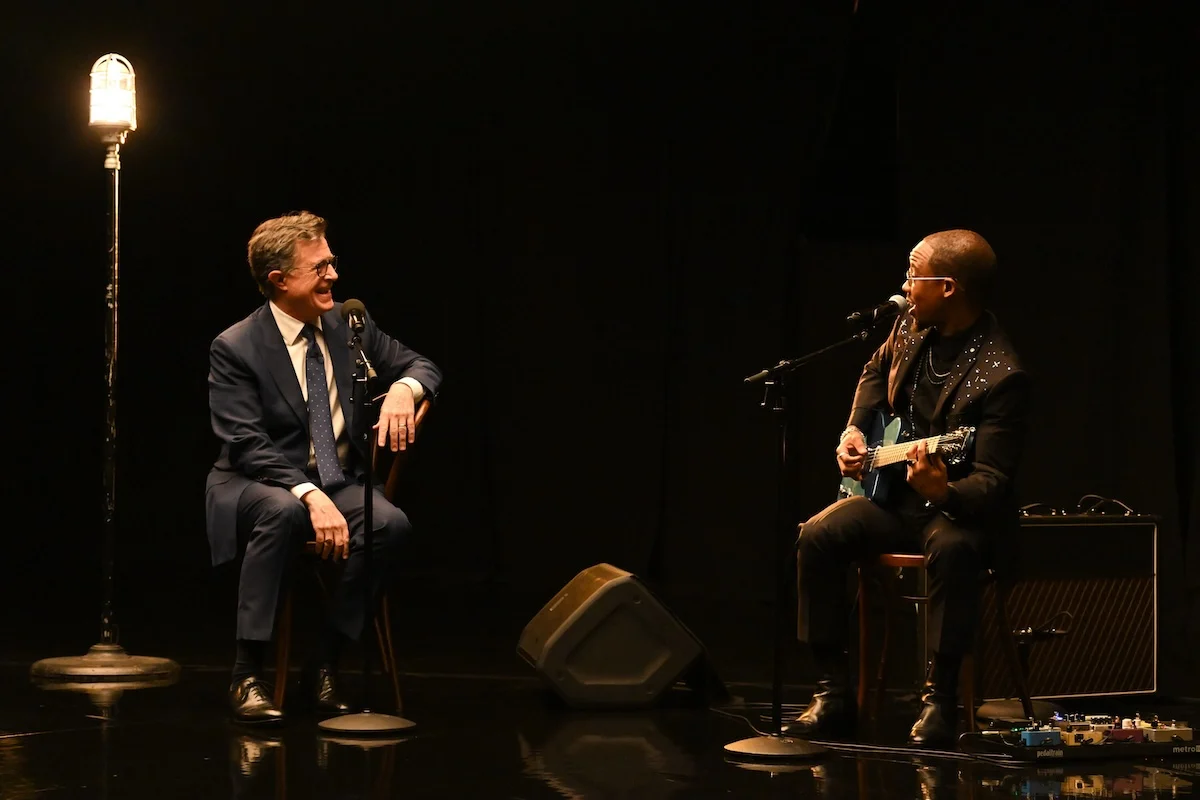
“We call this show The Joy Machine,” Stephen Colbert remarked during the opening moments of his final broadcast, his voice carrying that familiar blend of impish humor and genuine sincerity. “Because to do this many shows, it has to be a machine. But the thing is, if you choose to do it with joy, it doesn’t hurt as much when your fingers get caught in the gears.”
On Thursday night, the gears of that machine came to a definitive, orchestrated halt. After 11 years at the helm of the Ed Sullivan Theater, Stephen Colbert signed off from The Late Show, marking the end of an era for the 33-year-old CBS staple. Despite holding the top position in late-night ratings and maintaining a robust multi-platform footprint, the show was canceled—a decision that sent shockwaves through the industry and left a devoted audience grappling with the sudden vacuum in the late-night landscape.
The End of an Institution
The cancellation of The Late Show was not merely the loss of a television program; it was the dissolution of a cultural touchstone. Created by David Letterman, the franchise had served as a bedrock of American political and social discourse for over three decades. When Colbert took the chair in 2015, he brought a specific brand of intellectual curiosity and performative satire that evolved into a sophisticated, highly personal take on the late-night format.
Despite a 10-month lead-up to this final curtain call, the transition felt premature to the staff, the host, and the millions of viewers who viewed the show as a nightly ritual. The industry reaction was swift, characterized by bewilderment at how a broadcast powerhouse—one that remained highly profitable and culturally relevant—could be shuttered. Yet, true to form, Colbert refused to let the circumstances of his departure dictate the quality of his final performance.
A Chronology of the Final Bow
Colbert opened the final episode with a defiant mission statement: there would be no grand, tear-jerking spectacle, no radical departure from his established rhythm. He insisted on a “regular show,” because, as he posited, every episode of The Late Show was special in its own right. However, the universe had other plans.

The evening became a comedic gauntlet of interruptions. A parade of celebrities—including Bryan Cranston, Paul Rudd, and Tig Notaro—attempted to stake their claim on the final guest chair, only to be rebuffed with Colbert’s signature deadpan humor. Paul Rudd, in a nod to the surrealism that defined the show’s later years, arrived bearing five bananas as a "customary" retirement gift, a gag that echoed through the night as Ryan Reynolds later bestowed the same fruit upon keyboardist Corey Bernhard.
The middle segment was vintage Colbert. He navigated the day’s headlines with his typical sharp-witted precision, updated his "First Drafts" segment, and shared historical trivia about the Ed Sullivan Theater, including the infamous, lighthearted fact that Elvis Presley had used the backstage facilities without incident. He even managed to squeeze in a segment about the Pope—his perennial "dream guest"—before welcoming his final, officially sanctioned guest: Paul McCartney.
The conversation with McCartney was the emotional anchor of the evening. Eschewing the frantic pacing of modern celebrity interviews, Colbert sat with the Beatle for a deeply human exchange that touched on the nature of democracy, the absurdity of modern technology ("I hate cookies," McCartney quipped about his phone), and the foundational memories of music. McCartney presented a signed photograph of The Beatles’ historic performance at the same theater, a poignant gift that bridged the gap between the show’s origins and its final, silent moment.
The Metaphysical Breakdown: The Green Wormhole
While the interviews were grounded, the show’s narrative arc took a turn into the absurd. Throughout the night, a recurring glitch—a green light accompanied by a strange, grinding sound—haunted the set. Colbert eventually left the stage to investigate, only to discover an inter-dimensional wormhole in the basement of the theater.
The sketch served as a meta-commentary on the show’s precarious position: a paradox where the No. 1 show in late-night was simultaneously "canceled." The wormhole consumed astrophysicist Neil deGrasse Tyson and beckoned for a "wise mentor." This prompted a cameo from Jon Stewart, who appeared "on behalf of Paramount" to urge Colbert to face the void with courage. "The hole’s here," Stewart said, delivering the blunt truth of the industry’s changing tides. "You can’t ignore it, the only choice you have now is how you choose to walk through it."

The sketch culminated in a surreal, pre-taped sequence where Colbert stood in a desolate void, accompanied by musical legends Elvis Costello, Jon Batiste, and current bandleader Louis Cato. Together, they performed a haunting rendition of "Jump Up," before the broadcast transitioned back to the live studio audience for a final, joyous rendition of The Beatles’ "Hello, Goodbye."
Supporting Data: The Ratings and the Reach
The decision to cancel The Late Show remains a point of contention among media analysts. Throughout his tenure, Colbert consistently outperformed his competitors in the Nielsen ratings. His digital strategy, which prioritized viral clips and social media engagement, allowed the show to transcend the traditional 11:35 PM time slot, reaching a global audience that often engaged with the content hours or days after the initial broadcast.
By the time of the final episode, the show’s cross-platform reach was at an all-time high. The move to cancel, therefore, appears to be less about a decline in viewership and more about a seismic shift in corporate strategy at the network level—a pivot toward different content models that do not necessarily prioritize the expensive, labor-intensive model of late-night talk.
Implications of the Departure
The end of The Late Show with Stephen Colbert signals a profound transition for late-night television. For decades, the genre was defined by the monolithic "talk show host"—a figurehead who served as a national therapist and cultural arbiter. Colbert’s tenure refined this, blending the hard-hitting political commentary of his Colbert Report days with the traditional warmth of a variety show host.
The implication for the industry is clear: the era of the "Joy Machine" is over. As corporate entities prioritize short-term profitability and fragmented content over long-term, appointment-based viewing, the cultural space once occupied by the late-night monologue is shrinking. The "wormhole" that consumed the theater in the finale is, in a very real sense, the digital disruption that has rendered the traditional late-night format an endangered species.

A Final Note on Sincerity
Despite the external pressures and the abruptness of the end, the finale succeeded because it felt entirely authentic. It was not a show built for the network executives; it was a show built for the audience.
When the lights finally went out on the Ed Sullivan Theater, the final image was not one of despair, but of a quiet, circular return. A snow globe was left behind, and Colbert’s dog, Benny, sniffed at the debris of a career that had defined a decade of television.
"We love doing the show for you, but what we really, really love is doing the show with you," Colbert had said in his opening. It was a mission statement that held true until the final second. Whether or not Stephen Colbert returns to the medium remains to be seen. But in his departure, he left a template for how to handle the inevitable "hurt" of life’s gears: you do it with joy, you do it with intelligence, and you do it with the people you love.
As the screen faded to black, the industry was left to wonder if the late-night landscape could ever be truly whole again without the man who had, for eleven years, held up a mirror to the world and dared us to laugh at the reflection. For now, the machine is silent, the theater is dark, and a massive, loyal audience is left waiting to see where the next chapter begins.











No comments yet. Be the first to join the conversation!