

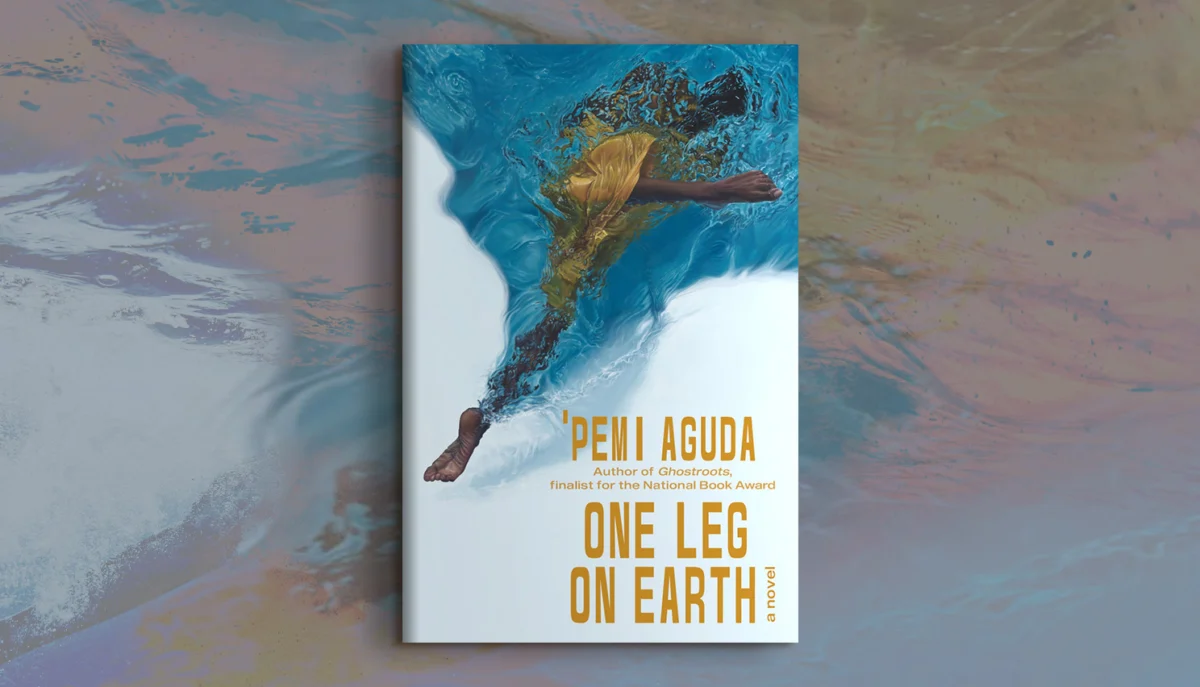
In the landscape of contemporary literature, few voices have emerged with the visceral, haunting clarity of ‘Pemi Aguda. Known for her ability to weave the tapestry of Nigerian folklore with the jagged edges of modern reality, Aguda’s latest work, One Leg on Earth, stands as a monumental exploration of the maternal psyche. Recently, Aguda sat down with Brenda Allison on the Poured Over podcast to dissect the intricate layers of her writing process, the architectural heartbeat of Lagos, and the profound, often isolating experience of motherhood.
Main Facts: The Intersection of Myth and Modernity
One Leg on Earth is not merely a novel; it is an examination of autonomy. Aguda uses the lens of speculative fiction to interrogate what it means for a woman to claim ownership of her body and her narrative within a society that frequently demands both be surrendered.
The conversation between Aguda and Allison centered on the "daring exploration" of motherhood. In the book, Aguda tackles the physiological and psychological metamorphosis of pregnancy, treating it not as a static biological event, but as a liminal space where the boundaries between the self and the "other" begin to dissolve. By blending folklore—the ancient, whispered stories of the past—with the concrete, bustling reality of Lagos, Aguda creates a setting where the supernatural is not a deviation from reality, but an essential component of it.
For Aguda, Lagos is more than just a backdrop; it is a character. Its sprawling, chaotic, and vibrant architecture serves as a metaphor for the internal structures of her protagonists. The city’s vertical growth, its labyrinthine streets, and its history of colonial and post-colonial development mirror the complicated, often contradictory feelings of women struggling to find their footing in a world designed to constrain them.
Chronology of a Literary Voice
Aguda’s rise to prominence has been characterized by a steady, deliberate accumulation of acclaim. While her debut collection, Ghostroots, introduced readers to her penchant for the uncanny and the domestic, One Leg on Earth marks a significant evolution in her narrative scope.
- Early Literary Foundations: Aguda’s writing has always been informed by the "craft of the real." Early in her career, she looked toward pedagogical texts like Matthew Salesses’ Craft in the Real World to challenge traditional, Western-centric structures of storytelling.
- The Ghostroots Era: With the release of Ghostroots, Aguda established herself as a master of the short story, using the medium to explore ancestral baggage and the ghosts of memory.
- The Development of One Leg on Earth: During the development of her latest novel, Aguda turned toward the "classics" of feminine entrapment and rebellion. Works such as Kate Chopin’s The Awakening and Henrik Ibsen’s A Doll’s House provided a thematic framework for her investigation into the domestic sphere.
- Current Discourse: The release of One Leg on Earth has sparked a broader conversation regarding the "new wave" of African literature, where genre boundaries are increasingly porous.
Supporting Data: A Literary Genealogy
To understand the depth of Aguda’s latest offering, one must look at the canon she draws from. The episode of Poured Over highlighted a curated list of titles that influenced the creation of One Leg on Earth. These works represent a cross-section of feminist literature and experimental fiction:
- Foundational Feminist Texts: The Awakening (Kate Chopin) and A Doll’s House (Henrik Ibsen) serve as the bedrock for Aguda’s exploration of the stifling nature of 19th and 20th-century domesticity.
- Contemporary Echoes: The selection includes works by Han Kang (The Vegetarian) and Julia Armfield (Our Wives Under the Sea), both of whom are known for their surreal, body-horror-adjacent approaches to feminine identity and transformation.
- The Craft of Fiction: Elizabeth McCracken’s A Long Game: Notes on Writing Fiction and Matthew Salesses’ Craft in the Real World illustrate Aguda’s commitment to refining the mechanics of storytelling, ensuring that her surrealist elements remain anchored in emotional truth.
- Emerging Voices: By referencing Tolani Akinola (Leave Your Mess at Home) and Katherine Packert Burke (All Us Saints), Aguda acknowledges her place within a thriving ecosystem of contemporary authors who are actively deconstructing the myths of the home.
Official Responses and Creative Insight
During the Poured Over interview, hosted by Brenda Allison and technically produced by Harry Liang, Aguda provided candid insights into the "loneliness" of the creative process. She noted that while writing One Leg on Earth, she often felt a kinship with her characters—a profound sense of detachment necessitated by the act of creation.
"Motherhood is an architecture," Aguda noted, describing how the physical body changes in ways that are both miraculous and alienating. She discussed the importance of autonomy, specifically how pregnant characters in literature are often treated as vessels rather than individuals. In One Leg on Earth, she pushes back against this trope, insisting that her characters maintain their agency, even when the world around them—and the forces of folklore—insist otherwise.
When asked about the influence of architecture, Aguda explained that the physical spaces of Lagos—the way houses are built, the way they crumble, and the way they are renovated—reflect the persistence of history. "A house in Lagos," she remarked, "is never just a house. It is a repository of ghosts, a site of negotiation, and a structure that holds the weight of our collective past."
Implications: The Future of the "Domestic Gothic"
The implications of Aguda’s work extend far beyond the bookstore shelves. One Leg on Earth contributes to a growing movement of "Domestic Gothic"—a subgenre that takes the familiar, safe space of the home and renders it unsettling.
1. Reclaiming the Body
By placing the maternal experience at the center of a narrative that also involves the supernatural, Aguda asserts that the most "monstrous" and "miraculous" things happen within the biological body. This challenges readers to view pregnancy not as a passive state, but as a radical, transformative period of existence.
2. The Globalized Nigerian Narrative
Aguda is part of a generation of Nigerian writers who are moving away from the "trauma-focused" narratives often expected of African authors by Western markets. Instead, she utilizes the specificities of Nigerian life—its architecture, its myths, its socio-economic pressures—to tell a universal story about the human condition.
3. Structural Innovation in Fiction
The list of books referenced in the podcast suggests a shift in how authors approach their craft. The dialogue between classic feminist plays and contemporary experimental novels shows a move toward a more inclusive, globally-minded canon. Writers are no longer bound by a single tradition; they are building their own, synthesizing the works of Ibsen with the oral traditions of Lagos.
Conclusion
As One Leg on Earth gains traction, it is clear that ‘Pemi Aguda has solidified her position as a formidable voice in global literature. Her conversation on Poured Over serves as a vital guide for readers, offering a glimpse into the rigorous intellectual and emotional labor behind her prose.
For those interested in exploring the intersection of the domestic and the supernatural, the titles discussed in the episode provide a comprehensive roadmap. Whether it is through the haunting imagery of Edwidge Danticat’s Claire of the Sea Light or the short-form brilliance of M Lin’s The Memory Museum, these works, alongside Aguda’s own, invite us to look at our surroundings—and ourselves—with a new, more piercing intensity.
As the literary world continues to evolve, Aguda reminds us that our stories are grounded in the earth, even as we reach toward the folklore and myths that define our humanity. New episodes of Poured Over continue to provide a platform for these essential conversations, ensuring that the dialogue between authors and readers remains as vibrant and complex as the cities they inhabit.











No comments yet. Be the first to join the conversation!