Sagoh
Sagoh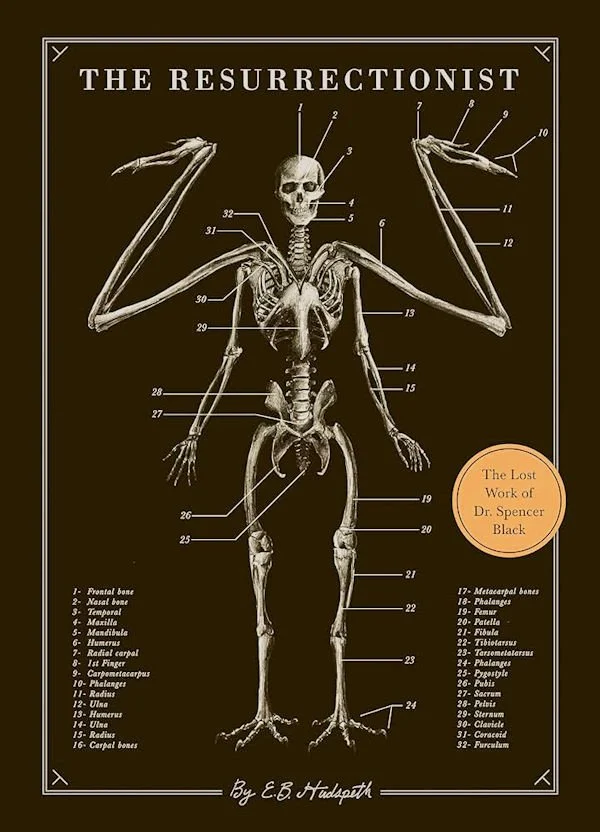
In the annals of speculative fiction, few subgenres possess the uncanny power of “fictional non-fiction.” It is a literary sleight of hand that requires not just a storyteller, but a world-builder, a historian, and a visual artist working in tandem to convince the reader that they are holding a piece of suppressed reality. E.B. Hudspeth’s The Resurrectionist is the latest, and perhaps most haunting, entry into this tradition. Blending the macabre atmosphere of late 19th-century Philadelphia with a faux-academic exploration of evolutionary biology, Hudspeth presents a work that is as much a psychological character study as it is a visual masterpiece.
The Premise: A Surgical Descent into Myth
The setting is Philadelphia, 1879. It is an era defined by the flicker of gaslight, the rattle of iron-rimmed carriage wheels on cobblestones, and the burgeoning, often ruthless, field of modern medicine. Into this landscape steps Dr. Spencer Black, a protagonist whose lineage is as grim as his ambition. Born to a grave robber, Black’s early exposure to the macabre serves as the foundation for his professional life at the esteemed Academy of Medicine.
However, Black is no ordinary practitioner. While his contemporaries are focused on the standard curricula of the time, Black is haunted by a singular, unorthodox hypothesis: that the creatures of ancient myth—satyrs, mermaids, sphinxes, and centaurs—are not merely the products of fevered imaginations. Instead, Black posits that these entities were the literal, biological ancestors of humankind. He argues that our evolutionary history is littered with the bones of giants and chimeras, and that modern man is merely a diluted, specialized offshoot of these legendary beings.
Chronology of a Man Unraveled
To understand the trajectory of The Resurrectionist, one must trace the arc of Dr. Black’s life, which serves as the narrative spine of the book.
- 1870–1875: The Academic Foundation. During his formative years at the Academy, Black is a prodigy. He is noted for his steady hand and anatomical precision, yet his journals reveal a mind increasingly preoccupied with anomalies. He begins to view traditional medicine as a limited framework for understanding the true, hidden history of the human form.
- 1876: The Hypothesis. Following a series of unauthorized dissections and field research, Black codifies his theory. He moves beyond abstract thought, seeking physical evidence of “atavistic traits” in human patients—vestigial tails, unusual skeletal protrusions, and other anomalies that he interprets as echoes of his mythological predecessors.
- 1877–1878: The Obsession. As the medical establishment begins to view his work with suspicion, Black retreats into isolation. He begins to see the world as a museum of lost relics. His journals reflect a man shifting from objective researcher to radical iconoclast, leading to his eventual expulsion from polite medical society.
- 1879 and Beyond: The Carnival of Horrors. The final, most tragic phase of Black’s life sees him transition from a surgeon to a showman. His work culminates in a grotesque attempt to recreate these mythological ancestors through surgery, a descent into madness that blurs the lines between a genius seeking truth and a monster creating it.
Supporting Data: The Codex Extinct Animalia
The true power of The Resurrectionist lies in its duality. The book is divided into two distinct sections: the biographical narrative of Dr. Black and the Codex Extinct Animalia.
The Codex is, for all intents and purposes, a medical textbook for the impossible. It contains detailed anatomical plates, skeletal renderings, and muscle-structure charts of mythological creatures. These are not the fantastical illustrations found in children’s storybooks; they are rendered with the clinical, cold, and dry precision of a 19th-century scientific manual.
When viewed in isolation, the Codex is a testament to the artist’s skill—an exercise in aesthetic world-building. However, when paired with the biography, the art takes on a chilling context. Each plate ceases to be a “curiosity” and becomes a document of a man’s mental disintegration. The meticulous detail in the drawings suggests that Black did not just imagine these creatures—he saw them in his mind’s eye with such clarity that he could map their biological functions. The art serves as a visual index of his madness.
Critical Analysis: The Genius of the “Faux-Fact”
Critics and readers alike have pointed to the unique tension inherent in Hudspeth’s work. By framing the narrative as a piece of history, the author forces the reader to confront the question: What if?
The Thin Line Between Science and Superstition
In the late 19th century, the scientific community was still grappling with Darwin’s On the Origin of Species. It was a time of intellectual volatility, where fringe theories were often given as much weight as empirical evidence. Hudspeth exploits this historical uncertainty masterfully. Dr. Black’s descent is not presented as a sudden snap, but as a logical, albeit terrifying, conclusion to the scientific fervor of the Victorian age.
The Problem of Pacing
While the atmosphere of the book is nearly flawless, some critical voices—including those who champion the work—have noted a desire for greater narrative depth. The transition from a respected, albeit eccentric, surgeon to a disgraced carnival performer is a massive shift. There is a sense that the reader is watching this transformation from a distance rather than living it. A more granular exploration of his time in the medical academy, or perhaps a more detailed look at the specific patients who inspired his madness, would have provided the emotional grounding necessary to make his final acts even more devastating.
Official Responses and Cultural Impact
Since its release, The Resurrectionist has gained a cult following among fans of dark fantasy, historical fiction, and the macabre. While the academic community has not officially "responded" (as the work is fiction), the book has been lauded by medical historians and fans of anatomical art for its commitment to the “bit.”
The book is frequently cited in discussions regarding the intersection of art and literature. It has been compared to works like The Voynich Manuscript or the writings of H.P. Lovecraft, where the power of the work lies not in the plot, but in the pervasive feeling of dread and the exhaustive detail provided to make the unbelievable seem plausible. It has challenged readers to reconsider the role of the "mad scientist" archetype, suggesting that the most dangerous men are not those who lack intellect, but those who possess too much of it.
Implications: The Legacy of Dr. Spencer Black
The legacy of The Resurrectionist is one of intellectual curiosity turned fatal. It asks a profound question about the nature of discovery: at what point does the pursuit of truth become an act of destruction? Dr. Black’s story is a warning that, in the search for our origins, we may lose our humanity.
For readers who enjoy "fictional non-fiction," this book is essential. It provides a blueprint for how to construct a narrative that feels like an artifact. It is a book that demands to be kept on a shelf, not just to be read, but to be studied. Whether one views it as a cautionary tale of hubris or a masterclass in gothic world-building, The Resurrectionist leaves an indelible mark.
In the final assessment, the book succeeds because it understands that the most effective horror is that which is presented with the utmost sincerity. By treating the impossible with the gravity of the medical profession, E.B. Hudspeth has crafted a narrative that is, in every sense of the word, infectious. It is a work that lingers in the mind, forcing us to look at our own anatomy and wonder if, perhaps, there is something ancient and mythological hidden just beneath our own skin.