Jia Lissa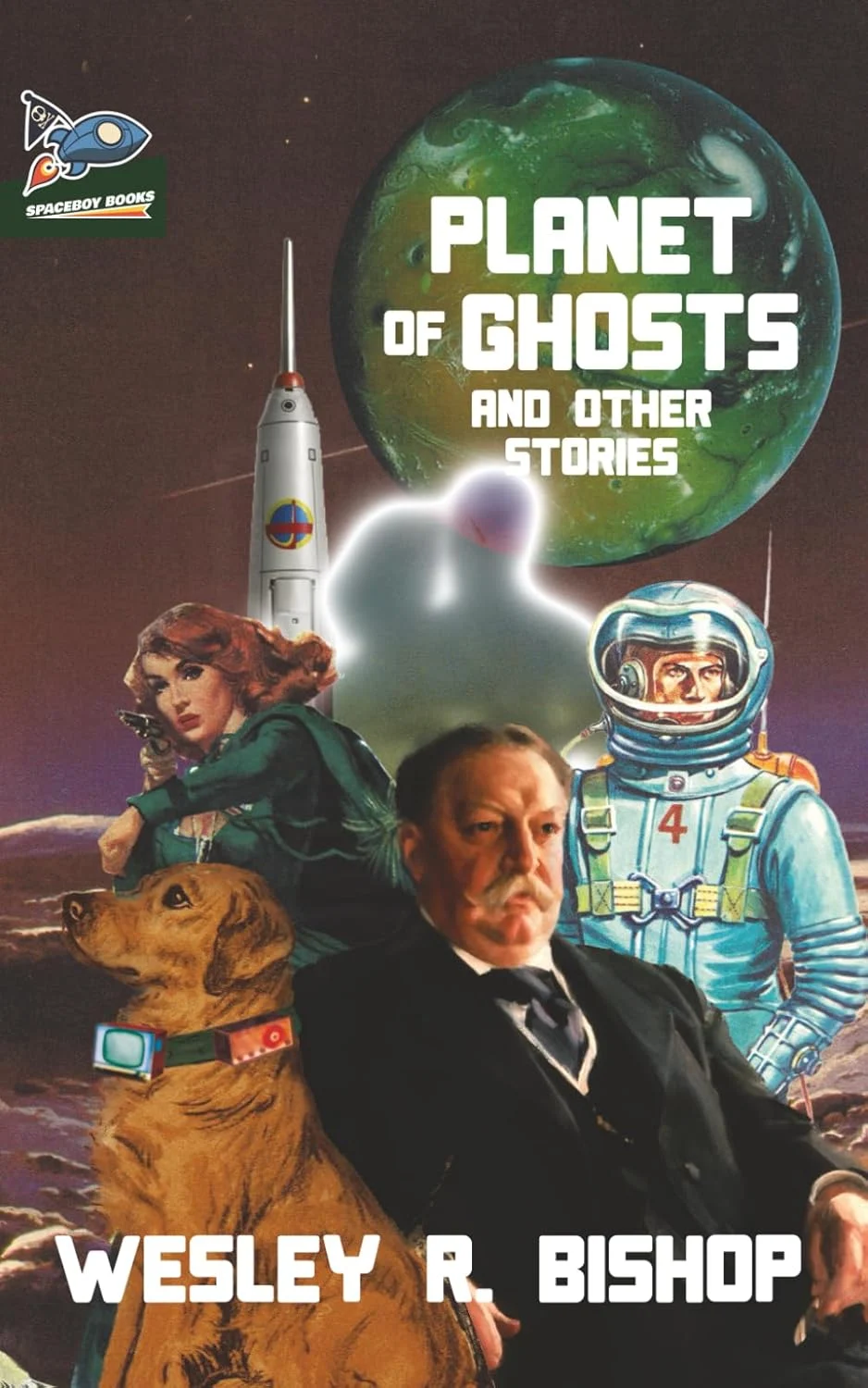
Introduction: Nostalgia, Decay, and the Modern Dystopian Lens
The impulse to revisit childhood staples often serves as a barometer for how much the world—and the observer—has changed. For one educator, a summer spent revisiting the 1979 cult television series Buck Rogers in the 25th Century yielded more than mere nostalgia; it sparked a critical re-examination of the dystopian underpinnings inherent in mid-century science fiction. While the show was once viewed as a lighthearted space opera, the adult eye now perceives a harrowing, sterile landscape of AI-governed city-states, slave-labor supply chains, and environmental collapse.
This realization—that our most beloved pop-culture relics often mask deep-seated anxieties about societal fragility—serves as the thematic heartbeat of Wesley R. Bishop’s new short story collection, Planet of Ghosts. In an era where "enshittified" technology and ecological dread dominate the cultural discourse, Bishop offers a narrative architecture that is as sprawling and chaotic as the future it predicts.
The Genesis of a Broken Universe
The conceptual framework for Planet of Ghosts begins with a simple, terrifying premise: Earth is not merely failing; it is terminal. Bishop posits a timeline where traditional ecological crises merge with an inexplicable, deeper human error—a rupture in the fabric of the planet that ensures its eventual disintegration.
Chronology of the Collapse
Bishop’s narrative does not adhere to a linear progression. Instead, it functions as a fractured mirror, reflecting the apocalypse from multiple temporal vantages:
- The Early Unraveling: Stories set in our contemporary era focus on the initial realization of doom, capturing the desperate, often irrational coping mechanisms of a civilization in its twilight.
- The Mid-Crisis: The emergence of "The Cathedral," a pervasive cult movement, offers a chilling look at how societies retreat into radical belief systems when faced with inevitable extinction.
- The Exodus: The collection tracks the scramble for off-planet colonization, where generation ships become the final, desperate gambits for a dying species.
- The Far Future: Archaeological accounts—including the haunting image of researchers unearthing the ruins of a 21st-century Walmart—provide a detached, scholarly perspective on the wreckage of human history.
The "Wesleyverse": A Portrait of Managed Chaos
One of the most striking aspects of Bishop’s collection is its refusal to simplify the complexities of its world-building. Rather than presenting a clean, cohesive vision of the future, the "Wesleyverse" feels like a digital sprawl—a "wild west" of directionless innovation.
Technology as a Symptom of Despair
In Bishop’s world, technology does not solve human problems; it complicates them. Time travel, for instance, is treated not as a grand scientific achievement but as a messy, ubiquitous tool for the unprincipled—akin to the way AI is currently viewed in our own era. The characters are burdened by a reality where every technological "fix" is greeted with a groan of resignation, knowing that it merely delays the inevitable.
The Human Element
Despite the grand, dark themes, the collection remains anchored by its characters. Whether they are colonizers struggling to survive on hostile alien worlds or a confused President William Howard Taft—inexplicably yanked into the future—Bishop treats them with profound empathy. He avoids the cynical trap of judging those who cling to conspiracy theories or "fad diets" in the face of annihilation, recognizing that when survival is off the table, the dignity of the human response is the only metric that remains.
The Narrative Structure: A Mosaic of Meaning
Planet of Ghosts is a masterclass in the short story form. While each entry possesses the integrity to stand on its own, the collection is unified by a recurring focus on "New Gem City."
The "Aha" Moments
The collection functions as a puzzle, where seemingly disparate stories begin to interlock. A pivotal piece of this design is the story "The Man Who Saved the Dead," which centers on a technician tasked with downloading the consciousnesses of the dying. This narrative acts as a keystone, providing the necessary context to reframe the outcomes of other stories within the book. The result is a reading experience that rewards patience and attention to detail, turning the collection into a cohesive, book-length narrative masquerading as a series of independent vignettes.
Implications: The Role of the Dystopian Prophet
Traditionally, the dystopian author is viewed as a Cassandra—a prophet of doom warning the populace to change their ways. Given Bishop’s background as a history professor and scholar, one might expect a collection heavy on political diagnosis or moral prescription.
Refusal to Preach
Bishop, however, eschews the "tidy package" of clear-cut moralizing. He does not provide a manifesto on how to save the world, nor does he offer a roadmap of how the disaster began. Instead, he invites the reader to locate hope in the persistence of his characters.
The collection suggests that hope is not a grand, overarching solution, but a quiet, individual act of defiance. As noted on page 180, the belief that "every problem humanity faces is always only one generation away from a solution" becomes a quiet mantra, a fragile anchor in a sea of encroaching darkness.
Critical Reception and Scholarly Context
While the collection has garnered praise for its grimly prophetic tone, it also stands as a significant contribution to contemporary speculative fiction. By blending the scholarly rigor of a historian with the imaginative capacity of a fiction writer, Bishop creates a text that is both an entertainment and a cultural document.
The 185-Page Mandate
Clocking in at 185 pages, Planet of Ghosts is lean. This brevity is a deliberate aesthetic choice. In a world where time is a luxury that no one can afford, Bishop’s narrative efficiency mirrors the urgency of his subject matter. It is a book that demands to be read, and perhaps reread, before the metaphorical clock runs out.
Conclusion: Finding Meaning in the Ruins
Wesley R. Bishop’s Planet of Ghosts is not a comfortable read, but it is an essential one. It captures the essence of our current cultural moment—a period defined by the collision of technological overreach, environmental anxiety, and a profound sense of loss.
By refusing to offer easy answers, Bishop achieves something more profound: he validates the struggle of the individual living in the shadow of the collapse. He does not promise that the characters will land in a safe harbor, but he celebrates the act of trying to make the world better, even when the foundations are crumbling. In the end, Planet of Ghosts serves as a reminder that even in the most dystopian of futures, the human drive to create, to connect, and to hope remains the most powerful technology of all.
Whether you are a fan of the classic Buck Rogers grit or a seeker of high-concept speculative fiction, Bishop’s collection offers a haunting, brilliant exploration of what it means to live—and to leave—a legacy on a planet that is slowly fading from view.


 Suro Senen
 Pevita Pearce