

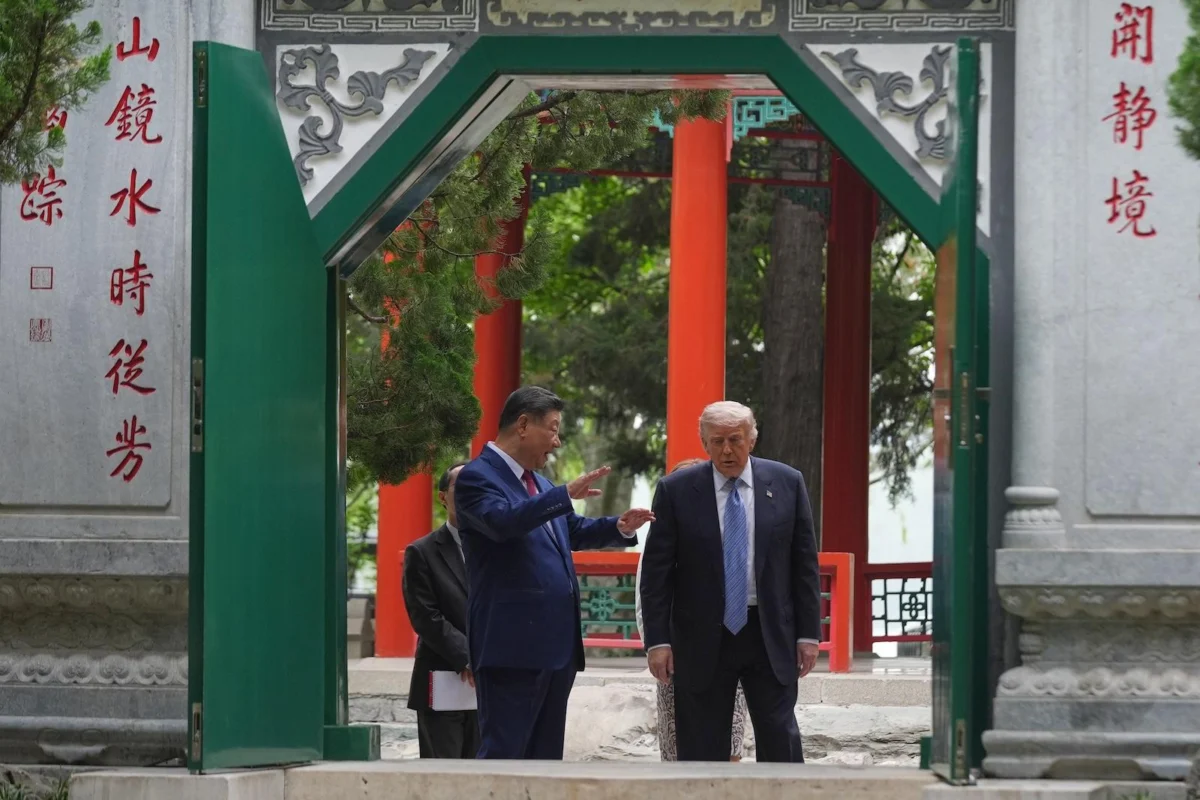
BEIJING – In a diplomatic marathon that underscored the complex, often volatile nature of the world’s most critical bilateral relationship, U.S. President Donald Trump concluded his high-profile visit to Beijing on Friday. The summit, held at the historic Zhongnanhai complex, saw the two leaders balance an elaborate choreography of state-level hospitality against the backdrop of cooling markets, regional military flashpoints, and a precarious global economic recovery.
While the optics of the visit—characterized by strolls through imperial gardens and lavish state banquets—suggested a veneer of cordiality, the substance of the talks revealed a relationship still grappling with fundamental structural disagreements. From the volatile energy markets impacted by the war in Iran to the long-standing, existential friction over the status of Taiwan, the summit served as a reminder that even as trade truces hold, the geopolitical competition between Washington and Beijing remains deeply entrenched.
The Chronology of a High-Stakes Summit
The summit, which marked the first visit to China by a U.S. president since 2017, unfolded over several days of intensive negotiations.
Thursday: The Optics of Power
The visit began with a series of carefully orchestrated interactions. President Trump and President Xi Jinping were seen strolling through the gardens of the Zhongnanhai complex, with the two leaders engaging in unscripted banter about the local flora. President Xi promised to send Trump seeds for the roses they admired—a gesture that provided a momentary reprieve from the intensity of the official agenda. This was followed by a working lunch featuring traditional delicacies, including lobster balls and shrimp dumplings. However, the evening state banquet signaled a shift toward gravity. Xi remarked that the China-U.S. relationship is "the most important in the world," stating firmly, "We must make it work and never mess it up."
Friday: The Hard Realities
By Friday, the tone shifted from the symbolic to the structural. As Trump prepared for his final meeting with Xi, the Chinese Ministry of Foreign Affairs issued a blunt statement regarding the ongoing war in Iran, characterizing the conflict as one that "should never have happened" and demanding an end to the instability affecting global energy supplies. The day concluded with the announcement of several trade agreements, though the market reaction—particularly regarding Boeing—remained tepid.
Economic Outcomes and Market Reactions
For President Trump, the visit was as much about domestic optics as it was about foreign policy. With midterm elections on the horizon, the White House had been seeking "wins" to bolster the President’s standing.
The Trade "Truce"
The central pillar of the economic discussion was the management of the fragile trade truce established last October. Under this agreement, the U.S. suspended triple-digit tariffs on Chinese goods, while Beijing refrained from weaponizing its monopoly on rare earth mineral supplies. While U.S. Trade Representative Jamieson Greer indicated that the administration has yet to decide on an extension of this truce, both parties agreed to establish new mechanisms to manage trade disputes.
Boeing and the Manufacturing Gap
One of the most anticipated announcements was a reported order for 200 Boeing jets. While Trump touted this as a massive win—the first such order in nearly a decade—market analysts were quick to temper expectations. Expectations in the financial sector had been centered on an order of roughly 500 aircraft. The shortfall caused Boeing shares to slide by more than 4% on Friday.
"For the market, the summit can be strategically reassuring while underwhelming in substance," observed Chim Lee, a senior China analyst at the Economist Intelligence Unit. The lack of movement on high-tech trade, specifically the inclusion of Nvidia’s advanced H200 AI chips, further frustrated investors. Despite the presence of Nvidia CEO Jensen Huang, who joined the delegation at the eleventh hour, no breakthrough was announced, highlighting the deep sensitivity surrounding semiconductor access.
Geopolitical Flashpoints: Iran and Taiwan
Beyond trade, the summit was dominated by two geopolitical crises that have strained U.S.-China cooperation: the war in Iran and the sovereignty of Taiwan.
The Iran Conundrum
The White House had hoped to leverage the summit to pressure Beijing into curbing its support for Tehran. The conflict has caused significant volatility in energy markets, as the Strait of Hormuz—a vital artery for one-fifth of global oil and liquefied natural gas—remains at risk.
While the U.S. summary of the talks highlighted a "shared desire" to reopen the Strait, analysts remain skeptical. China views Iran as a strategic counterweight to American influence in the Middle East. Beijing’s call for peace appeared aimed more at stabilizing the global economy and protecting its own energy imports than at aligning with Washington’s strategic goals.
The Taiwan Warning
The most significant departure from the friendly atmosphere of the gardens occurred during discussions regarding Taiwan. President Xi delivered what observers described as a sharp, unyielding warning, noting that any "mishandling" of the island could lead to direct conflict.
Taiwan, located just 50 miles off the Chinese coast, remains the ultimate flashpoint. Secretary of State Marco Rubio, who accompanied the President, reaffirmed the U.S. stance on NBC News, stating that American policy remains "unchanged." Rubio noted that the Chinese "always raise it," and that the U.S. position remains consistent. However, the tone from Beijing suggests that the patience of the CCP is thinning, posing a long-term challenge for U.S. regional security policy.
Humanitarian Concerns: The Case of Jimmy Lai
The summit also touched upon human rights, with President Trump reportedly raising the case of Jimmy Lai, the media tycoon and prominent critic of the Chinese Communist Party. Lai is currently serving a 20-year sentence following a high-profile national security case in Hong Kong.
Secretary of State Rubio characterized the U.S. position as being open to "any arrangement" that would secure Lai’s freedom. However, Beijing has consistently maintained that Hong Kong affairs are an internal matter, and there was no indication that the Chinese leadership is willing to concede on this issue. The mention of Lai serves as a reminder of the ideological divide that remains a persistent irritant in the bilateral relationship.
Implications: A Fragile Future
The summit in Beijing leaves the U.S.-China relationship in a state of suspended animation. On one hand, the maintenance of the trade truce provides a degree of certainty that both global markets and the domestic U.S. economy desperately need. The agreement to purchase U.S. beef, farm goods, and energy products represents a positive, albeit incremental, step toward balancing the trade ledger.
However, the "underwhelming" nature of the industrial and technology deals suggests that the era of deep economic integration is effectively over. Both nations are increasingly pivoting toward a model of strategic autonomy—China focusing on internal technology development and energy security, and the U.S. prioritizing protection of its critical supply chains and regional alliances.
As President Trump returns to Washington, the success of the trip will likely be judged by two metrics: whether the trade mechanisms established in Beijing can prevent a return to the tariff wars of the past, and whether the communication channels opened between Trump and Xi can prevent the "mishandling" of the Taiwan issue from spiraling into a kinetic conflict.
The roses in the Zhongnanhai gardens may have been beautiful, but the underlying thorns of the U.S.-China rivalry remain sharper than ever. Whether this summit marks a turning point toward stability or merely a pause in an inevitable escalation remains the defining question for the remainder of the decade.












No comments yet. Be the first to join the conversation!