


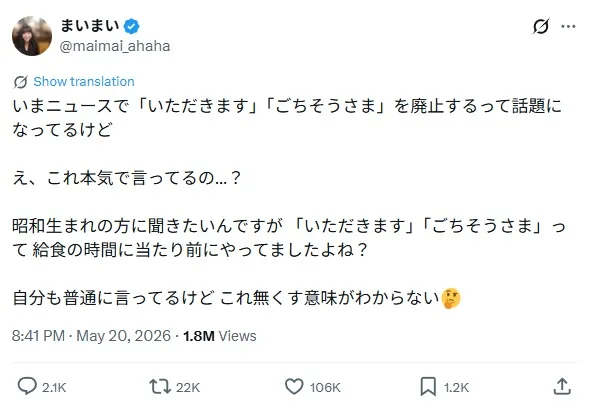
In the hyper-connected digital landscape of 2026, misinformation travels with unprecedented velocity. This past week, a singular, unfounded post on the social media platform X (formerly Twitter) ignited a firestorm of nationalistic anxiety across Japan. The rumor? That Japanese public schools were planning to abolish the time-honored mealtime greetings of “Itadakimasu” (I humbly receive) and “Gochisosama-deshita” (Thank you for the feast).
Despite the intensity of the digital outcry—garnering over 100,000 likes and tens of thousands of reposts—the report is entirely fictitious. There is no documented case of any Japanese school board, prefecture, or individual institution proposing, let alone implementing, such a ban. Yet, the viral nature of the claim offers a profound look into the fragility of digital truth and the ease with which social tensions can be weaponized through cultural nostalgia.
The Anatomy of a Digital Mirage
The panic began on May 20, 2026, when X user @maimai_ahaha published a speculative post. The user claimed to have heard rumors regarding the potential abolition of these greetings, specifically soliciting the opinions of those who grew up in the Showa era (1926–1989). By framing the inquiry through a generational lens, the author effectively activated a sense of protective guardianship among older demographics, who view these phrases as essential markers of Japanese identity.
The response was immediate and overwhelming. In the absence of any primary source or official notification, the digital sphere treated the claim as an established fact. A content analysis of the replies reveals that nearly 40% of the engagement was rooted in visceral disbelief that such a tradition could be threatened. Approximately 25% of the discourse focused on the inherent value of the phrases as expressions of gratitude, while a vocal 20% pivoted toward a more conspiratorial narrative, attributing the alleged "ban" to forced multiculturalism or a deliberate, systemic effort to erode Japanese national values.
Only a negligible 4.9% of participants engaged in fact-checking or questioned the provenance of the claim. One notable voice of reason was user @c0outa, a retired public junior high school teacher with 45 years of experience, who noted that the subject had never been broached in his four decades of service. Despite the clarity of such testimonies, the emotional gravity of the rumor proved more compelling than the lack of evidence.
A Chronology of a Resurrected Rumor
While the May 2026 tweet acted as the spark, the underlying fire is nearly three decades old. The rumor appears to be a cyclical phenomenon, a "zombie myth" that resurfaces whenever social anxieties regarding immigration or cultural change peak.
The 1996–1997 Toyama Incident
Fact-checkers, including the investigative blog Dennō Chiriakuta (“Cyber Dust”), have traced the origins of this concern back to a specific, localized event in Toyama Prefecture during the mid-1990s. At that time, a single school administration moved to stop requiring students to perform gasshō—the act of pressing one’s palms together—before meals. The rationale provided was centered on religious neutrality, as the gesture has roots in Buddhist prayer.

Crucially, the school never banned the spoken words “Itadakimasu.” However, in the retelling, the distinction between the physical gesture and the spoken word was lost. By the early 2000s, the narrative had mutated into a broader complaint: that schools were "forcing" children to express religious-adjacent gratitude, particularly in the context of school lunches that parents had already paid for.
The Political Amplification
Political figures have, at times, inadvertently or intentionally fueled these fires. In 2000, current Prime Minister Takaichi Sanae was associated with the popularization of the "paid lunch fees" anecdote, which suggested that because parents pay for the food, schools have no right to dictate how or if children express gratitude. Much like the 2026 viral post, these claims relied on second-hand, anecdotal evidence rather than systematic policy changes.
Data, Reality, and the MEXT Stance
To understand the absurdity of the rumor, one need only look at the official guidelines provided by Japan’s Ministry of Education, Culture, Sports, Science and Technology (MEXT). MEXT explicitly includes “Itadakimasu” in its recommended guidance for school lunches. It is framed as an educational tool—a way to teach children about the origins of food, the labor involved in production, and the environmental impact of consumption.
Furthermore, allegations circulating on social media regarding a supposed 2024–2025 survey claiming 38% of schools received complaints about the greetings have been debunked. Neither the MEXT school lunch survey nor the Japan Education Association reports mention such a statistic. The figure is an invention, designed to lend a veneer of academic legitimacy to an emotional argument.
This follows a worrying trend observed in 2025, when a similarly false narrative emerged regarding the city of Kitakyushu. Rumors suggested the city was "imposing" Muslim-friendly school lunches on the entire population, leading to an influx of over 1,000 hostile complaints directed at city officials. In both cases, the target is a perceived threat to "Japanese-ness," fueled by a lack of digital literacy and an appetite for outrage.
The Cultural Misconception: A "Recent" Tradition
Perhaps the most ironic aspect of this controversy is the misconception surrounding the history of the phrases themselves. Many participants in the online debate argued that the greetings are ancient, indigenous traditions that define the Japanese soul.
However, cultural historians at the National Museum of Ethnology have pointed out that the widespread, uniform practice of saying “Itadakimasu” and “Gochisosama” in school lunchrooms is likely less than 100 years old. Ethnographic surveys from the 1980s indicated that many individuals who were 70 or older at the time did not perform these greetings in their own childhoods.
Evidence suggests that the formalization of these phrases in a school setting was accelerated during the militarization of Japan in the early 20th century. During this era, state education emphasized uniformity and moral training. While this does not diminish the sincerity of those who use these phrases today—gratitude is a universal human sentiment, regardless of the age of the ritual—it does highlight that the "traditional" nature of the custom is, in itself, a construct.
Implications: Tradition and Social Tensions
Why does this specific rumor continue to gain traction? The answer lies in the current socio-political climate of Japan.
- Identity Anxiety: As Japan grapples with a shrinking population and the necessity of integrating more foreign workers, many citizens feel a sense of cultural drift. Traditions, whether ancient or modern, become symbols of a cohesive national identity that people fear losing.
- The Echo Chamber Effect: Social media algorithms prioritize high-engagement content. A post that triggers fear or outrage travels faster than a dry, factual correction from a government body.
- Religious Sensitivity vs. Secular Education: Japan’s public school system is strictly secular. When any practice—even one as benign as a mealtime greeting—is framed as having religious or "forced" connotations, it creates a friction point that can be easily exploited by those with political agendas.
In reality, some schools have moved toward making these greetings optional. This is not a "ban," but a pragmatic move to accommodate students with diverse religious backgrounds or to reduce the psychological pressure on students who may struggle with the communal nature of school lunches.
Conclusion: The Future of the Greeting
The mealtime greetings of “Itadakimasu” and “Gochisosama” remain firmly entrenched in the Japanese school system. They are not being abolished, they are not being debated by policymakers, and they remain a core part of the school-based nutritional education curriculum.
The danger, however, is not the loss of the greeting, but the gain of a culture that prioritizes misinformation over civic discourse. When a simple, fabricated tweet can mobilize thousands into a frenzy of nationalistic defense, it reveals a society that is increasingly susceptible to manipulation. As we move forward, the challenge for the Japanese public—and indeed for the global digital community—is to cultivate the skepticism necessary to differentiate between genuine cultural threats and the manufactured ghosts of the internet.
For now, the children of Japan will continue to press their palms together, offer their thanks, and consume their meals, unbothered by the digital panic occurring in the palm of their parents’ hands.












No comments yet. Be the first to join the conversation!