

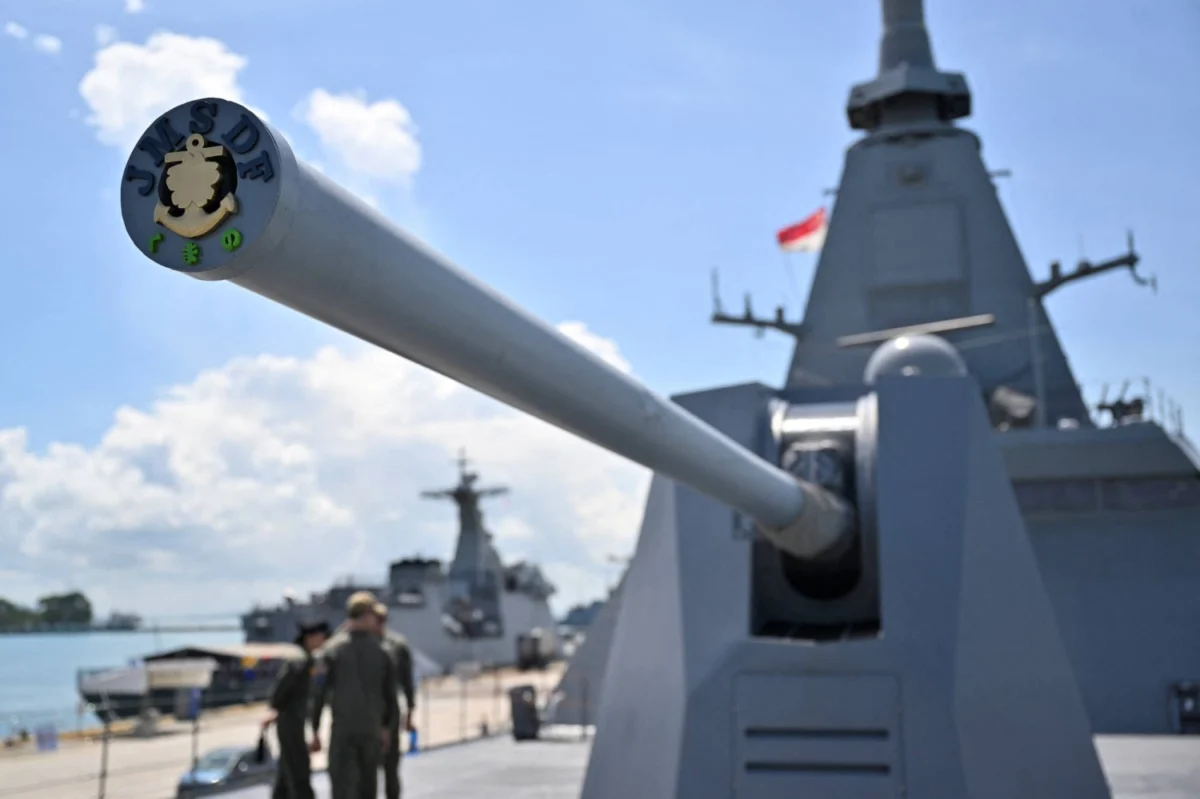
SINGAPORE — As the geopolitical architecture of the Indo-Pacific undergoes a profound shift, the New Zealand government has signaled its intent to undertake the most significant naval modernization program in a generation. Defense Minister Chris Penk, speaking exclusively to The Japan Times on the sidelines of the IISS Shangri-La Dialogue in Singapore, confirmed that Wellington is in the final stages of evaluating a successor to its aging fleet of Anzac-class frigates.
The decision, expected by the end of 2025 or early 2026, rests on a high-stakes competition between two distinct maritime platforms: Japan’s cutting-edge Mogami-class frigate and the United Kingdom’s Type 31 general-purpose frigate. This procurement process is not merely a logistical upgrade; it is a fundamental statement of intent regarding New Zealand’s future defense posture, its commitment to regional interoperability, and its evolving role within the Five Eyes and ANZUS-adjacent security frameworks.
The Core Challenge: A Fleet in Twilight
For decades, the Royal New Zealand Navy (RNZN) has relied on two Anzac-class frigates—Te Kaha and Te Mana—to project power and maintain maritime security. Commissioned in the late 1990s, these vessels have served as the backbone of New Zealand’s blue-water capability. However, the clock is ticking.
Minister Penk noted that these frigates are slated to reach the end of their operational lifespans by the mid-2030s. "We are conducting due diligence to get to a point that, in about 12 months or perhaps a bit longer, the New Zealand government would be in a position to make a choice between the two down-selected options," Penk stated.
The maintenance of these legacy ships has become increasingly burdensome, with the cost of life-extension programs offering diminishing returns compared to the acquisition of modern, software-defined, and stealth-oriented platforms. The urgency is compounded by the deteriorating security environment in the South Pacific and the South China Sea, where the demands on regional navies have shifted from humanitarian assistance and disaster relief (HADR) to high-end maritime deterrence.
The Contenders: A Tale of Two Philosophies
Japan’s Mogami-Class: The High-Tech Specialist
The Mogami-class represents a radical departure from traditional frigate design. Developed for the Japan Maritime Self-Defense Force (JMSDF), these ships prioritize automation, stealth, and a multi-mission capability that is uniquely suited for the contested waters of the Indo-Pacific.
- Stealth and Design: The Mogami features a clean, low-observable profile designed to minimize radar cross-section, allowing it to operate in proximity to sophisticated anti-access/area-denial (A2/AD) threats.
- Automation: One of the most striking features of the Mogami is its reduced crew requirement. By utilizing advanced sensor integration and AI-driven combat management systems, the vessel can operate with a significantly smaller complement than traditional frigates, a critical advantage for a nation like New Zealand that faces persistent recruitment and retention challenges within its defense force.
- Interoperability: As Penk highlighted, the potential for closer integration with the Australian Royal Navy—which is itself undergoing a massive modernization push—is a significant driver. Japan’s increasing alignment with AUKUS-plus initiatives makes the Mogami a "politically interoperable" choice.
The U.K.’s Type 31: The Versatile Workhorse
The Type 31 (the Inspiration-class) is the Royal Navy’s response to the need for a persistent, globally deployable, and cost-effective presence. Based on the Danish Iver Huitfeldt-class hull, the Type 31 is designed for flexibility.
- Modular Design: The Type 31 is built with "mission bays," allowing the ship to be reconfigured for a variety of tasks, ranging from counter-piracy and disaster relief to anti-submarine warfare.
- Logistical Familiarity: Given the deep-seated historical and logistical ties between the Royal Navy and the RNZN, the Type 31 offers a path of least resistance regarding training, maintenance protocols, and spare parts supply chains.
- Cost-Effectiveness: Designed to be built rapidly and at a lower price point than the Type 26 anti-submarine frigates, the Type 31 appeals to governments facing tight fiscal constraints.
Strategic Implications: Why This Matters
The decision between the Japanese and British options is a litmus test for New Zealand’s foreign policy. For years, Wellington has attempted to balance its economic dependence on China with its traditional security alliances with the West.

The Australia Factor
Minister Penk explicitly mentioned interoperability with Australia as a deciding factor. Canberra is currently implementing a massive naval expansion, moving toward a fleet of "Tier 2" vessels to complement its future nuclear-powered submarines. If New Zealand selects the Mogami, it would align its maritime capabilities with Japan and Australia, creating a cohesive trilateral sensor and strike network in the Pacific.
The Five Eyes Alignment
Choosing a platform from a close intelligence partner—either the U.K. or Japan (which is increasingly integrated into the Five Eyes intelligence-sharing architecture)—signals a commitment to a "Western-aligned" maritime strategy. It suggests that New Zealand is moving away from a policy of strategic ambiguity and toward a more proactive stance in regional security.
Chronology of the Procurement Process
- Late 1990s: Commissioning of HMNZS Te Kaha and HMNZS Te Mana.
- 2020–2023: Significant upgrades (Frigate Systems Upgrade) to extend the life of the Anzac class, providing a temporary stopgap.
- 2024: Formal commencement of the "Future Frigate" assessment process by the Ministry of Defence.
- May 2024: Defense Minister Chris Penk confirms at the Shangri-La Dialogue that the government has down-selected the Mogami and Type 31.
- Late 2025/Early 2026 (Projected): Final cabinet decision on the procurement contract.
- Mid-2030s: Retirement of the Anzac-class frigates and expected entry into service of the new vessels.
Official Responses and Political Landscape
The opposition in Wellington has expressed concerns regarding the fiscal implications of such a purchase. New Zealand’s defense spending has historically been lower as a percentage of GDP compared to its neighbors. The purchase of two modern frigates will require a substantial long-term commitment of taxpayer funds, likely necessitating a broader defense white paper to justify the expenditure.
However, the current government, under Prime Minister Christopher Luxon, has signaled a desire to bolster New Zealand’s defense contribution to the region. Defense Minister Penk’s emphasis on "due diligence" underscores a desire to avoid the cost overruns that have plagued other international naval procurement programs.
"We need a platform that is not just capable of fighting, but capable of operating continuously in a high-tempo environment," a senior analyst at a Wellington-based think tank remarked. "Whether it is the Mogami or the Type 31, the choice will define our maritime influence for the next thirty years."
Supporting Data: Naval Capabilities at a Glance
| Feature | Mogami-Class (Japan) | Type 31 (U.K.) |
|---|---|---|
| Primary Focus | Stealth & High-end ASW | Versatility & Modular Payload |
| Automation | Very High | Moderate |
| Key Advantage | Sensor Integration/Interoperability | Adaptability/Commonality with UK |
| Crew Size | ~90 | ~100+ |
| Regional Presence | Deeply integrated in Indo-Pacific | Global expeditionary focus |
Conclusion: A Turning Point for the Pacific
The path forward for the Royal New Zealand Navy is clear, but the destination remains open. By narrowing the field to Japan’s Mogami and the U.K.’s Type 31, New Zealand has effectively placed itself at the crossroads of two different visions for future naval warfare.
The Mogami offers a glimpse into the future of automated, stealth-oriented, and hyper-connected warfare. The Type 31 offers a pragmatic, flexible, and reliable bridge to the next generation of maritime operations. Whichever path Wellington chooses, the impact on the regional balance of power will be palpable. As Minister Penk continues his due diligence, the eyes of the Pacific security community will be firmly fixed on New Zealand, waiting to see if this small nation will choose the high-tech precision of the East or the modular reliability of the West.
The coming twelve months will be characterized by intense lobbying, technical assessments, and a rigorous debate over the future of New Zealand’s sovereignty at sea. In an era defined by the return of great power competition, the decision to replace the Anzac-class frigates is more than a hardware upgrade—it is a signal that New Zealand is ready to secure its place in an increasingly crowded and contested ocean.












No comments yet. Be the first to join the conversation!