

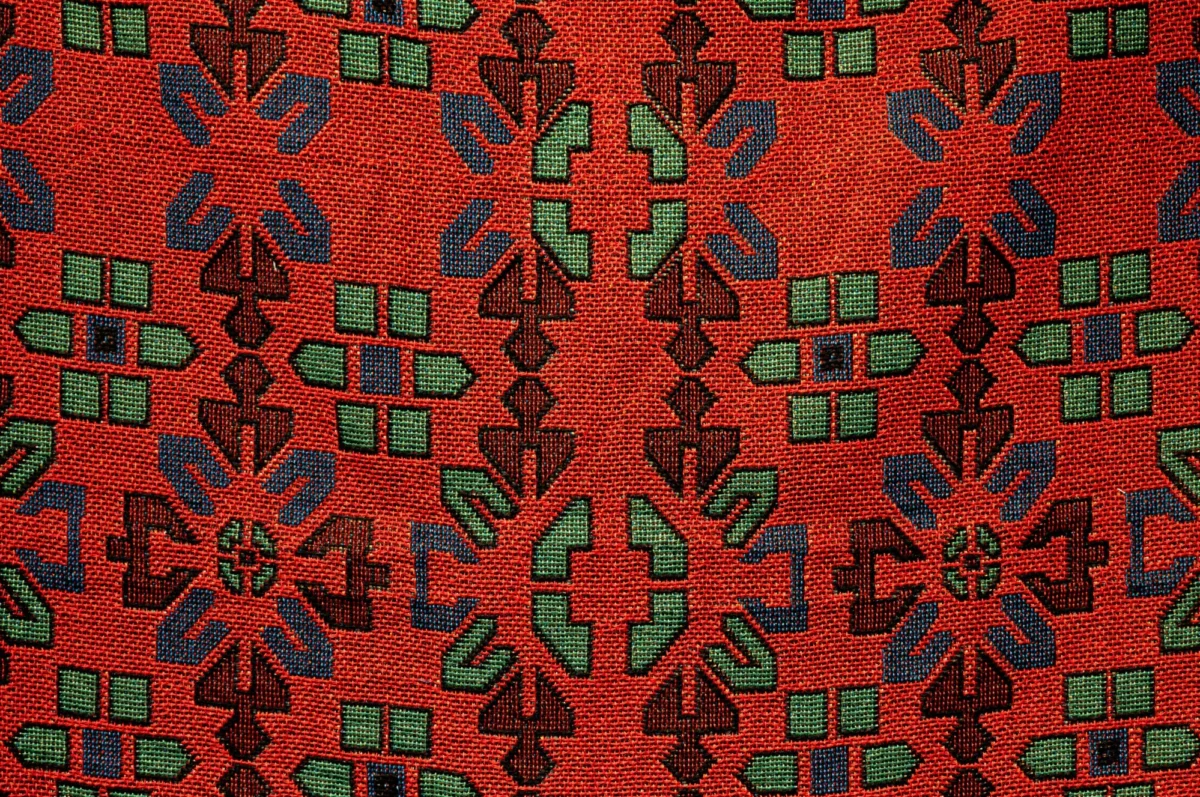
In the heart of Toronto’s contemporary art scene, Abbozzo Gallery is currently hosting a transformative solo exhibition by Kurdish artist Roda Medhat. Titled From the Loom, the exhibition serves as a profound meditation on the intersection of ancient heritage and the hyper-modern tools of the 21st century. By bridging the gap between traditional West Asian textile artistry and the cold, precise world of digital fabrication, Medhat has created a body of work that asks a fundamental, existential question: How do we carry our cultural stories forward, and what occurs when those narratives are translated into synthetic, technological languages?
The Fusion of Craft and Code: Main Facts
The exhibition is a sprawling sensory experience that challenges the viewer’s perception of what constitutes a "textile." Medhat, who has gained significant acclaim for his previous neon installations, brings a multidimensional approach to his latest collection. The gallery space is occupied by large-scale sculptures that converse with intricately woven wall pieces, all while bathed in the hum of glowing light-based works encased in glass and acrylic.

At the core of the exhibition is the tension between the organic and the artificial. Medhat utilizes electronic Jacquard machines—a technology that dates back to the early 19th century—to weave imagery derived from Kurdish children’s books directly into the fabric. These textiles serve as the canvas for a narrative of displacement and continuity. The iconography often features young boys navigating the natural world or riding horses, motifs deeply embedded in the cultural subconscious of the Kurdish people. By digitizing these traditional symbols and feeding them into a mechanized loom, Medhat creates a deliberate friction between the "preserved" object and the "reconstructed" artifact.
A Chronological Evolution of Practice
Roda Medhat’s journey toward this exhibition is one of gradual synthesis. His early practice was defined by a fascination with light—specifically the architectural potential of neon signage. Over the past several years, his work has evolved from purely formal light studies into a research-heavy investigation of ethnographic archives.

- Pre-2023: Medhat’s focus was primarily on urban aesthetics and light-based sculpture, exploring how light can map spaces and memories.
- 2024: A shift occurred as the artist began integrating 3D scanning and digital fabrication into his studio process. He began to look at Kurdish textiles not just as decorative items, but as data sets that could be "read" and reinterpreted.
- 2025: The production of the "A Rug Falls in Four Frames" series marked a turning point, where the artist began to deconstruct the geometry of traditional rugs, translating them into neon light patterns.
- 2026 (Present): The debut of From the Loom represents the culmination of this research, bringing together the Jacquard-woven textiles, the 3D-printed sculptures, and the signature neon light works into a singular, cohesive dialogue.
The Recontextualization of History: "The Sheep and the Chevrolet"
Perhaps the most striking component of the exhibition is the centerpiece, The Sheep and the Chevrolet. The work serves as a direct, critical engagement with the 1947 ethnographic travelogue by François Balsan. Balsan’s original account of Kurdish life was heavily criticized for its "Orientalist" lens—a gaze that exoticized the Kurdish people by juxtaposing their traditional, rural, and "bucolic" existence with the encroaching, mechanical "modernity" of the West, symbolized by the automobile.
Medhat’s interpretation is nothing short of subversive. By using 3D-printing technology—the ultimate symbol of modern industrial production—to construct a monumental, pink-hued sheep perched atop a small, scale-model Chevrolet, Medhat flips the script. He removes the "anthropological" judgment of the original text, replacing it with a playful, yet pointed, commentary on how cultures are curated and consumed. The sculpture effectively neutralizes the power dynamic of the original 1947 work, turning a tool of colonial observation into a medium for indigenous agency.

Supporting Data: Technology as a Cultural Bridge
The exhibition relies heavily on the technical proficiency of modern digital tools to achieve its conceptual goals. According to the artist’s statement, the work acts as a "distillation of a wider body of research," which includes the active subversion of archival materials.
| Technology Used | Function in Art | Cultural Significance |
|---|---|---|
| Electronic Jacquard | Weaving digital imagery into fabric | Bridges the gap between old-world looms and new-world data |
| 3D Scanning | Capturing physical artifacts in digital space | Allows for the manipulation of memory in a virtual environment |
| 3D Printing | Materializing synthetic forms | Challenges the "authenticity" of historical crafts |
| Neon/Acrylic | Encasement of light-based patterns | Transforms traditional rug geometry into modern, glowing symbols |
By utilizing these tools, Medhat does not simply mimic traditional weaving; he re-codes it. The electronic Jacquard machine acts as a translator, turning the pixels of digital files into the physical knots and threads of a textile. This process highlights the artist’s preoccupation with the "loss" that occurs during translation—an apt metaphor for the Kurdish diaspora’s experience of trying to maintain cultural identity in a rapidly shifting, globalized world.

Official and Critical Perspectives
The art community has responded with enthusiasm to the exhibition’s intellectual depth. Curators at the Abbozzo Gallery have noted that Medhat’s work stands out because it refuses to be categorized as "craft" or "technology" alone. Instead, it occupies a liminal space where the artist acts as an archivist, a programmer, and a weaver simultaneously.
In his own statements, Medhat emphasizes that he is not trying to "save" traditional techniques, but rather to understand how they survive the transition into the digital age. "When we translate our stories into new, synthetic languages," Medhat explains, "we are creating something that is both entirely new and deeply rooted in the past. It is an evolution, not a replacement."

Societal Implications: Why "From the Loom" Matters
The implications of From the Loom extend far beyond the white walls of the Toronto gallery. In an era where digital archives are increasingly replacing physical museums, Medhat’s work addresses the fragility of cultural memory. His focus on Kurdish children’s books as source material is particularly poignant; these are the foundational texts that teach a child their heritage. By weaving them into synthetic materials using high-tech machinery, Medhat is effectively "saving" them in a digital, indestructible format—or perhaps he is highlighting how these stories become unrecognizable when taken out of their original context.
Furthermore, the exhibition serves as a critique of how Western institutions historically "collected" non-Western cultures. By engaging with Balsan’s work, Medhat invites the audience to consider the subjectivity of the history books we read and the museums we visit. He challenges the viewer to recognize that all cultural representation is a construction—and that the artist has the power to reconstruct that narrative.

A Future-Facing Legacy
From the Loom is not merely an exhibition of beautiful, complex objects; it is a profound intellectual challenge. Roda Medhat has managed to create a body of work that is visually arresting while remaining deeply rooted in the complexities of identity, technology, and colonial legacy.
As the exhibition continues its run through May 26, it serves as a reminder that the "loom" of history is never static. Whether through the threads of a carpet or the pixels of a digital file, the process of storytelling is continuous. Medhat’s work ensures that the stories of the Kurdish people remain not just preserved, but active, evolving, and ready to meet the challenges of a digital future. For those interested in the evolving dialogue between the ancient and the avant-garde, the work of Roda Medhat is an essential, if not mandatory, encounter.










No comments yet. Be the first to join the conversation!