Nana Muazin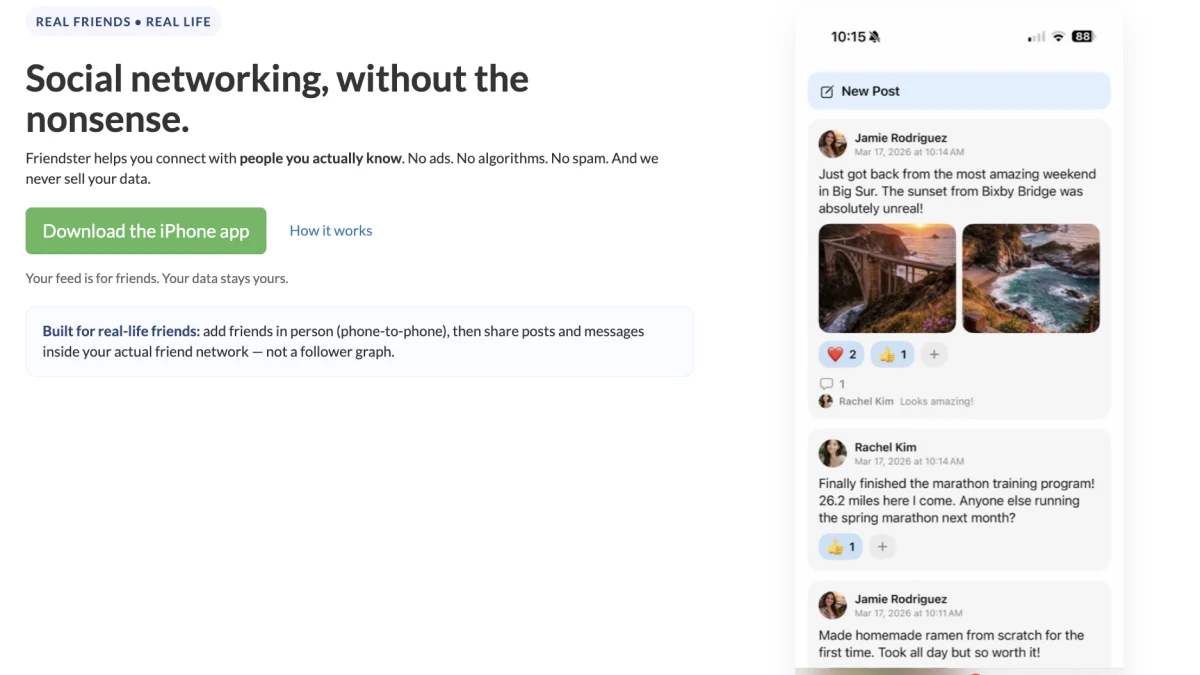
Do you remember the sound of a dial-up modem, the aesthetic of early 2000s web design, and the genuine thrill of a "Top 8" list? For a generation of digital natives, the internet’s social fabric began with Friendster. Launched in 2002, it was the primordial soup of the modern social media landscape. Now, nearly a quarter-century later, the brand has returned from the dead—but it looks nothing like the platform you once knew.
Under the stewardship of entrepreneur Mike Carson, the new Friendster has shed the features that define modern social media. There are no algorithmic feeds, no advertisements, no "influencers," and, most strikingly, no way to find friends online. It is a social network designed to be completely, intentionally empty—until you step out of your front door.
A Return to the Physical: The New Philosophy
In an era of digital fatigue, where social media is often criticized for fueling polarization and vanity, the resurrected Friendster is positioning itself as an antidote. Carson’s vision for the platform is one of radical proximity.
Upon downloading the current iOS app, users are greeted by a void. There are no profiles to browse, no "recommended for you" lists, and no search bars. The app is a blank canvas. To connect with another user, you cannot simply send a request or find them via a handle. Instead, the platform requires physical proximity: two users must have the app open and physically tap their phones together.
This "NFC-style" handshake protocol ensures that every digital connection is anchored in a physical, real-world encounter. It is a provocative stance against the "infinite scroll" model that has dominated Silicon Valley for two decades. By forcing the human element back into the connection process, Carson hopes to strip away the performative nature of modern social media and return to a model of genuine, verified human interaction.
A Brief History: From Pioneer to Relic
To understand the audacity of this reboot, one must look at the meteoric rise and fall of the original platform.
The Dawn of Social Networking (2002–2004)
Friendster was officially launched in March 2002 by computer programmer Jonathan Abrams. It was the first major social network to achieve mass-market penetration, providing a structured way for people to map their real-world social circles. At its peak, it was a cultural phenomenon, boasting millions of users who were discovering for the first time that their digital presence could reflect their actual life.
However, the platform struggled with technical scalability. As the user base grew, the site became notoriously slow, suffering from frequent crashes. This technical stagnation allowed competitors like MySpace—which offered more customization—and eventually Facebook—which offered a more streamlined, academic-centric experience—to siphon off its user base.
The Pivot and The End (2005–2015)
By the mid-2000s, Friendster had lost its dominance in the American market. It found a second life in Southeast Asia, where it remained popular for several years before being acquired by a Malaysian company. In 2011, the platform made a desperate pivot to become a social gaming site, abandoning its roots as a communication tool. This transition failed to regain momentum, and in 2015, the site was officially shuttered, leaving behind nothing but a digital ghost town of archived memories.
The $20,000 Resurrection
The path to the current revival is as unconventional as the app itself. In 2023, Mike Carson, an entrepreneur with an interest in digital history, noticed that the Friendster.com domain had devolved into a site riddled with intrusive pop-up ads and malicious links.
Intrigued, Carson tracked down the domain’s owner. It turned out the owner had acquired the legendary domain at an expired domain auction just a year prior for a modest $7,456. Carson negotiated a complex deal: he purchased the domain for $20,000 in Bitcoin, supplemented by another domain he owned that generated roughly $9,000 in annual revenue.
For Carson, the investment was not just about buying a domain; it was about reclaiming a piece of internet history to serve as a laboratory for his theories on social connectivity. "I wanted to see if we could strip away the noise," Carson noted in his documentation of the acquisition. "The internet was meant to be a tool for people, not a machine to keep people trapped in an infinite loop of consumption."
The Roadmap: Future Features and Hurdles
While the current version of the app is intentionally barren, Carson has outlined a roadmap that suggests a measured expansion, albeit one that maintains his core philosophy.
Friends of Friends
Carson plans to introduce a "Friends of Friends" feature. This would allow users to connect online, but only if they share a mutual acquaintance who has already "verified" their relationship via a physical tap. This creates a chain of trust, theoretically preventing the bot-heavy environment that plagues platforms like X (formerly Twitter) or Instagram.
The Fading Connection
Perhaps the most controversial and innovative addition is the proposed "Fading Connection" feature. The app would track when you last shared a physical space with a contact. If you haven’t been in the same room as a friend for over a year, the app will send a nudge.
"It is not a punishment," Carson explains. "It is a gentle reminder that the digital connection is a bridge, not the destination. Real friendships are kept alive in person, not by likes or comments."
Implications for the Social Media Landscape
The return of Friendster presents a fascinating case study in the current state of the tech industry. We are witnessing a "balkanization" of social media, where users are retreating from the massive, algorithmic public squares into smaller, more curated environments.
The Challenge of Growth
The primary obstacle for the new Friendster is the "cold start" problem. Because the app provides zero value to a new user until they happen to be in the same room as someone else who is also using the app, the barrier to entry is immense. Unlike platforms that hook users with content, Friendster requires a pre-existing social incentive.
Is it a Business or a Statement?
Critics argue that without a revenue model—there are no ads or data-harvesting mechanisms—the platform is unsustainable. However, Carson appears to be treating Friendster more as a "proof of concept" than a traditional venture-backed startup. If it succeeds, it could set a precedent for a new wave of "slow social" platforms that prioritize human well-being over "time-spent-on-platform" metrics.
Final Reflections
Returning to the site of one’s digital childhood is usually a melancholic experience. In the case of the new Friendster, it is a jarring one. The app is a mirror held up to our current social habits. If you find the emptiness of the app "daunting," as many early testers have reported, it says more about our addiction to constant stimulation than it does about the app’s design.
Whether Friendster becomes the next big thing or remains a niche experiment for digital purists, it has already achieved one thing: it has started a necessary conversation about the cost of convenience. By forcing us to step away from the screen and meet face-to-face, Friendster is attempting to do something truly radical—it is trying to make us human again, one tap at a time.
The internet is no longer in its infancy, and we are no longer the wide-eyed users we were in 2002. We have learned the hard way that when the product is free, we are the product. In this new iteration of Friendster, the product is the friendship itself, and the price of admission is simply showing up.

 Jia Lissa
 Raul Delapena Setiawan