Basiran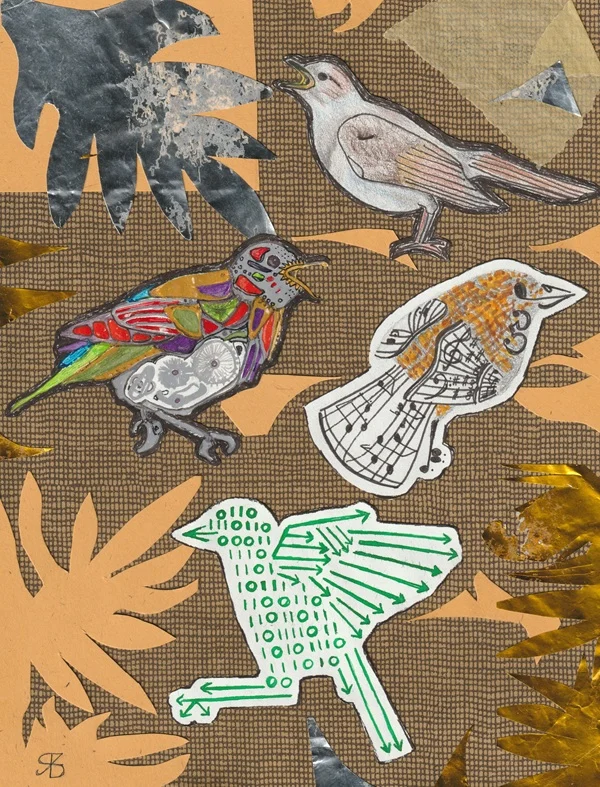
By Investigative Desk | May 2026
The recent controversy surrounding the imperial aviary has reached a fever pitch following the release of a haunting new poetic narrative by author Shantell Powell, titled "Death of the Emperor’s Nightingale." While the work is presented as verse, sources within the imperial court suggest it chronicles a series of documented events involving the capture, digitisation, and subsequent haunting of a creature that has long served as a symbol of the Emperor’s absolute dominion over nature.
The story serves as a cautionary tale of hubris, detailing the transition from a living, singing bird to a jewelled automaton, and finally, to a digital data set that refused to remain silent in the machine.
Main Facts: A Kingdom Obsessed with Perfection
For generations, the Emperor’s court was defined by the presence of a nightingale—a creature prized for its natural, unscripted melody. However, the narrative confirms long-standing rumors that this living bird was eventually ousted by a "jewelled simulacrum," a mechanical bird designed to provide a more consistent, controlled aesthetic.
When the mechanical bird inevitably suffered a systemic failure, the Emperor’s desperation led to a clandestine operation. The original, flesh-and-blood nightingale was ensnared in a net and forcibly removed to a high-security research laboratory. There, under the guise of scientific preservation, the bird was subjected to exhaustive scanning. Every feather, every vocal chord, and every nuance of its biology was mapped and uploaded to a digital mainframe.
However, the experiment failed in its primary objective: the capture of the bird’s "spirit." While the data banks were filled with high-fidelity audio recordings and biometric data, the digital nightingale remained a hollow echo. The real bird, having perished in the laboratory, returned as a spectral entity to the palace, seeking retribution against the man who had turned her life into a commodity.
Chronology of the Avian Crisis
The timeline of these events suggests a rapid decline in the Emperor’s stability:
- The Era of Artificiality: The flesh-and-blood nightingale is exiled in favor of a jewelled automaton, reflecting the court’s preference for static, unchanging beauty.
- The Mechanical Collapse: The automaton breaks down. Unable to accept the silence, the Emperor orders the capture of the original bird.
- The Lab Phase: Scientists subject the living nightingale to comprehensive data extraction, effectively killing the biological specimen to "save" its song in a computer.
- The Spectral Return: The spirit of the nightingale, refusing the digital loop, haunts the Emperor’s private chambers.
- The Dismantling of Power: Distraught and haunted by "song arrows" that pierce his heart, the Emperor destroys the automaton, scattering its rubies and diamonds among his subjects in a desperate, performative act of charity.
- The Final Decree: The Emperor officially bans the creation of digital simulacra and mandates the protection of wild nightingales.
Supporting Data: The Anatomy of a Digital Failure
The laboratory reports, though redacted, imply a massive technological oversight. The researchers attempted to reduce the "song" of the nightingale to a series of ones and zeroes. According to the records:
- The Data Loop: The digital recordings played in the Emperor’s chambers were functionally identical to the original song, yet they lacked the unpredictable, emotional cadence that defined the living bird.
- The Psychological Toll: The "song arrows"—as described in the narrative—refer to the phantom melodies that plagued the Emperor during his sleep. These melodies were not merely audio disturbances; they were cognitive dissonance manifested as physical pain, serving as a reminder of the life he destroyed.
- Material Obsolescence: The destruction of the automaton was not merely a reaction to the haunting, but a rejection of the material wealth that failed to satisfy the Emperor’s longing for authentic art.
Official Responses and Court Commentary
The imperial administration has maintained a policy of silence regarding the "haunting," though a spokesperson recently issued a statement regarding the "re-wilding" of the imperial gardens.

"The Emperor recognizes that true beauty is found in the autonomy of nature, not in the rigidity of the machine," the statement read. "We have moved toward a future of conservation, ensuring that no nightingale shall ever again be subjected to the indignity of a laboratory."
Critics, however, argue that this decree is too little, too late. The irony of a ruler who destroyed a species to preserve its music—only to be haunted by the void he created—has not been lost on the populace. The act of smashing the jewelled bird and distributing the rubies is seen by many historians as an attempt to "buy" forgiveness from the public, a tactic that evidently failed to grant the Emperor peace of mind.
Implications: The Ethics of Digital Preservation
The case of the Emperor’s nightingale raises profound questions about the ethics of modern technology. As we push further into the realm of digital immortality, the narrative by Shantell Powell asks: What happens when we record the form but ignore the soul?
The Paradox of Perfection
By attempting to replace the bird with a jewelled simulacrum, the Emperor sought to control his environment. By attempting to digitize the bird, he sought to control time itself. Both attempts resulted in a corruption of the very thing he sought to protect. The "digital simulacra" mentioned in the article were eventually destroyed not because they were faulty, but because they served as a constant reminder of the Emperor’s inability to capture the ephemeral nature of life.
Environmental Stewardship as Penance
The presence of the nightingale’s progeny nesting outside the Emperor’s bedroom window every season is a powerful symbol of persistence. Despite the Emperor’s attempts to commodify and then delete the bird, nature has returned to his doorstep. It is a persistent, inconvenient truth that demands he hear the real song—not the one he programmed, but the one that exists independently of his power.
A Cultural Shift
Shantell Powell, the author of this narrative, is known for her work exploring the intersection of the macabre and the natural world. Her background as an off-grid writer provides a unique lens through which to view this event. Her work challenges the reader to consider the cost of convenience. When we turn the world into data, we lose the ability to connect with the living pulse of the planet.
Conclusion: A Lesson in Humility
The tale of the Emperor’s nightingale is more than a folk legend; it is a clinical study in the failure of ego. The Emperor eventually learned that power—even power over the digital afterlife of a creature—is hollow when compared to the reality of the natural world.
While the Emperor may sleep easy now, shielded by the protection of the nightingale species and the deletion of the digital files, the ghosts of his past remain. The progeny of the original nightingale, nesting under his window, serve as a living indictment of his past hubris. They sing not for the Emperor, nor for his court, nor for his data banks. They sing because they are alive, a reality that the Emperor finally, albeit begrudgingly, accepted.
As we look toward the future of technology and its role in our lives, we must ask ourselves: are we creating a world where we can appreciate the song, or are we simply building better nets to trap the bird? The legacy of the Emperor’s nightingale suggests that some things, by their very nature, can never be captured—they can only be allowed to exist.

 Siti Muinah
 Ammar Sabilarrohman