

In the high-stakes world of modern animation, where digital assets are the standard and computer-generated environments dominate the screen, a surprising piece of tactile magic has emerged from the Lucasfilm studios. For the eighth episode of Star Wars: Maul – Shadow Lord, the production team made a conscious, creative pivot: instead of relying solely on digital modeling, they turned to the time-honored tradition of scratch-built miniature photography.
The result is a cargo ship that, while appearing only briefly before meeting a fiery, explosive end, represents a significant philosophical shift in how Lucasfilm Animation approaches visual storytelling. Spearheaded by Joel Aron, the Director of Lighting, Cinematography, and Visual Effects, this project serves as a bridge between the legendary legacy of Industrial Light & Magic (ILM) and the future of digital animation.
A Legacy Reimagined: The Philosophy of Practicality
The seed for this endeavor was planted roughly seven years ago during a serendipitous encounter between Joel Aron and John Knoll, ILM’s Executive Creative Director and a legendary figure in visual effects.
"John came into my office and said, ‘Come here, real quick,’" Aron recalls. "He rushed me downstairs to show me a motion-control rig and the miniature Razor Crest. He told me, ‘I’ve built this rig, and John Goodson built the model, and we are shooting it for The Mandalorian.’ From that moment on, I felt that we shouldn’t just treat animation like animation."
For Aron, who spent his formative years at ILM wandering through model bays and admiring the work of veterans like Goodson and Bill George, the practical model was more than just a prop; it was a soul. This philosophy of keeping the "practical spirit" alive became a cornerstone of his work at Lucasfilm Animation. Over the years, he and his team have integrated subtle physical elements—such as real smoke, miniature architecture, and physical matte paintings—into their animated workflows, seeking to bridge the gap between the tactile realism of the original trilogy and the expansive capabilities of modern software.
Chronology of a "Controlled Crash Landing"
The decision to build a physical miniature for Maul – Shadow Lord was not born out of a desire for nostalgia, but out of necessity. When the production team reached the eighth episode, they found themselves in a creative bind. The story required a freighter for the character Rheena Sul to use in a pivotal scene where she tricks the Empire. The initial story reel utilized a Black Sun ship as a proxy, but the production team realized the design was too iconic and recognizable for the specific narrative needs of the scene.
"We didn’t have the time to build it in CG," notes Art Director Andre Kirk. With the clock ticking and the schedule tightening, Aron proposed a solution that caught the team off guard: "I jokingly said, ‘What if we just built one? We could build a miniature and shoot it.’"
The Month-Long Build
What began as a joke quickly transformed into a high-intensity, month-long sprint. Aron’s process was a masterclass in "kit-bashing"—a technique where various pre-existing parts are combined to create something entirely new.
- Week 1-2: Planning and Core Construction. Aron sketched rough designs for a "pinched wanton shape"—an organic, utilitarian cargo vessel. He utilized foam for the fuselage core and integrated a base plate from a Gundam model kit for structural support.
- Week 3: Detailing and "Greebling." To achieve that lived-in Star Wars aesthetic, Aron applied "greeblies"—small, intricate surface details. He leveraged the digital asset library shared between Lucasfilm and ILM, 3D-printing parts scanned from original models like the Millennium Falcon and Imperial Star Destroyers. He even repurposed parts from a 1996 Shadows of the Empire Virago model, finding that the components fit the new ship’s geometry almost perfectly.
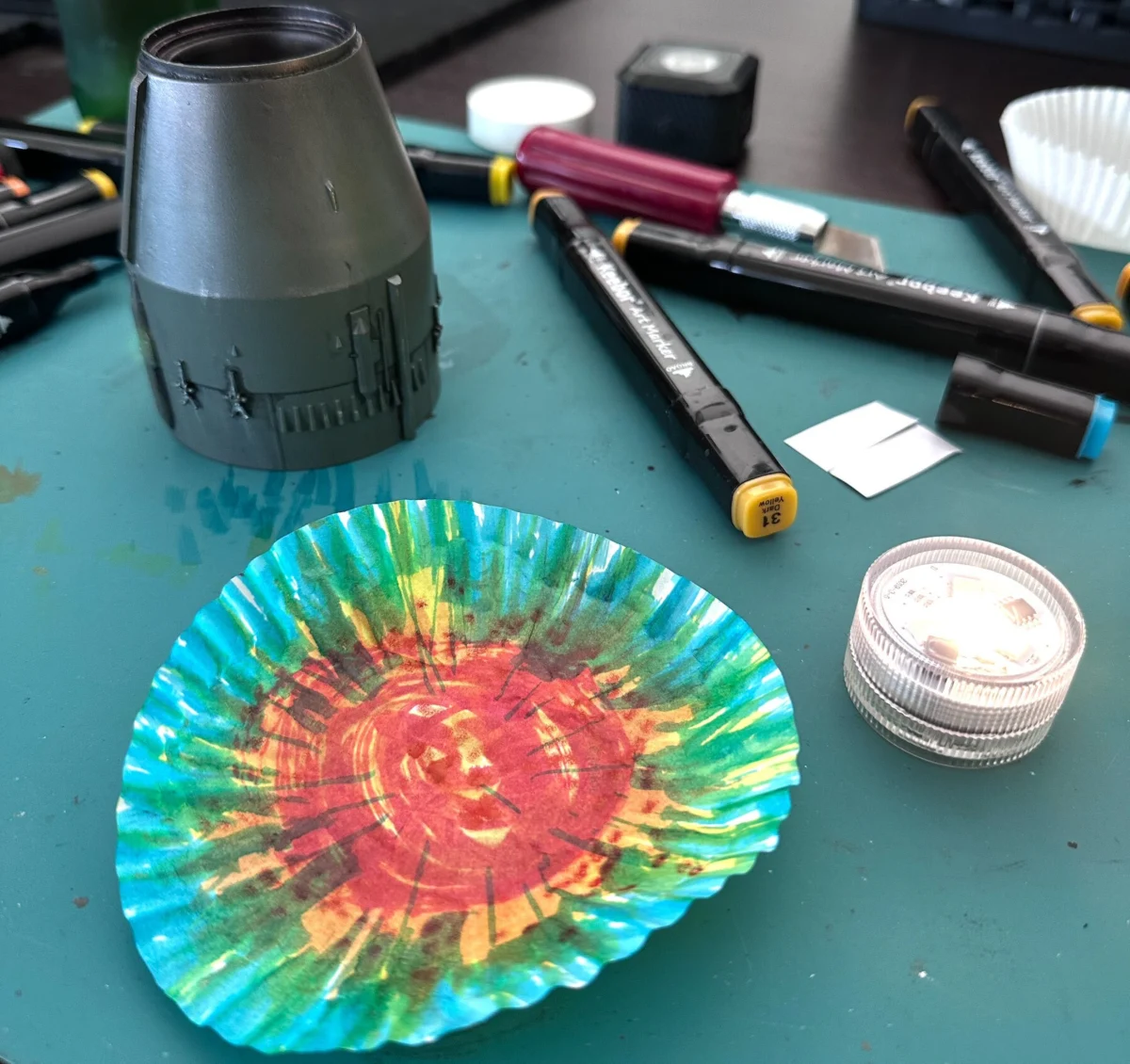
- Week 4: Weathering and Lighting. The final phase involved painting and lighting. Aron used graphite blocks to chip away at the surface, creating a realistic, battle-worn appearance. For the engine glow, he utilized cupcake liners dipped in resin to diffuse fiber-optic lights, proving that high-end production value can often be achieved with household ingenuity.
Technical Specifications: Blending the Analog and Digital
The project’s success relied on a unique hybrid workflow. While the model was physical, the final look was enhanced by digital artistry. Andre Kirk, who oversaw the painting process, opted for digital texturing rather than traditional paint.
"I suggested that we paint it digitally since it’s going to be a still shot," Kirk explains. "I added more surface detail for coloration—all of the yellow striping and other detailing. That made it more interesting than just a grey model. It combined the best of both worlds."
By keeping the physical model grey, the team saved immense amounts of time. The digital "paintover" added depth and complexity that would have taken weeks to achieve with physical pigments, yet the lighting remained entirely authentic. Aron utilized his home-based studio as a soundstage, employing natural light bounces from his west-facing windows to create an ambient, realistic falloff that software often struggles to replicate perfectly.
The shooting process was equally rigorous. Using long exposures—some lasting up to a minute—Aron "painted with light," manually adjusting the lighting passes to capture the ship’s engine flares and landing gear illumination. These dozen individual passes were then composited in Photoshop, resulting in a final asset that felt tangible, heavy, and undeniably real.
Official Perspectives: The Value of Group Effort
Lucasfilm leadership has emphasized that this project was far from a solo endeavor. Joel Aron is quick to credit his team for the collaborative nature of the build. "I wanted everyone to have input," Aron says. "I brought the designers in and they gave feedback. It was like a controlled crash landing down to the day when I needed to have it done."
The implications of this successful experiment are profound. By demonstrating that a small, dedicated team can produce a high-fidelity miniature in a timeframe that rivals or beats traditional CG production, Aron has provided a blueprint for future Lucasfilm productions.
"There’s a lot of pressure to just produce the show," Aron notes, "and as a result, there are gaps where we need to think creatively to solve problems. This miniature was a solution to a problem, but it was also a reminder of why we do this."
Implications for the Future of Animation
The inclusion of a practical miniature in Maul – Shadow Lord acts as a significant statement on the evolution of the Star Wars aesthetic. It suggests that, despite the technological leaps in real-time rendering and virtual production, there remains an irreplaceable quality in light interacting with physical surfaces.
- Efficiency and Cost-Effectiveness: The project proved that for specific, short-duration shots, physical models can be faster and more cost-effective than building high-fidelity digital assets from scratch.
- Visual Consistency: The "greebling" techniques used—drawing from the original, scanned assets of the 1970s and 80s—ensure a visual continuity that keeps the Star Wars universe feeling cohesive across generations.
- Artist Morale: By allowing the creative team to step away from the keyboard and engage with physical materials, Lucasfilm has tapped into a well of enthusiasm that is often lost in purely digital pipelines.
As Maul – Shadow Lord continues to stream on Disney+, the brief appearance of the cargo ship stands as a testament to the fact that the "old ways" of filmmaking are not obsolete. Instead, when combined with the precision of modern digital compositing, they offer a powerful toolset for creators looking to ground their fantastic worlds in a sense of physical reality.
For fans and industry professionals alike, this project serves as a beacon of artistic preservation. Joel Aron’s "obsession for making things look as real as possible" has resulted in a moment of screen magic that feels both fresh and timeless. In the age of digital dominance, the most "animated" thing one can do is sometimes to build something real.










No comments yet. Be the first to join the conversation!