Lina Irawan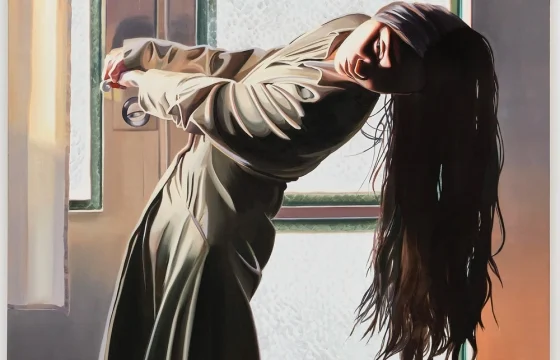
Introduction: A Vernal Awakening at Mrs.
On the occasion of the vernal equinox—that celestial inflection point where the scales of day and night achieve a momentary, fragile parity—the Maspeth-based gallery Mrs. has unveiled The Light That Loses, The Night That Wins. This exhibition marks the highly anticipated New York solo debut for Los Angeles-based painter Molly Bounds.
Following a successful introduction at The Armory Show in September 2025, The Light That Loses, The Night That Wins serves as a profound deepening of Bounds’ established visual language. Occupying the gallery’s 6040 56th Drive space through May 2, 2026, the collection functions as a psychological map of human stillness, transition, and the inevitable encroachment of shadow.
Main Facts: The Protagonist of Light
At the core of the exhibition is a deliberate re-centering of light. For Bounds, light is not merely a technical tool for illumination; it is the narrative protagonist. It acts as a shape-shifter—a force that simultaneously reveals the contours of the human form while concealing the underlying psychological currents of her subjects.
Bounds’ new series of paintings navigates the tension between the "slumped" body—a body in repose—and the "urgent" mind. Her work captures figures suspended in liminal states, those fleeting seconds between waking and dreaming, or between the comfort of an interior and the encroaching exterior darkness. By choosing to open the exhibition on the equinox, the artist underscores the thematic importance of thresholds: the space where winter’s dormancy yields to the chaotic, generative energy of spring.
Chronology: From Armory to Maspeth
The trajectory of Bounds’ career has been defined by a measured, deliberate evolution.
- September 2025: Molly Bounds makes her inaugural presentation with Mrs. at The Armory Show. The reception of her work, noted for its emotive color palettes and technical command of light, sets the stage for a solo exhibition.
- March 20, 2026: The vernal equinox serves as the official opening date for The Light That Loses, The Night That Wins. The timing is intentional, mirroring the thematic preoccupation with seasonal and emotional transitions found within the canvases.
- March 2026 – May 2, 2026: The exhibition occupies the gallery’s Maspeth location, offering viewers an extended opportunity to engage with the artist’s latest body of work.
Supporting Data and Thematic Analysis: A Psychological Study
The Interior as a Crucible of Tension
Bounds’ mastery of the interior scene is perhaps best exemplified by The Armchair. Here, the artist orchestrates a dialogue between two worlds: the warm, domestic glow of a fireplace and the cold, encroaching blue of an early evening sky visible through a window.
The painting invites the viewer to look past the surface of "rest." While the figure appears to be in repose, the viewer is quickly alerted to an underlying unease. The upholstery seams seem to unravel, mirroring a mind that is actively planning, scheming, or perhaps unraveling. The subject’s vacant stare suggests a transcendence of the physical space—an "eternal" quality that blurs the line between blissful detachment and existential exhaustion.
The Vanitas and the Diffusion of Privacy
In Privacy Glass, Bounds shifts her focus toward the interplay of light and opacity. The composition utilizes a diffused beam of light that filters through glass, illuminating the subject from behind while simultaneously obscuring her features.
Art historians may recognize the echo of Georges De La Tour in the way Bounds handles shadow and light. Like the traditional vanitas paintings of the 17th century, the work serves as a memento mori, reminding the viewer of the fleeting nature of time. The light does not just highlight the figure; it highlights the inevitable transition toward darkness, suggesting that privacy is a fragile, temporary state.
Landscapes of Optimism and Fantasy
Contrasting the pensive, claustrophobic interiors are works such as It Sings in Me and Among of Green, Again. In these pieces, the figures are transported to rolling, sun-drenched landscapes. The environment is aggressively, almost unnervingly, bucolic.
For Bounds, the "realism" of these landscapes is secondary to their function as vessels for psychological renewal. These paintings serve as a necessary counterweight to the darker interior scenes. They represent the "urgency of spring"—a belief in the possibility of rebirth after a period of prolonged cold. The landscapes are exercises in optimism, functioning as a mental escape hatch for both the subjects and the viewer.
Official Responses and Curatorial Intent
While the gallery has maintained a focused, contemplative approach to the show’s promotion, the curatorial intent is clear: to invite the viewer to sit with the discomfort of transition.
"Molly Bounds is interested in the moments we usually ignore," notes a gallery representative. "The moments where we are just sitting, just thinking, or just existing in the dark. She finds the narrative tension in that stillness."
The exhibition highlights the artist’s belief that renewal is not a passive event. It is a process—one that requires the recognition of the "night that wins" in order to fully appreciate the "light that loses." The show avoids didactic conclusions, instead offering a series of vignettes that ask the viewer to project their own experiences of time and transformation onto the subjects.
Implications: The Evolution of Contemporary Figuration
The emergence of Molly Bounds as a significant voice in contemporary figurative painting speaks to a broader shift in the art world. Following years of hyper-political or overtly conceptual work, there is a renewed appetite for "psychological realism"—art that prioritizes the internal life of the subject over the external spectacle.
Why This Matters
- The Reclamation of Light: By treating light as a narrative device rather than a stylistic choice, Bounds aligns herself with a lineage of masters who understood that how we see is as important as what we see.
- The Liminal Space: The focus on "liminality" resonates with a post-pandemic audience that has become acutely aware of the fragility of time and the blurred lines between domestic spaces and the outside world.
- The Persistence of Figuration: Bounds demonstrates that the human figure remains the most potent vessel for exploring complex, abstract emotions. By rendering the body in states of both exhaustion and freedom, she taps into a universal human experience.
A Look Ahead
As the exhibition runs through May 2, 2026, the impact of The Light That Loses, The Night That Wins will likely be measured by its ability to provoke conversation regarding our own "threshold moments." In an era of rapid, often overwhelming, technological and social acceleration, Bounds’ work offers a sanctuary for slow looking.
The exhibition is not merely a collection of paintings; it is a meditation on the cyclical nature of human existence. It posits that we are always in the process of becoming, always caught between the winter of our pasts and the spring of our potential futures. By the time the exhibition closes in early May, the seasonal transition will be complete, but the questions raised by Bounds—about the persistence of the mind, the inevitability of change, and the role of light in our darkest moments—will likely continue to resonate long after the canvases are packed away.
Final Thoughts
Molly Bounds’ New York debut is a testament to the power of quiet observation. By grounding her work in the specificities of light and the generalities of the human condition, she creates a space that feels both deeply personal and universally accessible. Whether in the slumped, contemplative posture of a figure in an armchair or the jubilant movement of a body in an imagined landscape, Bounds challenges us to look closer at our own thresholds.
As The Light That Loses, The Night That Wins continues its run at Mrs., visitors are encouraged to embrace the stillness. In the rare, fragile balance of the equinox, Bounds reminds us that even when the night wins, the light remains an essential, defining, and ever-present force.


 Pevita Pearce
 Neng Nana