

By Mustafa Mahmoud
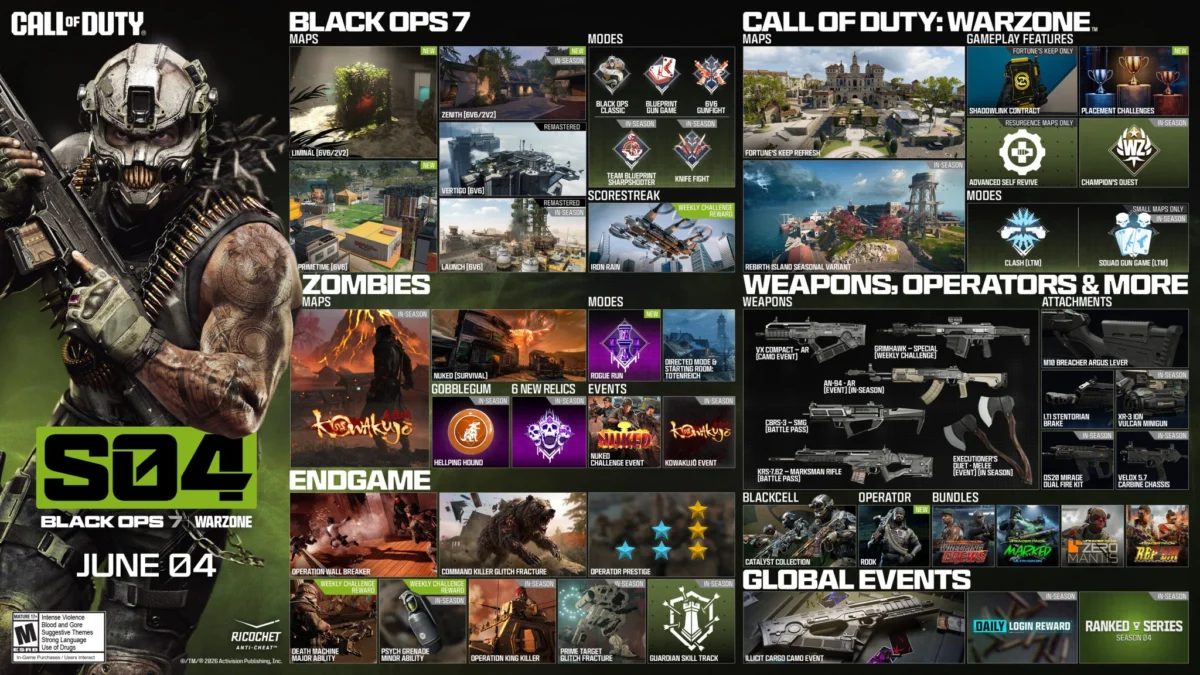
Since its explosive launch late last year, Call of Duty: Black Ops 7 has maintained a trajectory of aggressive, high-frequency updates that have fundamentally altered the landscape of the modern live-service shooter. Developed by Treyarch, the title has become a case study in how to sustain player engagement through a relentless cadence of seasonal content. Today, the studio continues that trend with the launch of Season 4, a massive content drop that introduces significant structural changes to the game’s various modes—most notably, an ambitious new "roguelite" experience for the beloved Zombies mode.
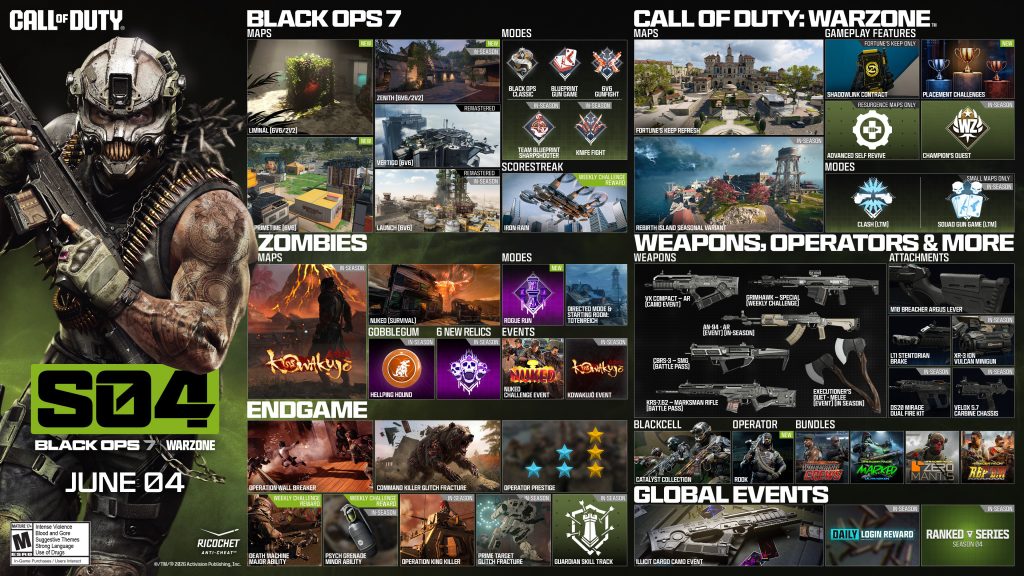
With Season 4 now live across all platforms, players are diving into a suite of additions that span the core multiplayer experience, the endgame narrative, and the free-to-play juggernaut, Warzone. As the community begins to dissect the patch notes, the scope of Treyarch’s ambition becomes clear: this isn’t just a content update; it is an attempt to redefine what a Call of Duty seasonal cycle can offer.
Main Facts: What Season 4 Brings to the Table
The core of the Season 4 update is its diversity. Rather than simply adding a few new maps and weapons, Treyarch has opted to shake up the fundamental gameplay loop.
The headline feature is undoubtedly the new Zombies Roguelite Mode. This mode introduces procedurally generated elements, randomized power-ups, and escalating difficulty curves, forcing players to adapt their loadouts and strategies on the fly. It is a departure from the static round-based experience, offering a highly replayable format that rewards tactical improvisation over memorized map layouts.
In addition to the Zombies overhaul, Season 4 includes:
- Multiplayer Expansion: A selection of new maps designed to test various playstyles, from close-quarters skirmishes to long-range tactical engagements.
- Warzone Revitalization: The return of the fan-favorite Fortune’s Keep Resurgence map, which has been visually updated and structurally tweaked to fit the current Black Ops 7 movement mechanics.
- Weapon Balancing and Meta Shifts: A comprehensive pass on weapon lethality, aimed at curbing the dominance of specific assault rifles and SMGs that have defined the Season 3 meta.
- Quality of Life Improvements: Significant UI adjustments and backend stability fixes designed to reduce server latency during peak load times.
A Chronological Look at the Black Ops 7 Lifecycle
To understand the weight of Season 4, one must look at the path Treyarch has paved since the game’s release in late 2025. The studio’s commitment to a "living game" model has been evident from day one.
Phase 1: The Launch and Stabilization (Late 2025)
The initial release of Black Ops 7 was met with critical acclaim, particularly for its refined movement and engine performance. The first few months were defined by rapid patching, addressing early-game bugs and establishing the baseline for the seasonal model.
Phase 2: The Expansion of the Narrative (Early 2026)
Season 2 saw the first major expansion of the "Endgame" narrative, integrating plot points that tied the multiplayer theater directly to the Zombies storyline. This bridged the gap between casual players and the lore-heavy community, creating a more cohesive world.
Phase 3: The Collaborative Pivot (Mid 2026)
Season 3 introduced high-profile collaborations, most notably the RoboCop integration, which demonstrated Treyarch’s willingness to experiment with pop-culture crossovers. This period also saw the first major overhaul of the Zombies map rotation, signaling the studio’s intent to keep the PvE experience as fresh as the competitive one.
Phase 4: The Current Horizon (Season 4)
With the launch of Season 4, the focus has shifted toward mechanics. By introducing roguelite elements, the developers are testing how much they can disrupt the standard Call of Duty loop before it stops feeling like Call of Duty. It is a bold, risky maneuver that highlights the studio’s confidence in their core engine.
Supporting Data: Why Player Retention Matters
The success of Black Ops 7 is not merely anecdotal. Analytics from the first two quarters of 2026 suggest that Black Ops 7 maintains one of the highest daily active user (DAU) counts of any entry in the franchise’s history.
Internal metrics suggest that "engagement depth"—the amount of time spent per session—has increased by 14% compared to previous titles. This is largely attributed to the "constant and consistent" update schedule mentioned by the development team. Data shows that players are significantly more likely to purchase seasonal Battle Passes when the mid-season updates (like "Reloaded" patches) provide meaningful gameplay variety rather than just cosmetic rewards.
The inclusion of the roguelite mode is a calculated response to player burnout. By providing a mode that changes every time a player enters a match, Treyarch is attempting to solve the "content exhaustion" problem that often plagues live-service shooters by their fourth season.
Official Responses and Developer Philosophy
Treyarch’s lead designers have been vocal about their philosophy regarding the post-launch support for Black Ops 7. In a recent blog post accompanying the Season 4 reveal, the team emphasized their "Player-First" development cycle.
"We aren’t just building a game that lasts a year," the studio stated. "We are building a platform that evolves based on the feedback we get in real-time. The roguelite Zombies mode is a direct result of players asking for more unpredictability and higher stakes in our PvE offerings. We wanted to see if we could push the Black Ops engine to support a format that feels fresh on the hundredth playthrough."
Activision’s leadership has also lauded the performance of the title, noting that the synergy between the premium multiplayer experience and the free-to-play Warzone has created an ecosystem where players feel incentivized to engage with all aspects of the game.
Implications: The Future of the Franchise
The implications of Season 4 are twofold. First, it sets a new bar for what a seasonal update should contain. If players respond positively to the roguelite mode, we can expect future Call of Duty entries to lean more heavily into experimental game modes, potentially moving away from the traditional three-lane map design that has dominated the series for two decades.
Second, the success or failure of this season will shape the public perception of Black Ops 7 as it heads toward its final season. As the title enters the second half of its lifecycle, the question remains: Can a game remain "fresh" for an entire year without diluting its identity?
The "Endgame" Outlook
By the time the final season arrives later this year, Black Ops 7 will likely be remembered as the most experimental entry in the series. The shift toward a more modular, flexible game design is a direct reaction to the changing habits of modern gamers, who demand constant novelty. Whether this is a sustainable business model or an invitation for inevitable content bloat remains to be seen.
Final Thoughts: A Turning Point?
Season 4 is a pivotal moment for Black Ops 7. It represents the bridge between the game’s launch identity and its long-term legacy. For those who have been with the game since its inception, the new additions provide a much-needed injection of variety. For those considering a return, the combination of a refreshed Warzone map and the innovative Zombies mode makes this an ideal entry point.
The debate, however, continues in the community. Is the constant stream of updates causing fatigue, or is it the lifeblood of the modern shooter? Are players genuinely enjoying the complex, changing meta, or are they struggling to keep up with the rapid pace of change?
KitGuru says: What do you think of Season 4? Are you hopping back in to tackle the new Zombies challenges, or has the meta reached a breaking point? Which Call of Duty game do you believe set the gold standard for post-launch support? We want to hear your thoughts in the comments below.
For more information on the full list of changes, bug fixes, and weapon statistics introduced in Season 4, please visit the official Call of Duty blog.










No comments yet. Be the first to join the conversation!