
 Reynand Wu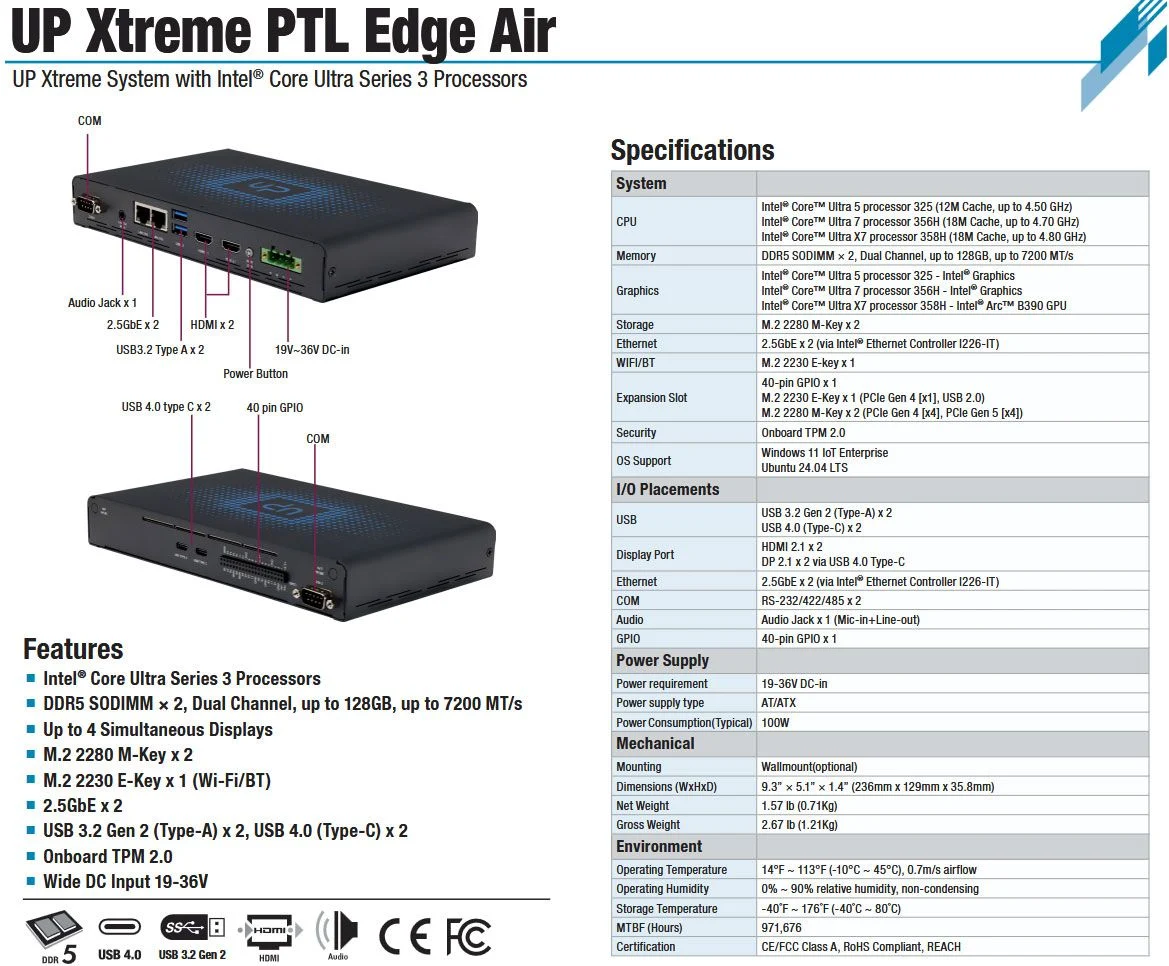
In the rapidly evolving landscape of industrial and embedded computing, the demand for high-performance processing in restricted physical spaces has reached a fever pitch. Aaeon, a long-standing specialist in industrial-grade hardware, has officially addressed this challenge with the launch of the Up Xtreme PTL Edge Air. By integrating Intel’s high-performance Core Ultra "Panther Lake" processors with Frore Systems’ groundbreaking AirJet ultrasonic cooling technology, Aaeon has effectively redefined the form factor for fanless industrial mini PCs.
Main Facts: The Intersection of Panther Lake and AirJet
The Up Xtreme PTL Edge Air is not merely a downsized desktop; it is a meticulously engineered industrial computing solution designed to operate in environments where noise, heat, and physical footprint are critical constraints. At the heart of the device lies the Intel Core Ultra X7 358H, a processor built on the Panther Lake architecture. This chip represents a significant leap in efficiency and performance, particularly in edge AI workloads and general computing tasks.
However, the standout feature of this new unit is its thermal management system. Unlike traditional mini PCs that rely on bulky copper heatsinks and mechanical spinning fans—which are prone to failure in dust-heavy industrial environments—the Edge Air employs Frore Systems’ AirJet Mini technology. This solid-state cooling solution uses ultrasonic membranes to generate high-velocity air jets, creating a localized high-pressure zone that pulls heat away from the silicon with far greater efficiency than a standard fan.
Key Technical Specifications:
- Processor: Intel Core Ultra X7 358H (Panther Lake architecture).
- Cooling System: Frore Systems AirJet solid-state cooling.
- Acoustics: Virtually silent, operating at less than 21 dBA.
- Form Factor: 35% thinner and 43% lighter than traditional active-cooled equivalents.
- Target Market: Industrial automation, edge AI, digital signage, and medical imaging.
Chronology: The Evolution of Industrial Mini-Computing
To understand the significance of the Up Xtreme PTL Edge Air, one must examine the trajectory of Aaeon’s design philosophy. For years, the industrial computing sector was bifurcated into two camps: passive-cooled systems (which were silent but limited in thermal headroom, and thus performance) and active-cooled systems (which were powerful but suffered from mechanical wear and tear).
The Pre-AirJet Era
Historically, Aaeon’s "Up" series was built on the premise of modularity. Early iterations relied on standard heatsinks. As processors grew more power-hungry, these units became increasingly bulky to accommodate the necessary cooling surface area. In the last three years, the industry hit a "thermal wall." Engineers were unable to cram more performance into smaller enclosures without drastically increasing fan noise or risking thermal throttling.
The Integration of Solid-State Cooling
The collaboration between Aaeon and Frore Systems did not happen overnight. Following the initial commercial release of the AirJet chip, Aaeon began testing the feasibility of replacing legacy fans in their edge computing units. The transition involved a complete redesign of the internal chassis airflow, moving from a "push" system to a directional jet-based heat expulsion system. The PTL Edge Air is the culmination of this two-year development cycle, marking the first time the Panther Lake architecture has been paired with this specific cooling methodology.
Supporting Data: Efficiency and Physical Metrics
The primary challenge in industrial computing is the "Performance-per-Liter" metric. By utilizing the AirJet technology, Aaeon has achieved a paradigm shift in how heat is managed in a compact enclosure.
Acoustic Performance
In industrial settings, noise pollution is an often-overlooked factor. A standard cooling fan operating at high speeds can reach 40–50 dBA, which, over an 8-hour shift, contributes to worker fatigue. The Up Xtreme PTL Edge Air operates at a nominal 21 dBA. To put this in perspective, 21 dBA is equivalent to the sound of rustling leaves or a quiet whisper. This makes the device ideal for medical offices, libraries, or quiet lab environments where a humming fan would be disruptive.
Physical Footprint Reduction
The reliance on solid-state cooling has allowed Aaeon to shed significant weight and volume. Because AirJet modules are thin (approximately 2.8mm), the internal volume required for air intake and exhaust is significantly smaller than that required for a centrifugal blower fan.
- Volume: The PTL Edge Air is 35% thinner than its predecessor.
- Weight: The elimination of the heavy copper fin-stack and mechanical fan assembly results in a 43% reduction in total unit weight, making it significantly easier to mount on the back of displays or in crowded server racks.
Official Responses and Strategic Vision
In a statement regarding the launch, Aaeon’s product development team highlighted that the goal was not just to make a "smaller PC," but a "more reliable PC."
"Industrial environments are notoriously harsh on mechanical components," said an Aaeon spokesperson. "Fans are the most common point of failure. By moving to a solid-state cooling system, we are effectively increasing the Mean Time Between Failures (MTBF) of the entire unit. We aren’t just offering a performance boost; we are offering longevity."
Frore Systems, the creators of AirJet, have also framed this partnership as a turning point for the industry. Their leadership noted that the Panther Lake architecture, with its advanced power-management features, provides the perfect canvas for AirJet. "The integration with the Core Ultra X7 358H proves that we no longer need to sacrifice performance for silence or portability," the company stated in a technical brief.
Implications: The Future of Edge Computing
The launch of the Up Xtreme PTL Edge Air carries significant implications for the future of the industrial computing market.
1. The Death of the Mechanical Fan?
If Aaeon’s implementation proves successful in the field, it could set a new industry standard. Reliability is the gold standard for industrial hardware; a cooling system with no moving parts is fundamentally superior to a fan-based system in environments involving dust, vibration, or extreme temperature cycling.
2. Pushing the Boundaries of Edge AI
The Panther Lake processor is optimized for local AI inference. By keeping the chip cool without the need for massive airflow, the device can sustain higher boost clocks for longer periods. This is vital for AI workloads—such as computer vision or real-time predictive maintenance—which require consistent processing power that doesn’t throttle due to heat accumulation.
3. Market Democratization
While initially marketed toward industrial clients, the PTL Edge Air is likely to find a home in high-end consumer and prosumer markets. Creators and professionals who demand a silent workstation that can handle modern computing loads without the "jet engine" noise of a traditional desktop will likely find this technology highly attractive.
4. Sustainability and Maintenance
The reduced physical footprint translates to lower shipping costs and fewer raw materials per unit, aligning with broader corporate ESG (Environmental, Social, and Governance) goals. Furthermore, the absence of fan maintenance—such as cleaning dust filters or replacing seized bearings—will significantly lower the total cost of ownership (TCO) for companies deploying these units at scale.
Conclusion
The Up Xtreme PTL Edge Air represents more than just a new product SKU; it is a manifesto for the future of computing hardware. By marrying Intel’s cutting-edge Panther Lake silicon with the innovative solid-state cooling of Frore Systems, Aaeon has successfully navigated the trade-off between power and physical limitations.
As we move toward a future defined by ubiquitous edge computing and localized AI, the need for reliable, quiet, and compact hardware will only increase. The Up Xtreme PTL Edge Air demonstrates that the industry is finally moving past the limitations of 20th-century cooling methods, signaling a cleaner, quieter, and more robust era for industrial and professional computing. Whether it is powering a diagnostic machine in a hospital or an autonomous sensor in a manufacturing plant, this device stands as a testament to the fact that when it comes to engineering, sometimes the best way forward is to keep things quiet.


 Pevita Pearce
 Dwi Wanna




