In the high-stakes world of professional cosplay, few names command as much respect as Kamui Cosplay. Known for their intricate armor builds and meticulous attention to detail, the duo—comprising Svetlana and Benni—recently undertook one of their most challenging projects to date: bringing Yelan, the mysterious intelligence operative from Genshin Impact, to life for Gamescom 2023.
Following a successful collaboration on a Beidou cosplay, Hoyoverse once again tapped Kamui to showcase the depth of Genshin Impact’s character design. What followed was a grueling five-week production cycle that pushed the boundaries of sewing, 3D printing, and structural engineering. This article explores the technical marathon required to transform a digital model into a convention-ready masterpiece.

The Foundation: Leveraging Official Digital Assets
The project began not with fabric, but with data. Unlike many cosplayers who rely solely on 2D concept art, Kamui Cosplay utilized official 3D character models provided by Hoyoverse via the Aplaybox platform.
For the modern cosplayer, access to these assets is a game-changer. By importing these files into software like Blender, creators can rotate, scale, and analyze complex costume components that are often obscured in promotional trailers or screenshots. This access provided the team with an exact blueprint for Yelan’s outfit, allowing them to map out the complex geometry of her dress, jacket, and accessories with mathematical precision.

Chronology: A Five-Week Sprint
The production schedule was dictated by the looming deadline of Gamescom 2023. The project was broken down into distinct, hyper-focused phases, each requiring a different set of technical skills.
Phase 1: The Engineering of the Dress
The primary challenge was Yelan’s dress, an elegant but structurally difficult garment. To achieve the perfect silhouette, the team utilized a "duct tape dummy"—a classic, albeit labor-intensive, method where the wearer is wrapped in tape to create a precise 1:1 mold of their torso. This mold served as the pattern for the heavy royal blue satin. Because satin is notoriously difficult to work with—prone to fraying and lacking elasticity—the team had to solve for an open-back design that maintained structural integrity while allowing for movement. By integrating a custom-strapped internal foundation, they ensured the garment remained secure throughout the day.

Phase 2: The Jacket and Asymmetrical Elements
Next came the white jacket, which in-game appears to defy gravity. To bridge the gap between digital fantasy and physical reality, Kamui opted for a white brocade fabric, enhanced with 3D-printed resin components and laser-cut faux leather to add a tactile, believable texture. The jacket’s weight was a significant hurdle; adding fur collars, pleather, and resin pieces made the garment increasingly heavy. To maintain the illusion of the jacket “floating” on the back, they utilized a series of hidden press-on buttons and structural reinforcements, allowing for easy wear without compromising the aesthetic.
Phase 3: Leggings and Gloves
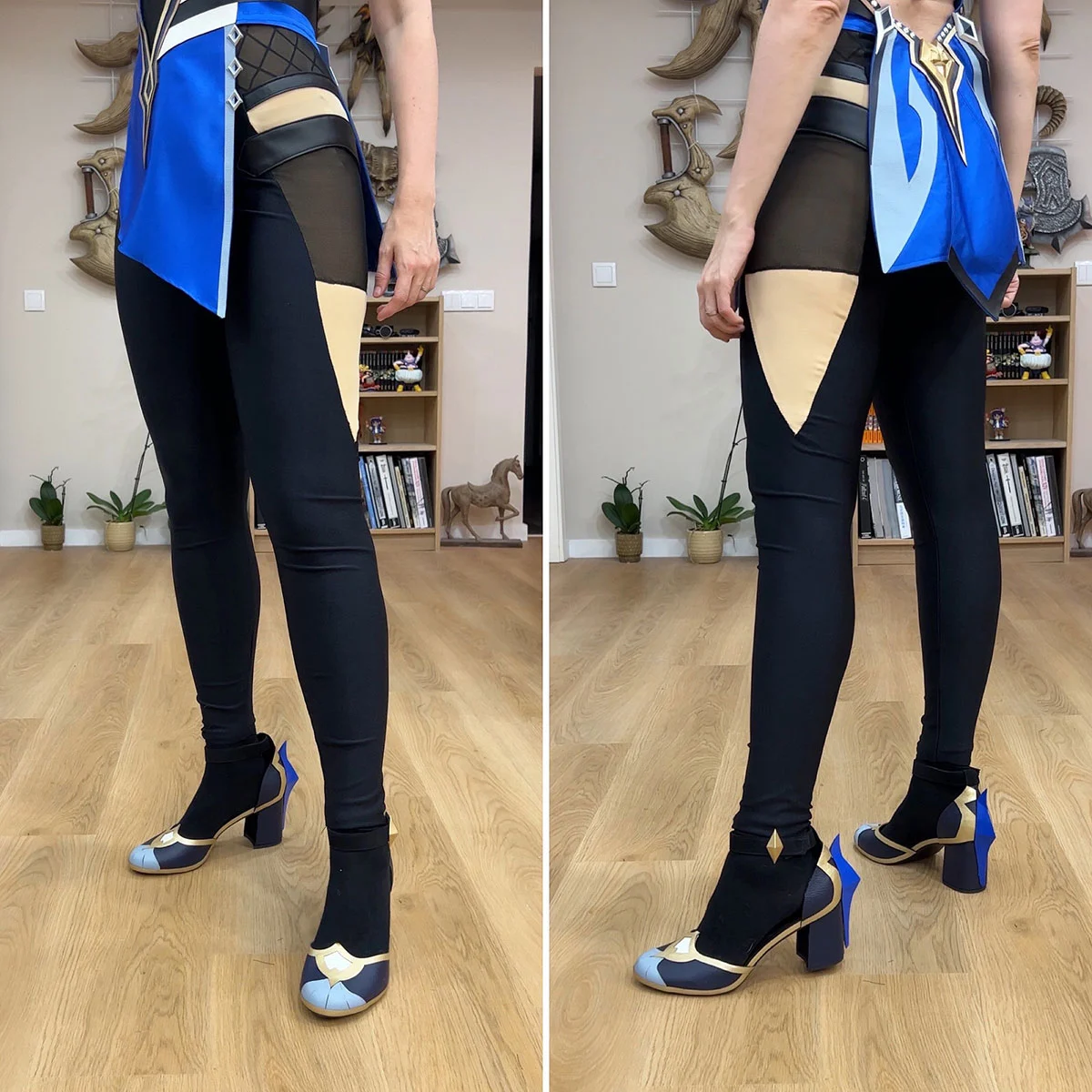
The lower half of the costume proved to be a masterclass in asymmetrical pattern-making. Because Yelan’s leggings feature unique cut-outs and distinct ornamentation on each leg, the team could not mirror their patterns. This necessitated two entirely separate builds. Incorporating mesh, faux leather, and metallic accents, the leggings alone required five different types of fabric, each with its own sewing requirements.

Phase 4: The Weaponry — Aqua Simulacra
While Svetlana handled the textile work, Benni and Jakob focused on the “Aqua Simulacra” bow. The weapon was sculpted from scratch in Blender, requiring over a week of design time. The physical production involved printing, sanding, and assembling the components around a PVC core for durability. To ensure portability for a massive event like Gamescom, the bow was designed to be detachable. The final finish was achieved through airbrushing, utilizing a complex gradient of blues, whites, and golds to replicate the weapon’s signature crystalline glow.
Supporting Data: The Anatomy of a Build
The complexity of this project cannot be overstated. A summary of the materials and tools involved highlights the professional-grade effort required for such a build:

- Total Fabric Count: Over 20 distinct materials, including heavy satin, brocade, mesh, faux fur, and various weights of faux leather.
- Hardware Suite: Brother CS7000X sewing machine for assembly, Flux Beambox Pro for laser cutting, and an Anycubic Photon Mono M5s 12K for high-resolution resin printing.
- Adhesion and Finishing: Use of Güttermann HT2 Fabric Glue for precision attachment and Vallejo metallic paints for the weapon’s finish.
- External Support: Professional wig styling was commissioned from Krystl Cosplay, ensuring the hair design matched the game’s high-fidelity standards.
Official Collaboration and Community Impact
The partnership between Hoyoverse and Kamui Cosplay highlights a growing trend in the gaming industry: the formal recognition and support of the cosplay community. By providing 3D models and facilitating high-profile appearances at events like Gamescom, developers are moving beyond simple licensing to active community engagement.
For Hoyoverse, the ROI is clear: high-quality, authentic portrayals of their characters act as organic marketing, driving engagement for titles like Genshin Impact, Honkai: Star Rail, and Zenless Zone Zero. For the cosplay community, it provides a sense of legitimacy and access to the exact references needed to push the boundaries of their craft.

Implications for the Future of Cosplay
The Yelan project serves as a case study in the evolution of the hobby. As games become more graphically advanced, the designs of their characters—featuring physics-defying fabrics and magical glowing weapons—become increasingly difficult to translate into reality.
Kamui’s success here rests on three pillars: specialization, collaboration, and iterative problem-solving. By breaking a massive project into individual components (the dress, the jacket, the bow), the team avoided the paralysis of looking at the “whole” and instead focused on mastering each piece one at a time.

Furthermore, the willingness to leverage modern technology—such as resin 3D printing and vector-based laser cutting—has become essential for any professional-grade build. The ability to “print” a piece of armor or a weapon component has replaced the messy, hit-or-miss nature of traditional EVA foam sculpting for high-detail characters.
Conclusion
The transformation of Yelan from a collection of digital polygons into a walking, talking attendee at Gamescom 2023 was a testament to the dedication of the entire team. It was not just a costume; it was an engineering project, a textile study, and a piece of interactive art. As the line between digital assets and physical craftsmanship continues to blur, projects like this set the standard for what is possible when developers and creators align to bring the worlds of Teyvat into our own.

For those looking to replicate such high-level builds, the takeaway is clear: utilize the assets provided by the developers, do not be afraid to outsource specific skills (like wig styling), and treat every component of a costume as a separate engineering challenge. As Kamui Cosplay demonstrates, the "crazy" projects are often the most rewarding.