Dwi Wanna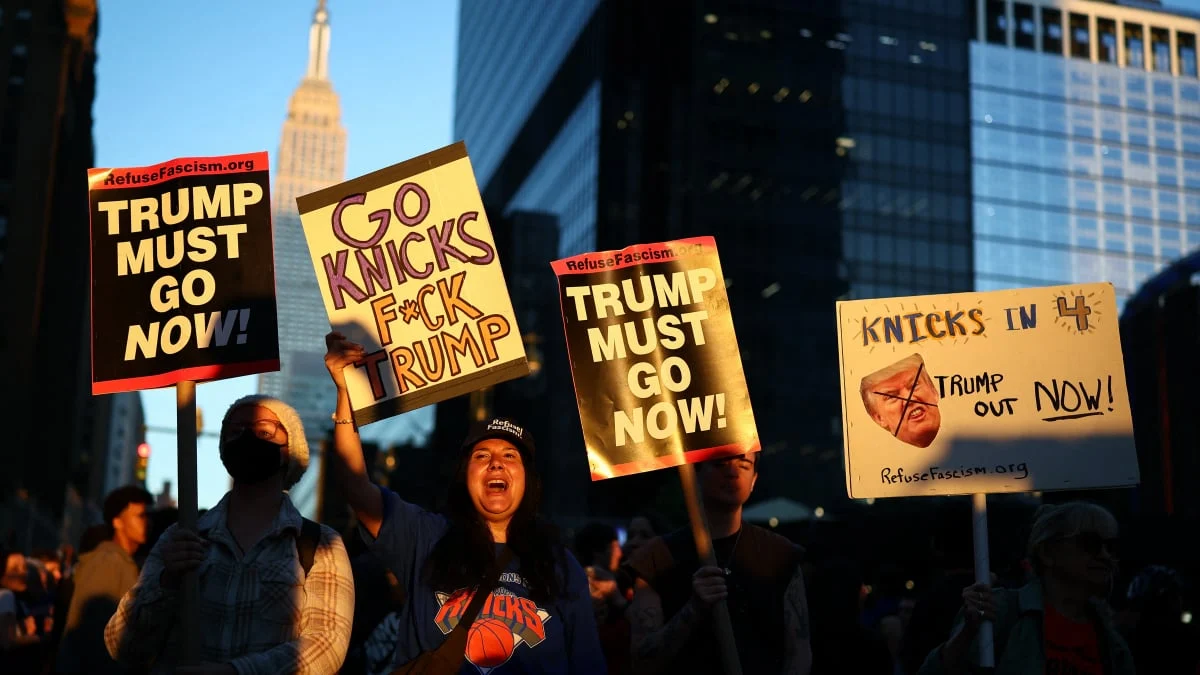
By Chase DiBenedetto | June 9, 2026
The electric atmosphere surrounding Madison Square Garden—the epicenter of a city currently gripped by a 27-year championship drought—was fundamentally altered on Tuesday night. As the New York Knicks squared off against the San Antonio Spurs in a pivotal Game 3 of the NBA Finals, the arena’s focus shifted from the hardwood to a private suite, where President Donald Trump made an unprecedented appearance. The result was a night defined by political friction, logistical disruption, and a pervasive sense of superstition that has since taken the internet by storm.
The Context: A City Under a Spell
For the past two weeks, New York City has been draped in a fever of orange and blue. With the Knicks making their first Finals appearance in nearly three decades, the city has transformed. From makeshift memorials of custom airbrushed merchandise sold on corner streets to spontaneous celebrations atop taxis and synchronized revelry in subway cars, the energy has been palpable.
However, the announcement that President Trump would attend Game 3 acted as an immediate "ice bath" for that collective euphoria. For many New Yorkers, the President’s presence was not merely a political statement but an omen. In the hyper-superstitious world of professional sports, where the "Knicks Curse" is a long-standing urban legend, the arrival of a polarizing political figure was viewed by many fans as the ultimate harbinger of bad luck.
A Chronology of the Disruption
The evening’s tensions began hours before tip-off. To accommodate the President’s security detail, the U.S. Secret Service implemented a massive perimeter around Madison Square Garden. These measures included the forced cancellation of a highly anticipated public watch party outside the arena—a move that left thousands of fans stranded and frustrated.
In a display of local leadership, Mayor Zohran Mamdani, who attended the game personally, quickly pivoted to organize an alternative viewing event at Bryant Park. This logistical friction served to amplify the preexisting sentiment against the President’s visit. On social media, the discourse turned tactical. TikTok users shared viral tutorials on "how to properly boo," with many framing their dissent as a necessary ritual to "ward off the curse" that they believed the President would bring to the court.
As the national anthem concluded, the moment of truth arrived. When the arena cameras panned to the President’s box, the reaction was instantaneous. A thunderous, unified chorus of boos erupted throughout Madison Square Garden. The sound was so intense that it was reportedly echoed by the crowd gathered at the Bryant Park watch party, creating a sonic chain reaction that spanned the borough of Manhattan.
The game itself proved to be a grueling, high-stakes affair. Despite the crowd’s fervor and their attempt to "boo away" the negative energy, the Knicks ultimately fell to the Spurs in a nail-biting, defensive contest that ended in heartbreak for the hometown faithful.
The Data of Discontent
The intensity of the public’s reaction to the President’s attendance can be measured through both digital engagement and physical presence. The decision to attend the game, despite his historically low approval ratings within urban centers like New York, prompted immediate academic and political inquiry.
Experts in political communication suggest that the booing was a manifestation of a "stadium-wide referendum." By appearing in such a highly charged environment, the President invited a direct, unmediated assessment from a demographic—urban, diverse, and passionate—that has consistently voiced opposition to his administration. The viral nature of the #KnicksCurse hashtag on X (formerly Twitter) and TikTok served as a modern barometer for this resentment, with millions of impressions recorded within the first three hours of the game.
Furthermore, the economic impact of the security protocols cannot be overlooked. Local businesses surrounding MSG reported a decline in foot traffic due to the Secret Service barricades, leading to a secondary layer of grievance that transcended partisan politics and touched upon the city’s economic vitality.
Official Responses and Political Rhetoric
In the immediate aftermath of the loss, the narrative shifted toward the President’s own interpretation of the night. Speaking to the press corps outside of Air Force One, President Trump offered a counter-intuitive assessment of the evening’s events.

"I mean, I thought it was amazing, actually," the President stated. "You mean when they had the camera on me? I thought it was very good. Yeah. It was certainly amazing. It was, I think, mostly cheers. It was loud and it was very enthusiastic."
When questioned about the pervasive boos that were clearly audible on every broadcast, the President doubled down, suggesting that the perception of hostility was a misinterpretation of his reception. Moreover, he took the opportunity to revisit his long-standing grievances with the NBA.
"It tends to be a little left wing, but it’s great entertainment," he remarked. His commentary reflects a consistent strategy of framing cultural and sporting institutions as part of a "liberal" establishment, a narrative that has fueled his base while simultaneously alienating the very sports fans he attempted to engage with on Tuesday night.
Implications: Sports as a Political Arena
The events of June 9, 2026, serve as a microcosm of the current American landscape. The intersection of sports and politics has become increasingly unavoidable. When a sitting president enters a space defined by civic passion and collective identity, the result is rarely neutral.
1. The Erosion of Neutral Ground
Traditionally, sports venues were viewed as secular temples—spaces where political identities were left at the door in favor of team loyalty. The "Trump at the Knicks" incident highlights the erosion of this neutrality. As politics continue to permeate every aspect of American life, the ability to enjoy a game without the intrusion of state-level controversy is becoming a relic of the past.
2. The Power of "Curse" Culture
The internet’s obsession with the "Knicks Curse" is a fascinating sociological study in how fans process collective trauma. By pinning the team’s failure on a political figure, fans were able to externalize their frustration. It transformed a sporting loss into a political battle, allowing for a form of catharsis that, while ultimately ineffective in altering the game’s outcome, provided a mechanism for social cohesion among the opposition.
3. Future Security and Public Access
The logistical failure of the watch party has sparked a debate regarding the rights of the public in the presence of high-ranking officials. Critics are now calling for a re-evaluation of how Secret Service protocols interact with public spaces, arguing that the security of a single individual should not mandate the cancellation of public gatherings that are essential to the city’s cultural life.
4. The Rhetorical Disconnect
The President’s claim that he heard "mostly cheers" presents a significant challenge for political analysts. It demonstrates a profound disconnect between the executive branch and the reality of public sentiment in blue-leaning cities. Whether this is a calculated political maneuver to maintain his base’s loyalty or a genuine detachment from the public mood, it signals that the divide between the administration and its critics is only deepening.
Conclusion: A City Unconvinced
As New York prepares for the remainder of the Finals, the memory of Game 3 remains a point of contention. The Knicks now face an uphill battle, trailing in the series and dealing with the psychological weight of a demoralizing loss.
Whether the President’s attendance truly cursed the team remains a matter of folklore, but the lasting impact on the city’s political climate is a matter of record. Madison Square Garden, an arena built for basketball, found itself temporarily repurposed as a stage for the national struggle between a leader seeking validation and a public that—if the volume of the booing was any indicator—is far from providing it.
As the Knicks head to their next matchup, the city remains united in its desire for a win, and perhaps, a slightly quieter, less political environment in which to pursue it. The events of Tuesday night proved one thing above all: in 2026, there is no such thing as "just a game."

 Nana Wu
 Nana
Nana